What the ranking is built on
1. Which standard the piece is actually certified to
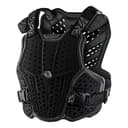
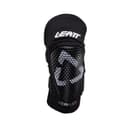
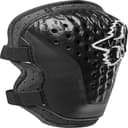
Applied in order, this one criterion produced most of the ranking. The Rockfight leads because it carries both: EN 14021 on the front plate for roost, and a D3O back insert Troy Lee publishes as exceeding EN 1621 Level 1 for impact. The two Leatt guards and the Fox Titan Sport elbow publish EN 1621-1 with a level attached — Level 2 for the Leatt 3DF 6.0 Evo, Level 1 for the Leatt ReaFlex Pro knee and the Fox elbow.
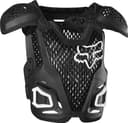
The Fox R3 Roost Deflector is here precisely because it is the clean example of the category’s confusion: it is EN 14021 certified and explicitly not EN 1621 impact-rated, and its card says so in capitals. It is excellent at the job it is certified for. It is not a chest protector in the impact sense, and nothing on this page will imply it is.
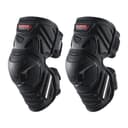
The Scoyco knee and shin guards sit last on this criterion for a specific reason: the listing says “CE Level 1” without naming the EN standard behind it. Five of the thirty-six pieces in our registry do that and all five are marketplace listings. A certification names the standard as well as the level, because the level is meaningless without the test it was measured against. We still rank the Scoyco, because strapped-on TPU over the knee beats bare jeans by a distance, and we record the gap rather than smoothing it over.
2. Soft guard or hard shell, which off-road inverts
On the street, a hard thermoplastic shell has an advantage the EN test does not score: hard plastic slides on tarmac where foam and fabric grip it. Off-road that logic weakens — dirt and gravel do not reward sliding the way asphalt does — and the priority shifts to coverage area, retention and whether the guard fits under a shell jacket.
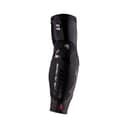
Which is why the Leatt 3DF 6.0 Evo is ranked second rather than a hard-shell exoskeleton: Leatt publishes EN 1621-1 Level 2 for a low-profile soft 3DF foam guard with an abrasion-resistant DeFLEXtion outer, pre-curved, and sized S through XXL — the widest size run in our registry for any Level 2 limb guard. Level 2 that disappears under an adventure jacket is Level 2 you will actually wear. The Fox Titan Sport, by contrast, is a frank MX-style external guard with hard plastic across the elbow and the forearm: more coverage, at the cost of fitting badly under a road jacket sleeve. Both trade-offs are on their cards.
3. Retention, which is where cheap off-road armor fails
A guard that rotates on the limb protects whatever it has rotated onto. The ReaFlex Pro knee is a single-size compression sleeve with a silicone-printed cupped knee grip, which is the format that stays put best over a long day. The Leatt elbow uses a single anti-slip forearm band — less retention than a buckled hinge system, and we say so. The Fox Titan Sport uses elastic and hook-and-loop straps that need re-checking on a long ride. The Scoyco guards are strap-on and rotate more than a sleeve. That ordering is the ranking within the knee and elbow positions.
4. Weight and heat, both of which off-road punishes
Dirt riding is hot, slow work and armor you overheat in is armor you take off at the trailhead. The ReaFlex Pro publishes from 300 g per pair, which is the only published weight figure for any guard on this page — and worth noting, because not one of the thirty-six armor pieces in our registry publishes a weight other than this one. Leatt lists the 3DF 6.0 Evo’s weight as TBC, so there is no figure and we have not invented one. The Fox R3 is vented hard shell designed for off-road heat; the Rockfight is low-profile enough to wear under a jacket, which the big MX harnesses are not.
Buy in this order for dirt and adventure riding
First, the back. Same as on the road, and for the same reason: it is the position with its own dedicated standard (EN 1621-2) and the one most jackets leave to an uncertified foam pad. If you want one purchase that covers the back and the roost, the Rockfight at the top of this page is it. If your jacket already takes an insert, our back-insert page and armor under $200 both get you a certified Level 2 plate for a fraction of a harness.
Second, knees. Off-road the knee takes the handlebar, the peg and the ground, and in that order of frequency. A certified Level 1 sleeve you wear every ride beats a Level 2 exoskeleton in the garage. Our knee-guard ranking covers the whole position including the hard-shell Level 2 options.
Third, elbows. Lower priority than knees off-road, but the cheapest certified upgrade on this page lives here: EN 1621-1 Level 1 for less than a tank of fuel in a big bike. The elbow-guard page ranks the position on its own terms.
Roost, only if you ride behind other people. This is the one piece of off-road armor that is genuinely situational. If you ride alone on trails, roost protection is solving a problem you do not have, and the money is better spent on an impact-rated back protector. If you ride in a group or race, a deflector stops a real and painful nuisance that no impact armor addresses.
What this page is not
It is not a street armor page. Three things change on tarmac: hard sliding shells become more valuable, roost protection becomes irrelevant, and an EN 1621-3 chest impact rating becomes something worth looking for — which, again, no product on this page carries. Our chest-protector ranking includes the two registry pieces that do publish 1621-3, and the best motorcycle armor ranking covers every position in street buying order.
It is also not a neck brace page, and that absence is deliberate rather than an oversight: we track none, so there is nothing honest to rank. We do not add products to fill a slot.
For the rest of the off-road kit, our dual-sport helmet ranking covers the peak-and-goggle shape, riding pants covers the garments that armor fits inside, and armored base layers covers the shirt route for riders who would rather carry armor than wear a jacket. If you are building a kit from nothing, the beginner gear guide puts the whole order of purchase in one place.