The five criteria this ranking is built on
In the order they actually decide the purchase. They are deliberately not the criteria behind the touring ranking, where sealing and quiet dominate, or the main ranking, where certification leads and nothing else gets to overrule it.
| Criterion | Why it decides a hot ride | What to look for |
|---|
| Vent hardware you can work in gloves | A vent you cannot find at 60 mph is a vent you ride with shut. Heat is a problem you solve mid-ride, repeatedly | Big sliders or levers at the brow and chin, exhausts at the back, and a maker who describes the airflow path rather than just counting holes |
|---|
| Helmet type | This changes airflow more than any single feature. An adventure lid with a peak and a goggle port flows more at 25 mph than any sealed full-face flows at 70 | Match the type to your speed: sport or sport-touring full-face for highway, ADV for slow work, 3/4 only if you accept the trade |
|---|
| Weight | Heat and neck fatigue compound. The same 1,700 g helmet that is fine in October is miserable at 95°F in traffic | A published figure. Composite shells land roughly 1,250–1,500 g; budget polycarbonate runs heavier |
|---|
| A liner you can remove and wash | Summer is the season that destroys a liner. Sweat and sunscreen do it in weeks, not years | Removable, washable cheek pads and crown liner — and replaceable ones, so the wear item is not the whole helmet |
|---|
| Glare management | Summer is the brightest riding of the year, and squinting for two hours is its own kind of fatigue | A drop-down internal sun visor, or a second tinted shield in the box. Both work; only one of them needs a car park |
|---|
Certification is not negotiable, even in July
Every helmet on this page publishes DOT FMVSS 218, the legal floor for on-road sale in the US, and four of the seven add an ECE homologation on top. That ordering is deliberate and it is not a formality: heat is a comfort problem and a crash is not, so no amount of airflow buys its way past the certification line. Our certification guide explains what each mark measures, our safest-helmets ranking sorts the whole registry by what each maker publishes, and our guide to helmet brands shows why you cannot read the certification off the badge — not one brand on this site certifies its whole range the same way.
One consequence worth stating plainly, because the summer market is full of it. A novelty “shorty” lid is cooler than anything here, and it is not a helmet. The cheapest certified helmet on this page costs less than a tank of fuel, which removes the only argument anyone has for an uncertified one. If you want to know how to tell them apart on a listing, that is a guide of its own.
The trade nobody mentions: vents make noise
A well-ventilated helmet is a loud helmet. The same open paths that move air past your scalp move air past your ears, which is why the helmets at the top of our quietest ranking are sealed touring lids and why none of them is on this page. You cannot have both, and you should not pretend you can — the R1 Air’s own published trade-off is that sport ventilation makes it loud at highway speeds.
The honest way to handle it is to buy the airflow and manage the noise separately, because noise damage is cumulative and heat is not. A pair of earplugs with a published SNR costs a rounding error against any helmet here, and our earplugs guidecovers which ones publish a figure and which just say “noise-reducing”. Nobody publishes a helmet noise rating either, which is the same gap as the airflow one.
How we ranked these seven
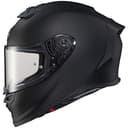
- The ScorpionEXO R1 Air leads because airflow is its design brief, not a feature-list item. Scorpion describes the aero profile and airflow as tuned for a head-down sport position, it is DOT and ECE certified, and the Pinlock-ready shield is in the box. The cost is noise, and Scorpion does not publish a weight for the standard non-carbon shell — so it cannot be ranked on grams, only on construction.
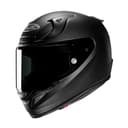
- The HJC RPHA 12 is the pick if you want the certification and the glare answer in one box. DOT on the US listing with ECE 22.06 published for the model, a PIM EVO composite shell, a wider eye port, and both a clear and a dark smoke HJ-42 shield plus the Pinlock insert included — which is the cheapest version of a summer tint there is. HJC does not publish a shell weight for it, and the double D-ring closure is slower in gloves than a ratchet.
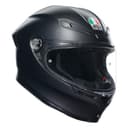
- The AGV K6 S is here on weight and eyeport.About 1,255 g of carbon-aramid with DOT plus ECE 22.06, and AGV publishes a wide eyeport and strong airflow from its racing lineage. In genuine heat the lightest certified full-face you can buy is doing something no vent can do. It is premium money, and the sportier padding is firmer than a plush touring interior.
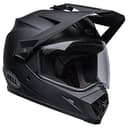
- The Bell MX-9 Adventure MIPS is the answer for heat at low speed, which is the hard case. Traffic, fire roads, parking lots — anywhere there is no airflow to collect. An ADV shell with a peak, a shield-or-goggle configuration and a huge eye port moves air at speeds where a sealed full-face has given up, and it still carries DOT plus ECE 22.06 with a MIPS layer. The honest cost is roughly 1,696 g, which is heavy for a hot day, and a polycarbonate shell rather than a composite. See our dual-sport ranking for the rest of that category.
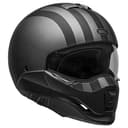
- The Bell Broozer is the two-in-one, with one thing you must understand first. The chin bar bolts off for town and back on for the highway, and a face shield is included. But Bell publishes no impact rating for the removable chin bar, so it is a wind deflector and not a full-face conversion. Bought with that understood it is a genuinely useful hot-weather helmet at about 1,452 g; bought as “a full-face that opens up” it is a misunderstanding. The same point runs through open-face versus full-face.
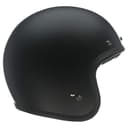
- The Bell Custom 500 is the maximum-airflow option and the maximum- exposure one. A fiberglass composite 3/4 at about 982 g — the lightest helmet on this page by a wide margin — in five shell sizes, so a small head is not wearing a padded-out big shell. There is no chin bar and no face shield as standard, which means zero facial impact protection and a separate purchase for a shield or goggles. It is on this page because it is honest about what it is.
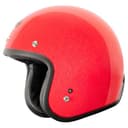
- The TORC T-50 is the cheapest certified way to ride cooler. DOT FMVSS 218, a polycarbonate shell, multi-density EPS and a D-ring strap rather than a cheap quick-release, with a removable suede liner. No ECE rating, no published weight, and snap-on visor only — budget goggles or glasses on top. It is on this page to make the novelty-lid argument impossible.
Three things that cool you more than moving up a helmet tier
- A second, tinted shield — or an internal sun visor. Glare is half of what makes a hot ride exhausting, and a dark shield costs a fraction of a helmet. Two picks here ship with one or the other; our sun-visor ranking covers the drop-down mechanism and what it costs you in weight, and our visor guide covers tints, coatings and the legal limits.
- A thin wicking skull cap or balaclava. Counter-intuitive in summer, and it works: it moves sweat off your scalp into a layer you can wash, instead of into the liner you cannot replace cheaply. It also makes the helmet easier to pull on and off at every stop.
- Washing the liner.The single most underrated hot-weather intervention, because a salt-loaded liner stops wicking and starts holding heat. Most helmets on this page publish removable cheek pads or a removable liner — check the listing before you assume yours does. Our helmet cleaning guide covers doing it without wrecking the EPS or the shield coating.
What we did not rank, and why
Touring flagships.The Shoei GT-Air 3 and Neotec 3 are the best helmets on this site for a long day, and their virtue is sealing — the opposite of what this page is ranking. A quiet helmet is a helmet that is keeping air out. They lead the touring ranking, where that is the right goal.
Several well-vented helmets we would otherwise have ranked. The KLIM Krios Pro is a carbon ADV lid whose ventilation KLIM specifically describes as designed for low-speed off-road work, and the ScorpionEXO AT960 is a modular ADV helmet; both would have earned a slot on merit. Both were excluded on availability — on the day this page was written the listings we link to read “only 3 left” and “only 2 left” respectively, which is below the stock bar we hold picks to. The Fly Trekker and the ScorpionEXO Covert 2 were excluded for the same reason. All four remain ranked on the pages that already carry them, including the dual-sport page.
The Bell Qualifier.It is one of the best-value certified full-faces we know of and it is deliberately not on this page, because Bell’s own trade-off for it is basic ventilation. It belongs on the budget ranking, not here. Putting it on a ventilation page because it is cheap would be exactly the kind of recycled pick list this site tries not to publish.
Anything SNELL-certified. SNELL helmets are built around the hardest energy test in common use, which generally means more shell, more EPS and a tighter seal. That is the right set of trade-offs for a track day and the wrong one for crawling through August traffic. They are ranked on the SNELL page.