Measure before you shop
A tape measure around the widest part of the head, roughly a centimeter above the eyebrows and around the fullest part at the back. Take the largest of three readings. That number, in centimeters, is what you match against a maker’s chart — never against a small/medium/large label, because those do not agree between brands. The full method, including the fit checks that tell you whether the helmet is actually right, is in our helmet sizing guide.
As a rough orientation, most makers put 2XL somewhere around 63–64 cm and 3XL around 65–66 cm, but the exact cut-off is different for every brand and every model. Two helmets both labeled 2XL can be more than a centimeter apart. Buy from the chart, not from the letter.
Shell count is the specification that matters most
A helmet range built on one shell for every size has to reach the big sizes by thinning the interior padding, and the largest size in that range is often the shell’s limit rather than a size designed for a large head. A range built on three or five shells has an actual larger shell for the larger sizes.
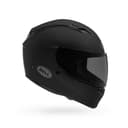
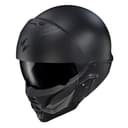
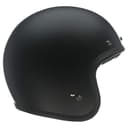
That is why the Bell Custom 500 is here despite being an open-face: five shell sizes from XS to 3XL is unusually thorough engineering, and it means a 3XL Custom 500 is a genuinely larger helmet rather than a hollowed-out XL. The Bell Qualifier uses three shells; the ScorpionEXO Covert 2 uses two across XS–3XL. Where a maker publishes the shell count, we have put it in the spec table.
What to expect at 2XL and 3XL
- Fewer certifications. The big sizes cluster in value ranges, and value ranges more often carry DOT alone rather than DOT plus ECE 22.06. The HJC i10 is the exception here and the reason it is on the list — DOT plus SNELL M2020 at 2X-Large is the most certification you will find in this size band.
- More weight. A bigger shell is a heavier shell. This compounds with the fact that a larger head is often attached to a rider carrying it further from the neck pivot, so the weight figures in the spec tables above are worth reading closely.
- Thin stock. The largest size in any range sells out first and gets restocked last. If you find the helmet you want in your size, the practical advice is to buy it rather than wait.
- Fewer colorways. Graphic versions are typically produced in the middle sizes. Expect solid black in 3XL.
If nothing fits: the interior route
Before concluding you need a bigger shell, check whether you need a thinner interior. Most makers sell cheek pads and crown padding in multiple thicknesses for the same shell, and dropping one step frees real room without touching the EPS liner or the shell — the parts that do the protecting. This is the correct order of operations: right shell size, then adjust the padding. It is the same fix we recommend to riders in glasses on helmets for glasses, and for the same reason.
What you must not do is buy the next size up to make the pressure stop. A helmet protects by holding its crushable EPS liner in contact with your skull so it can crush against it; a helmet that moves cannot. NHTSA’s consumer guidance leads with fit for exactly this reason. A loose 3XL is worse than a snug 2XL that needs a thinner cheek pad.
The head-shape check, in one paragraph
Have someone photograph the top of your head from directly above with your hair flat. A circle that is nearly round means a round-oval head; noticeably longer front-to-back than side-to-side means long oval; in between — which is most people — is intermediate oval. Every helmet on this page is built on an intermediate-oval interior, which is the industry default. If your photograph looks distinctly long, you will get pressure at the forehead and the back of the skull in these helmets no matter which size you take, and no amount of sizing up will resolve it. That is a shape problem, and our head shapes guide covers what to do about it.