Shoei Neotec 3 vs HJC i90
The flagship touring modular against the one that costs a fraction as much — 1,850 g of hand-laid composite and ECE 22.06 versus a polycarbonate shell with ECE 22.05. Where the money actually goes.
These are the two modulars we rank first in their respective categories, and the gap between them is one of the largest on the site. The Shoei Neotec 3 is the touring flip-front that experienced riders converge on: a hand-laid AIM multi-composite shell, DOT plus ECE 22.06, and a helmet whose entire design brief is being quiet enough for a 400-mile day. The HJC i90 does the same job — flip-front, drop-down sun visor, comms-ready — in an advanced polycarbonate shell with DOT and ECE 22.05, at a small fraction of the money.
The question is not which is better. It obviously is the Neotec. The question is what the difference actually consists of, and whether any of it matters to how you ride. Below is the spec comparison, then an honest account of where the money goes — including the two places where the gap is real and the several where it is not.
How this is funded: we earn a commission if you buy through our links, at no extra cost to you. It never changes which gear we recommend, and we’ll tell you plainly when to skip a pick. Full disclosure.
The flagship
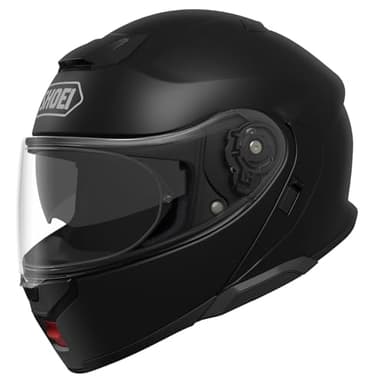
Shoei Neotec 3
The benchmark touring modular. Shoei's AIM shell, DOT plus ECE 22.06 with P/J dual homologation (legal to ride with the chin bar up), and the quietest flip-front we know of. Expensive, and worth it for high-mileage touring.
Price as of October 19, 2026. #ad How we’re funded
The value pick
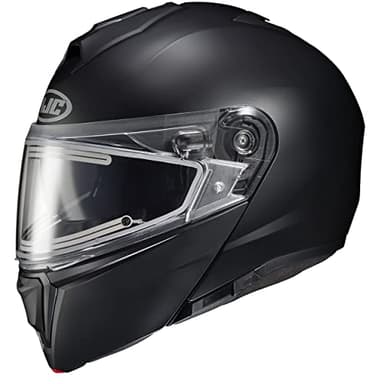
HJC i90
The value modular that gets the important things right: DOT and ECE 22.05 certification, a drop-down sun visor, and comms-ready ear pockets, for a fraction of a premium flip-front's price.
Price as of October 19, 2026. #ad How we’re funded
| Spec | Shoei Neotec 3 | HJC i90 |
|---|---|---|
| Certification | DOT + ECE 22.06 | DOT + ECE 22.05 |
| Shell material | AIM multi-composite (hand-laid) | Advanced polycarbonate |
| Claimed weight | ~1,850 g | Not published by HJC |
| Head shape | Intermediate oval | Intermediate oval |
| Interior | Plush touring liner, tight base seal | Roomy cheek pads, basic padding |
| Sun visor | Internal drop-down | Internal drop-down |
| Comms | Designed around a matched system | Universal speaker pockets |
| Best suited to | Long-distance touring, all weathers | Commuting and weekend distance |
| Price tier | Premium | Mid |
Where the money genuinely goes
1. The certification is a version apart
Both helmets carry DOT, so both are legal everywhere in the US. Both add ECE — but ECE 22.06 and ECE 22.05 are not the same claim. 22.06 replaced 22.05 and added oblique-impact testing for rotational forces, more impact points on the shell, and a shield-impact requirement. A 22.05 helmet cleared a real protocol; a 22.06 helmet cleared a broader one. This is the single most defensible reason to spend the difference, and it is explained in full in our certification guide.
2. Noise
Shoei’s pitch for the Neotec line is quietness, and the engineering behind it is unglamorous: a tight seal where the chin bar meets the shell, a well-fitted neck roll, and aero shaping around the base. Neither maker publishes a decibel figure — nobody in this industry does in a way that can be compared — so we will not quote one. What we will say is that base sealing is the mechanism that matters, that a flagship touring helmet is where makers spend effort on it, and that the effect over a long day is real. Our quietest helmets page covers the mechanism properly, along with the reminder that earplugs beat any helmet upgrade.
Where the gap is smaller than the price suggests
The feature list is nearly identical
Drop-down internal sun visor: both. Flip-front chin bar: both. Removable washable liner: both. Speaker pockets: both. Pinlock-ready shield: both. If you write out what a touring modular is supposed to do, the i90 does all of it. That is the uncomfortable part of this comparison for anyone justifying a flagship purchase on features.
Fit is a wash — and the i90 wins one case
Both are built on an intermediate-oval interior, the industry default. The i90’s cheek pads are the roomier of the two, which is precisely why it is our top pick on helmets for glasses. If you wear prescription glasses, the cheaper helmet is the better helmet for you, and that is not a consolation prize.
Weight, with a caveat
Shoei publishes 1,850 g for the Neotec 3. HJC does not publish a figure for the i90, so the spec table says so rather than guessing. A polycarbonate shell is generally heavier than a hand-laid composite of the same strength, so the i90 is unlikely to be lighter — but we are not going to state a number we cannot source. Either way, both are modulars, and both are heavier than an equivalent full-face for the structural reasons covered on modular vs full-face.
Which one should you buy?
Buy the Neotec 3 if
You ride long distances, regularly, in weather you did not choose. The argument for the flagship is cumulative: the newer certification, the quieter base seal and the better interior compound over hours, and touring is where hours happen. It is also the right call if you are keeping the helmet for its full five-year service life and want the most current standard on your head for all of it.
Buy the i90 if
You commute, you ride at weekends, or this is your first modular and you are not yet certain a flip-front is what you want. It is also the better buy if you wear glasses, and the sensible buy if the difference in price is the difference between a modular and no modular at all. The i90 appears on our modular ranking and HJC range pages for the same reason: it is an enormous amount of certified helmet for the money.
The third option worth considering
If your reason for wanting a modular is convenience at stops rather than touring comfort, a lighter full-face plus a habit of taking the helmet off is a legitimate alternative, and it is cheaper and safer than either of these. We are not going to pretend the flip-front is free — it adds a hinge, a latch and weight to the front of the helmet.
Frequently asked questions
Is the Shoei Neotec 3 worth the extra money over the HJC i90?
If you tour, yes; if you commute, probably not. The two things you genuinely buy are a newer certification — ECE 22.06 against the i90's 22.05, which adds rotational-impact testing — and a hand-laid composite shell in a helmet engineered around base sealing and quietness. Those pay off cumulatively over long days. The feature lists are almost identical, both have drop-down sun visors and comms pockets, and the i90's cheek pads are actually roomier.
What is the difference between ECE 22.05 and ECE 22.06?
22.06 is the current European standard and 22.05 is the one it replaced. The newer protocol added oblique-impact testing to address rotational forces on the brain, increased the number of impact points tested on the shell, and introduced a shield-impact requirement. A 22.05 helmet is still a certified helmet that passed a real test program; it simply cleared a narrower one. When you are comparing two helmets and one carries 22.06, that is a genuine, checkable difference rather than marketing.
Which of these is better for wearing glasses?
The HJC i90, and it is not close. HJC builds the i90 with roomy cheek pads, and on a flip-front you can raise the chin bar, put the helmet on, and then seat your glasses through the open front rather than dragging the arms across foam. It is our top pick on the helmets-for-glasses roundup for exactly that combination. The Neotec 3's tighter, plusher touring liner is part of what makes it quiet, and it works against you here.
How much does the Shoei Neotec 3 weigh?
Shoei publishes approximately 1,850 g. That is heavy in absolute terms and normal for a premium touring modular — the hinge, the latch, the second sealing surface and the drop-down sun visor are all mass, and they sit low and forward where you feel them most. For comparison, Shoei's own RF-1400 full-face is about 1,640 g. HJC does not publish a weight for the i90, so we do not quote one.
Are modular helmets as safe as full-face helmets?
A certified modular has passed the same test program as a certified full-face to the same standard, so at the level of the certification the answer is yes. What differs is structure: a one-piece shell has no hinge and no latch, and that remains the simpler object. Ride with the chin bar latched down, treat the raised position as a stationary convenience rather than a riding mode, and the practical gap is smaller than the internet suggests. We cover the full trade separately.
Is the HJC i90 quiet?
Quieter than a bare sport helmet, not as quiet as a flagship touring modular, and we cannot give you a number for either. No maker publishes comparable decibel figures, and any page that gives you one for a helmet it did not test in a controlled setting is guessing. What is checkable is the mechanism: quietness comes from the seal at the base of the helmet and the fit of the neck roll, and that is where premium touring helmets spend their engineering budget. Earplugs remain the biggest single improvement available on either helmet.
Sources
- NHTSA — How to Choose the Right Motorcycle Helmet — NHTSA consumer guidance on DOT certification and spotting novelty helmets (accessed July 21, 2026)
- 49 CFR 571.218 — FMVSS No. 218, Motorcycle helmets — The US federal helmet standard: peak-acceleration, penetration and retention requirements; applies to all on-road motorcycle helmets (accessed July 21, 2026)
- UNECE — Vehicle Regulations (UN Regulation No. 22 / ECE 22.06) — The UN regulation behind ECE 22.06, which added rotational/oblique-impact testing over 22.05 (accessed July 21, 2026)
- Snell Memorial Foundation — Standards — Snell's motorcycle helmet standards: M2025D/M2025R are the current generation and M2020D/M2020R the previous one (D = DOT markets, R = ECE markets) (accessed July 21, 2026)
Keep reading
Best modular helmets
The full flip-front ranking, compared on certification, weight and wind noise.
See the modular picksBest HJC helmets
The full HJC range and the certification pattern that means the cheap one sometimes has the better rating.
See the HJC rangeModular vs full-face helmets
The trade you are actually making: a hinge and a latch, in exchange for lifting the chin bar at every stop.
Read the comparisonBest touring helmets
Quiet, well-sealed helmets built for 400-mile days, with the certification each one carries.
See the touring picks