The four criteria this ranking is built on
In the order they actually decide a cold ride. They are deliberately not the criteria behind the hot-weather ranking, which ranks on exactly the opposite virtues, or the main ranking, where certification leads and nothing is allowed to overrule it.
| Criterion | Why it decides a cold ride | What to look for |
|---|
| An anti-fog shield system | This is the whole category. A fogged shield in traffic at 40°F is a safety problem, not a comfort one, and breath plus cold glass guarantees it | A Pinlock-prepared shield (it has the two pins) AND the insert itself. Two picks here include both in the box; most helmets include only the prepared shield |
|---|
| A drop-down sun visor | Winter sun sits low and stays in your eyes for the whole ride, and the days are short enough that a dark outer shield traps you after dark | An internal visor you can drop and lift with a glove on. Five of the seven picks publish one; it is the most consistently useful winter feature after the Pinlock |
|---|
| A wind collar or chin curtain | Cold air pushed up from under the helmet chills your neck and carries your own breath onto the shield, which is what fogs it | A padded wind collar, a chin curtain, or at least a breath deflector. The Bell Qualifier publishes a padded wind collar as standard, which is why a budget helmet is on this page |
|---|
| Glove-friendly operation | Winter gloves are thick. Anything you cannot work in them — a fiddly vent, a double-D strap, a bolt-on comms button — is a thing you stop using in January | A flip-front you can open at a fuel stop, a micrometric ratchet rather than a double-D, and comms that are either integrated or in pre-cut ear pockets |
|---|
Certification does not change with the season
Every helmet on this page publishes DOT FMVSS 218, the legal floor for on-road sale in the US, and three of the seven add an ECE homologation on top. That ordering is deliberate: fog is a visibility problem and a crash is an impact problem, and no amount of winter convenience buys its way past the certification line. Our certification guide explains what each mark measures, our safest-helmets ranking sorts the whole registry by what each maker publishes, and our guide to helmet brands shows why you cannot read a certification off a badge — not one brand on this site certifies its whole range the same way.
The thing that actually fixes winter: a Pinlock insert
A Pinlock insert is a second lens that seals to the inside of the shield and leaves a thin air gap, so the inner surface never gets cold enough for your breath to condense on it. It is the single highest-value cold-weather purchase in motorcycling, and it costs a rounding error against any helmet here. The catch is that “Pinlock-ready” and “Pinlock included” are different claims, and listings blur them. Ready means the shield has the pins; included means the lens is in the box. The HJC RPHA 91 and RPHA 12 publish the insert as included. The HJC i90 publishes a Pinlock-ready shield, which means one more order.
Fitment is lens-to-shield specific — an insert is cut for one visor and will not seal on another — so buy it against your exact model rather than by brand. Our fogging guide covers the insert, the breath deflector and the three habits that matter more than any product, and our visor guide covers tints, coatings and what is legal after dark.
How we ranked these seven
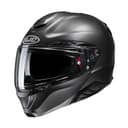
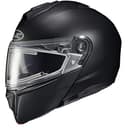
- The HJC RPHA 91 leads because it is the only helmet here that arrives winter-ready. A PIM advanced composite shell, DOT approval, the HJ-37 Pinlock-prepared shield included rather than sold separately, a drop-down sun visor and a comms-ready interior. The honest costs: HJC publishes no shell weight for it, so it cannot be ranked on grams, and a flip-front hinge is a noise source a sealed full-face does not have.
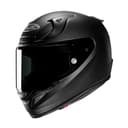
- The HJC RPHA 12 is the pick if you want a sealed full-face rather than a flip-front. DOT on the US listing with ECE 22.06 published for the model, a PIM EVO composite shell, and — the winter argument — a clear shield, a dark smoke HJ-42 shield and the Pinlock insert all in the box, which covers both the fog and the low-sun problem without a second order. The double D-ring closure is slower in thick gloves than a ratchet, and HJC publishes no weight for it either.
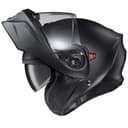
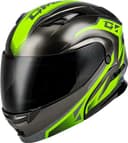
- The ScorpionEXO GT930 Transformer is for the rider who stops constantly. Full-face, modular or chin-bar-off open-face, with DOT plus ECE 22.05 and a drop-down sun visor. In winter the flip-front matters more than it does in July: glasses, a scarf, a fuel pump and a card reader are all easier with the front up. The cost is honest and real — about 1,810 g, the heaviest helmet on this page, because the convertible hardware weighs something. The open-face setting has no chin protection and is a fair-weather mode, not a winter one.
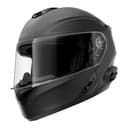
- The Sena Outrush R is here because winter is the season you stop taking your gloves off. A DOT-certified modular with the Bluetooth intercom built into the shell rather than bolted to it, voice controls and a drop-down sun visor. No external module means nothing to snag, nothing to lose at a cold fuel stop and no clamp to fit with numb hands. The trade-offs: the comms cannot be upgraded independently of the helmet, and at roughly 1,730 g it is a heavy polycarbonate lid. If you would rather choose the intercom separately, we have written up that exact decision.
- The HJC i90 is the value modular.DOT plus ECE 22.05 on an advanced polycarbonate shell, a drop-down sun visor, a Pinlock-ready shield and ear pockets already sized for a Cardo or Sena install — which is the practical definition of comms-ready. Two honest notes: the Pinlock lens is a separate purchase here, and a polycarbonate modular is heavier than a composite one, with no published figure from HJC to put a number on it.
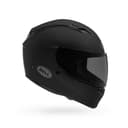
- The Bell Qualifier is on this page for the same reason it is not on the hot-weather one. Bell’s own published trade-off for it is basic ventilation, which is a liability in August and a genuine virtue in January, and it ships with a padded wind collar and speaker pockets as standard. DOT approval, three shell sizes, about 1,488 g — light for a budget full-face. What it does not have: MIPS, an ECE rating, a sun visor or a Pinlock lens in the box. It is the cheap, sealed, certified answer, and it is ranked on our budget helmet page as well.
- The GMAX MD-01 exists so that nobody has an excuse to ride winter in an uncertified lid. DOT plus ECE at well under a hundred dollars, with a drop-down internal sun visor and a flip-front. The shell is poly-alloy, it is heavy, the finish is basic, and GMAX publishes neither the ECE sub-version nor the weight. It is a knock-around winter commuter helmet, honestly described.
Three things that improve a cold ride more than a new helmet
- A Pinlock insert for the helmet you already own. If your current helmet is certified and fits, the insert is the upgrade, not a new lid. Check whether your shield has the two pins before you order, and order against the exact shield model.
- A balaclava or neck tube.It closes the gap at the bottom of the helmet that is both cooling your neck and feeding your breath onto the shield, and it is the cheapest thing on this page by a wide margin. It also keeps sweat and skin oil out of a liner you cannot easily replace — our cleaning guide covers washing the liner without wrecking the EPS.
- Heated gloves or grips before a heated jacket. Hands fail first and they are the ones operating the controls. Our heated glove ranking covers the bike-powered and battery options and what each maker publishes, and the heated jacket page covers the wattages on the torso side.
What we did not rank, and why
The touring flagships, and they would have been near the top. The Shoei GT-Air 3 and Neotec 3 are the best cold-weather helmets on this site on paper — deep neck rolls, chin curtains, sealed shields and internal sun visors — and both were excluded on availability alone. On the day this page was written the listings we link to read “only 1 left” and “only 2 left” respectively, which is below the stock bar we hold new picks to. The ScorpionEXO T520 (“only 2 left”) went the same way. All three remain ranked on the touring page and the quietest page, where that sealing is the headline, and our head-to-head compares the two Shoeis directly.
Open-face and 3/4 helmets, all of them. Our open-face picks are a genuine recommendation in the right conditions and winter is not those conditions: an exposed jaw in cold air is a fatigue problem within twenty minutes, before the protection argument even starts. The open-face ranking and open-face versus full-face both say the same thing about cold.
Anything whose only winter feature is a dark visor. A tinted shield is a summer answer that becomes a hazard on a December afternoon, because the light goes at four o’clock and you cannot change shields at the roadside in gloves. That is the argument for a drop-down internal sun visor, and it is why five of these seven have one. The full visor-system trade-off is in our sun-visor ranking.