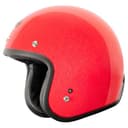
What people actually mean by “custom”
1. Factory graphics
By far the most common. The helmet you want exists; it just needs to not be plain matte black. Every helmet above ships in multiple colorways, and a graphic version of a helmet is the identical certified shell with a different finish applied during manufacture. There is no safety trade-off, no warranty question and no risk. If what you want is a helmet that looks like something, start here and stop here.
2. Custom paint
A painter strips or scuffs the existing finish and lays down new artwork. This is the version that produces the helmets people post photographs of, and it is also the version with real consequences. More on it below, because it deserves its own section.
3. Custom fit
Swapping cheek pads and crown padding to change how the helmet sits. This is the one nobody searches for and the one that actually improves the helmet. Most makers sell interior components in several thicknesses for the same shell, so a helmet that is correct around the crown but loose at the jaw can be corrected for the price of a pair of pads. Our helmet sizing guide covers the fit checks that tell you which part is wrong.
What painting does to a certified helmet
A helmet is three bonded systems: an outer shell that spreads impact energy, an EPS liner that crushes to absorb it, and the adhesives and fasteners holding the two together with the retention system. Paint work touches all three, in ways that are not visible afterwards.
- Solvents migrate. Paint thinners, lacquer, primers and aggressive cleaners attack polycarbonate directly — the same reason NHTSA and every maker tell you to clean a helmet with mild soap and water. Fiberglass and composite shells tolerate more than polycarbonate, but the adhesives inside do not care what the shell is made of.
- Heat is the second problem. Forced-drying or baking a finish puts the EPS liner at temperatures it was never qualified at. EPS degrades with heat; that is the same mechanism behind the advice not to leave a helmet on a parcel shelf in summer.
- Sanding removes shell. Aggressive prep on a thin polycarbonate shell takes away structural material. On a hand-laid composite it can break the outer fiber layer that does the load spreading.
- It usually voids the warranty, and it makes any subsequent inspection harder — a repainted shell hides the crazing and cracking you would otherwise use to judge whether a helmet took a hit.
None of this makes custom paint impossible. It means the job belongs with a shop that paints helmets specifically, that will tell you which shell materials they will and will not work on, that uses helmet-compatible products, that never removes or heats the EPS, and that masks the vents and the retention hardware. A general automotive body shop is not that. If a painter does not ask what the shell is made of, find another painter.
The cheaper, reversible alternatives
Vinyl wrap avoids the solvent problem almost entirely and can be removed. The caveats are that wrapping over vents reduces airflow, and that a poorly applied wrap edge can lift at highway speed. Stickers and decals are the lowest-risk option of all, with one warning: solvent-based adhesives can attack a polycarbonate shell over time, so stick to vinyl decals designed for the job. Shells and covers that slip over a helmet are the option we would avoid — they can interfere with the shell’s ability to slide on impact, and none of them is part of any certification.
The novelty helmet problem
The custom and cruiser end of the helmet market is where novelty helmets live. These are shells sold as motorcycle helmets that were never built to meet FMVSS 218 — often thin, often with little or no EPS liner, often carrying a DOT sticker that means nothing because the maker applied it themselves without doing the testing. NHTSA publishes consumer guidance on spotting them precisely because they are common.
The practical checks: a certified helmet has a genuine EPS liner roughly an inch thick that you can feel through the comfort padding; it has a sturdy chin strap riveted to the shell; and it carries a manufacturer label with brand, model, size, month and year of manufacture. A helmet that weighs almost nothing, has thin foam padding instead of a crushable liner, and carries a stick-on DOT decal and nothing else, is a hat. Our certification guide covers exactly what the DOT mark is supposed to represent and how the self-certification system works.
Choosing a base helmet for a build
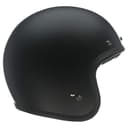
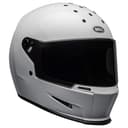
If you are having something painted, the shell material decides most of it. Fiberglass and composite shells — the Bell Custom 500 and Eliminator here — are the ones painters prefer, because they tolerate prep and finishing that would compromise a polycarbonate shell. A polycarbonate helmet is not unpaintable, but it narrows the products a painter can safely use, and on a cheap shell the cost of the paint job will exceed the cost of the helmet several times over.
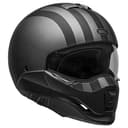
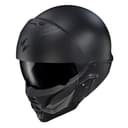
The second consideration is what you are giving up for the look. Three of the five helmets above are open-face or convertible, which means no chin bar for most or all of the time you are wearing them. That is a genuine reduction in protection, not a styling preference, and we say so on the open-face roundup as well. If the look you want can be achieved with a full-face — and with the Eliminator and the Broozer it can — take the full-face.