The published weights, in order
Before the list, the caveat that limits it: only 18 of the 37 helmets in our registry publish a weight at all, and they skew premium. Our guide to helmet weight sets out the published ranges by helmet type, what grams do and do not buy, and why “no published weight” is itself information.
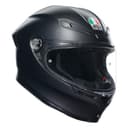
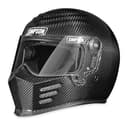
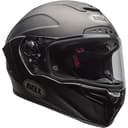
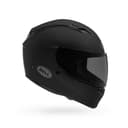
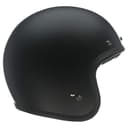
Read the spec tables above for the full figures. In grams, lightest first, the helmets on this page run: Bell Custom 500 at 982 g (an open-face, so not comparable to the rest), AGV K6 S at 1,255 g, Bell Qualifier at 1,488 g, Simpson Outlaw Bandit 3.0 Carbon at 1,529 g, and Bell Race Star DLX Flex at 1,540 g. For context, other helmets we cover sit at 1,620 g (Bell Qualifier DLX MIPS), 1,640 g (Shoei RF-1400), 1,714 g (Shoei GT-Air 3) and 1,850 g (Shoei Neotec 3, a modular).
That range — roughly 1,250 g to 1,850 g across street-legal helmets we would actually recommend — is the whole playing field. A 600 gram spread sounds small written down. It is about a third of the total mass, held up by your neck, all day.
What makes a helmet light
Shell material does most of it
A polycarbonate shell is injection-molded in one shot: cheap, tough, and heavy for its strength. A composite shell — fiberglass, aramid, carbon, or the multi-fiber blends premium makers use — is laid up from sheets, which lets the maker put material where the load is and leave it out elsewhere. Carbon is the lightest of these, which is why the two carbon helmets here sit near the top despite being full-face lids with hardware.
The important caveat: a lighter shell is not automatically a safer or a weaker one. Shell material governs how impact energy spreads across the shell; the crushable EPS liner underneath does the energy absorption. Both the 1,255 g AGV K6 S and the 1,680 g HJC i10 passed the certification tests on their labels. What weight buys you is comfort and fatigue resistance, not certification.
Shell count
A range built on three or five shell sizes rather than one avoids wrapping a small head in a large helmet packed out with foam. If you wear a small or medium, shell count affects your real-world weight more than shell material does.
Everything bolted on
Drop-down sun visors, intercom modules, thick touring neck rolls and modular hinges all add mass. A modular is structurally required to be heavier than the equivalent full-face — there is a hinge, a latch and a second sealing surface. That is the trade covered on modular vs full-face.
How much does weight actually matter?
Honestly: less than fit, less than certification, and more than almost everything else. Here is the order we would put it in.
- Fit. A helmet that does not fit cannot protect you properly and you will not wear it. Nothing outranks this.
- Certification. DOT is the legal floor; ECE 22.06 and SNELL M2020 mean the helmet cleared more, and harder, tests.
- Weight and noise. The two comfort factors that decide how far you can ride before you stop enjoying it. Both are why touring riders spend money on helmets.
- Features. Sun visors, comms pockets, vent count. Real conveniences, but you can ride without them.
The rider who benefits most from a light helmet is the one covering long distances upright, without a fairing, or with a neck that already objects. If you commute twenty minutes each way, buy the helmet that fits and stop reading this page.
Why we will not estimate the missing numbers
Several helmets riders reasonably expect to see here — the HJC RPHA 12, the KLIM Krios Pro, the ScorpionEXO R1 Air — are absent because their makers do not publish a shell weight in the material we can verify. Reviewers do put their own scale figures out there, and those figures vary by size and by whether the shield and liner were fitted, so a number quoted for “the RPHA 12” without a size attached is not a specification.
Our product data layer treats an unpublished spec as a first-class state: the field is null, the table says “Check current listing,” and no page invents a figure. On a page whose entire ranking is one number, that rule does more work than usual. If a maker starts publishing, the helmet will appear here.
One thing to check before you buy on weight
Published weights are almost always quoted for a specific size — usually medium — and rarely say so. Your 2XL of the same helmet will weigh more, sometimes 100 g or more, because a larger shell contains more material. Treat these figures as a way to rank helmets against each other, not as the weight of the box that arrives. And check what the number includes: some makers quote the bare shell, others the complete helmet with shield and liner.