How to tell a real women’s glove from a small one
- It has its own model name or a Stella-style sub-brand. Where a maker has drafted a separate pattern, it usually says so in the product name rather than in a size dropdown.
- The size chart is different, not just shorter. A genuine women’s chart gives palm circumference and hand length separately. A men’s chart with the top three sizes removed is a men’s glove.
- The wrist closure is proportional. Look at the product photography: a men’s glove in XS often has a strap so long it wraps almost twice.
- The fingers look long relative to the palm. This is the visible signature of a women’s pattern, and once you have noticed it you cannot unsee it.
Measure, then buy
Two measurements, both on your dominant hand. First, palm circumference — a tape around the widest part of your palm, excluding the thumb, with the hand flat. Second, hand length — the base of the palm at the wrist crease to the tip of the middle finger. Most women’s charts want the first; the good ones want both, because the ratio between them is exactly what the pattern is trying to get right.
Then buy snug. A new glove — leather especially — should feel slightly tight, with no loose material at the fingertips. It will mold to your hand within a few rides. A glove that is comfortable in the shop will be loose in a month, and loose is the condition that lets it come off.
What we ranked on
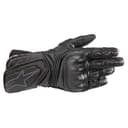
- A published CE rating where one exists. EN 13594 is the glove standard, with Level 1 and Level 2 and a KP suffix where knuckle protection has been separately tested. The Alpinestars Stella SP-8 V3 publishes EN 13594:2015 Level 1 KP. Nothing else on this page publishes anything, and the spec tables say so rather than implying otherwise.
- Palm construction. The heel of the hand takes the load. A one-piece palm with reinforcement across the landing zone beats a seamed one, and leather beats textile.
- Knuckle protection. A molded hard knuckle rather than a foam pad.
- Retention. A wrist strap that actually closes. This is the specification most often compromised in small sizes, and it is the one that decides whether the glove stays on.
The honest state of the market
It is thin, and it is thin in a specific way: the budget end is full of women’s-cut gloves with no certification, and the certified end has very few women’s patterns. That leaves a real gap in the middle, and it is the same gap we describe on helmets for women and women’s jackets — the product exists, but the range is a fraction of the men’s equivalent and the good options sell out first.
Two practical consequences. If you find a certified glove in a women’s pattern that fits, buy it rather than waiting for a sale; stock in this category does not come back reliably. And do not rule out a men’s glove entirely — some riders with wider hands genuinely fit them better, and a men’s glove that fits is a better purchase than a women’s glove that does not. The pattern is a tool for getting the fit right, not a rule.
What about winter and heated?
Women’s-pattern winter gloves are rarer still, and heated gloves in a women’s cut are close to non-existent — most heated gloves are sold as unisex with a size chart that starts at small. That is genuinely a compromise, because bulk and a loose fit are the two things a winter glove already struggles with. Our winter gloves and heated gloves rankings cover the unisex market, and the sizing advice there applies: check the chart, size for the palm, and accept less dexterity than a summer glove.