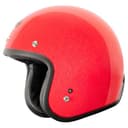
Before you buy: are you sure you want an open-face?
Worth settling first, because it is the decision this page assumes you have already made. We work the trade through properly in open-face versus full-face — what the chin bar is actually worth, why the strongest certification pairs on the market are almost all full-face, and the four kinds of rider for whom a certified 3/4 helmet is genuinely the right buy. If what you actually want is the safety question answered head-on, are open-face helmets safe sets out exactly what a certification does and does not cover here — and why we refuse to repeat the chin-impact statistic everyone else quotes. If you are not yet sure which category you want at all, types of motorcycle helmet is the reference, and how to choose a motorcycle helmet puts the whole sequence in order.
How to choose an open-face helmet
The decision tree is shorter than for a full-face, because you have already accepted the big trade. What’s left is certification, shell sizing, eye protection and how much wind you’re willing to take in the face.
Certification first, and check the sticker
A DOT sticker on the back of a genuine helmet is backed by the manufacturer’s self-certification and by NHTSA’s random compliance testing. On a novelty helmet it is a sticker somebody bought. The reliable tells are physical: the EPS liner should be a solid inch or more thick, the strap should be riveted rather than glued, and the whole thing should have real mass. All five helmets here come from established makers with published certifications.
Shell sizes matter more here, not less
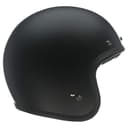
An open-face has less contact area with your head than a full-face, so a helmet that’s padded out from a too-large shell moves around more. The Bell Custom 500 runs five shell and EPS sizes, which is unusually generous for the category and the main reason it sits at the top of this list. Two or three shell sizes is normal; one shell size across the range is a warning sign.
Eye protection is your problem now
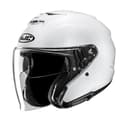
Most open-face helmets ship with a snap-on peak, not a face shield. That means goggles, riding glasses or a separately-purchased snap shield — and it means insects, grit and rain hit your eyes at speed if you skip it. The HJC i31 solves this properly with a full face shield and a drop-down internal sun visor, which is why it is our commuting pick even though it looks less classic than the others.
The convertible question
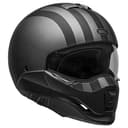
The Bell Broozer has a removable chin bar, which sounds like a solution to the entire trade-off. It is not. Bell publishes no impact rating for the removable chin bar, so treat it as a wind and debris deflector rather than as a certified full-face conversion. That is not a criticism of the helmet — it’s a well-made DOT-approved open-face — it is a correction to the assumption most buyers make. If you want chin protection you can rely on, you want a modular helmet with a certified, latching chin bar.
Noise and fatigue
Open-face helmets are loud. Without a chin bar there is nothing to manage the airflow under your jaw, and turbulence hits your ears more directly. Earplugs are effectively mandatory for highway use — not optional, and not a comfort item. Wind also drags on your head at speed in a way a sealed full-face doesn’t, which is the real fatigue cost of the category over a long day. If heat is the reason you are reading this page, it is worth seeing the alternative ranked properly first: our hot-weather helmet ranking puts the best-vented full-faces, an ADV lid and two 3/4s on the same list and is explicit about what each one costs you.