Why “safest” splits into two answers
The two voluntary standards a US buyer can actually find on a listing test for different failures, and neither is a superset of the other. This is the whole reason the ranking above is not a single straight line.
| Mark | Who decides it passed | What it is good at | Required in the US? |
|---|
| DOT FMVSS 218 | The manufacturer certifies its own helmet; NHTSA buys samples and re-tests | A legal floor every road helmet must meet. It is a pass/fail minimum, not a grade | Yes— legally required for on-road sale |
| ECE 22.06 | An approval authority tests before the helmet may be sold in the UNECE market | The only one of the three that added oblique-impact testing for rotational forces, the mechanism linear drop tests never measured | No — voluntary here |
| SNELL M2020 / M2025 | The Snell Memorial Foundation tests and re-tests production samples | The toughest energy-management and penetration protocol in common use; helmets are checked again after certification | No — voluntary here |
Read that table and the ranking makes sense. A DOT + SNELL helmet has survived the hardest energy test. A DOT + ECE 22.06 helmet has survived the only rotational test. Almost nothing sold into the US carries both SNELL and 22.06 by name, so the honest position is that you are choosing which failure mode you want the most protection against — not picking a winner. Our SNELL-certified helmets page and ECE 22.06 helmets page each rank one side of that in full, including which sizes the certification actually covers.
The third thing: rotational management
Both cert families are about what the shell and the liner do to a straight-line impact. Neither DOT nor SNELL measures the twisting your head takes in an angled hit. Two of the picks above address it with hardware rather than with a certificate:
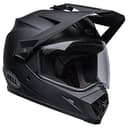
- MIPSis a low-friction layer between your head and the liner, designed to let the shell rotate a few millimetres independently of your skull. The Bell Qualifier DLX MIPS puts it in a sub-$200 helmet and the MX-9 Adventure MIPS stacks it on top of ECE 22.06 — the only pick here with a rotational test and a rotational system. Our MIPS guide covers what it does and does not claim.
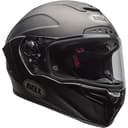
- Multi-density linersdo the same job with geometry. Bell’s Flex liner on the Race Star DLX Flex is three layers chosen to handle low, mid and high-energy impacts instead of one EPS density compromising between them.
Neither is a certification and we do not treat them as one. They are a published design feature, the same way a shell material is.
How we ranked these seven
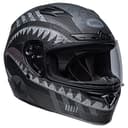
- The Race Star DLX Flex leads on the stack.DOT and SNELL on a 3K carbon shell, a three-layer Flex liner, and a published 1,540 g — the lightest helmet on this page despite carrying the heaviest certification. Bell is explicit that the airflow is race-tuned, which is a polite way of saying it is loud at 70 mph. Buy earplugs with it; see our earplugs guide.
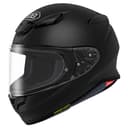
- The RF-1400 is the version of that you can tour in. DOT plus SNELL M2020D on Shoei’s hand-laid AIM+ shell at about 1,640 g, and genuinely quiet. It is the helmet we put first on our main helmet ranking for exactly that reason. Second here, not first, only because the Bell adds the multi-layer liner on top of the same cert pair.
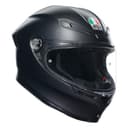
- The K6 S is the rotational answer. DOT plus ECE 22.06 by name on a carbon-aramid shell, and the lightest full-face we rank on weight. If the injury mechanism you are most worried about is the angled hit rather than the dropped kerb, this is the one standard that tested for it.
- The MX-9 Adventure MIPS is the cheapest way to get both. DOT, ECE 22.06 and a MIPS liner at a mid price. The trade is honest and published: a polycarbonate shell rather than a composite, and about 1,696 g, which you feel on a long day.
- The Qualifier DLX MIPS is the under-$200 pick.DOT FMVSS 218 plus the MIPS liner. One certification, not two — that is why it is fifth and not higher — but it is the cheapest helmet here doing anything at all about rotation.
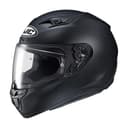
- The HJC i10 is the safest budget helmet we can name. DOT plus SNELL M2020 in a helmet that sits in the budget tier, which should not be possible and is. If you are shopping the bottom of the market, start here and read our budget ranking for the rest.
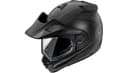
- The Arai XD-5 is the adventure answer.DOT plus SNELL M2025 — the newest SNELL revision — on a vacuum-formed Super Fiber shell in four shell sizes. Four shell sizes matters more than it sounds: a small head in a one-shell helmet is wearing an oversized shell with extra padding, and that is a fit problem, not a comfort one.
What actually makes your helmet safe, after you have bought it
Certification sets the ceiling. Fit decides how much of it you get. A SNELL-certified helmet in the wrong shell shape sits on your forehead instead of on your head, moves under braking and can come off in a crash; a DOT-only helmet that fits correctly outperforms it every time. Three things do more for your actual risk than moving up a certification tier:
- Get the head shape right first, then the size. Round, intermediate and long oval are real differences and they are published — see head shapes and sizing.
- Fasten it properly, every time. An unfastened or loose helmet is a statistic, not a helmet. Our guide on wearing a helmet correctly covers the roll-off check.
- Buy a new one, from a seller you can verify. Counterfeit DOT stickers are a real market. Our guide on spotting a fake helmet and the one on used gear cover what to check.
What we did not rank, and why
Any helmet by brand reputation.“Safest motorcycle helmet brands” is a popular search and it is the wrong question — certification is per model, not per badge. The same maker will sell you a DOT-only polycarbonate lid and a SNELL-certified composite one, and both have the same logo on the chin bar.
Modular helmets, with one exception.A flip-front has a hinge where a full-face has a single moulding, and most modulars publish certification for the closed position only. The exception is dual-homologated P/J models such as the Shoei Neotec 3, which is rated with the chin bar up as well as down — covered on our modular ranking and in modular versus full-face. If you want the most certification per dollar, buy a full-face.
Open-face helmets, by definition. A 3/4 helmet can be fully DOT-certified and still leave your jaw exposed, which is why it is a separate ranking rather than a low rank here. We argue that trade honestly on open-face versus full-face instead of pretending the two compete on this page.
SHARP and MotoCAP scores.Both are real, independent and worth reading — and both rate the market they test in. We will not map a SHARP score for a UK model variant onto a US listing and present it as a rating for the helmet you can buy, because the shells, liners and sizes sold under one model name are not always the same product.