Apex & Armor

Best Dual-Sport & Adventure Helmets

Peak-and-goggle helmets for riders who split the day between highway miles and dirt — compared on certification, weight, airflow and how well each one works in all three configurations.

By Stephen V.Last updated How we research

An adventure helmet is asked to do three incompatible jobs. On the highway it needs to be aerodynamically stable and quiet enough to tolerate for four hours. Standing on the pegs at 15 mph in the dirt it needs to flow enough air that you don’t overheat, because at that speed almost nothing is moving through the vents. And it needs to accept goggles when the visor fogs or the dust gets bad. The peak — the visor on top — is what makes the third job possible and the first job harder, because it catches wind.

The good ADV helmets are the ones that let you delete what you aren’t using: peak off for the highway, shield off for goggles, or all of it on for mixed days. The mediocre ones bolt a peak onto a street helmet and call it adventure. Below we’ve ranked on certification first, then on how genuinely modular each one is, then on weight — which matters more here than anywhere else, because a peak acts as a lever on your neck every time you turn your head at speed.

As always: we have not crash-tested any of these helmets and we don’t claim to have. Every certification below was read from the maker’s published specification or an authoritative retailer on a dated visit — see how we researchfor exactly what that process is and isn’t.

How this is funded: we earn a commission if you buy through our links, at no extra cost to you. It never changes which gear we recommend, and we’ll tell you plainly when to skip a pick. Full disclosure.

Quick picks

Ranked on certification, spec and buyer fit. Select a row to jump to the full write-up. We haven’t crash-tested this gear — here is exactly what we do instead.

#GearBest forPrice
1
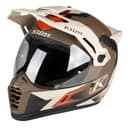
KLIM Krios Pro

KLIM Krios Pro

DOT + ECE

The adventure helmet that actually works in all three configurations — peak on, peak off, shield or goggles. Carbon shell, ECE and DOT certification, and airflow tuned for standing on the pegs at low speed.

Best overall
$449.99 · View on Amazon

Price as of September 4, 2026. #ad How we’re funded

2
Arai XD-5

Arai XD-5

DOT + SNELL M2025

The only dual-sport helmet here carrying a SNELL rating on top of DOT. Arai's hand-laid Super Fiber shell and four shell sizes make it the reference adventure lid — and it is priced like one.

Best certified (SNELL)
$1,039.95 · View on Amazon

Price as of September 4, 2026. #ad How we’re funded

3
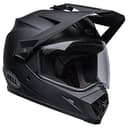
Bell MX-9 Adventure MIPS

Bell MX-9 Adventure MIPS

DOT + ECE 22.06

The value benchmark for adventure helmets: DOT and ECE 22.06 certification plus a MIPS rotational-management liner at a mid price. Heavy at roughly 1,696 g, but nothing else certified to 22.06 costs this little.

Best value
$249.95 · View on Amazon

Price as of September 4, 2026. #ad How we’re funded

4
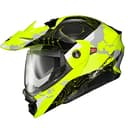
ScorpionEXO AT960

ScorpionEXO AT960

DOT + ECE

A modular adventure helmet — flip-front convenience with the peak and the goggle-friendly eyeport of an ADV lid. DOT and ECE approved, and the most versatile single helmet on this page.

Best modular ADV
$191.00 · View on Amazon

Price as of September 4, 2026. #ad How we’re funded

5
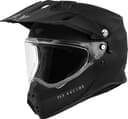
Fly Racing Trekker

Fly Racing Trekker

DOT + ECE

The budget way into a certified adventure helmet. FLY lists it as DOT (FMVSS 218) and ECE approved with a dual-density EPS liner — the same structural ideas as the expensive lids, in a polymer shell.

Best budget
$229.95 · View on Amazon

Price as of September 4, 2026. #ad How we’re funded

The picks in full

#1Best overallDOT + ECE

KLIM Krios Pro

The adventure helmet that actually works in all three configurations — peak on, peak off, shield or goggles. Carbon shell, ECE and DOT certification, and airflow tuned for standing on the pegs at low speed.

Strengths

  • ECE + DOT certified carbon fiber shell
  • Genuinely modular: peak, shield and goggle configurations all supported
  • Ventilation designed for low-speed off-road work, where most ADV lids suffocate you

Trade-offs

  • Premium price, and the peak still generates lift at highway speed
  • KLIM doesn't publish a single weight figure across all shell sizes
Safety standardDOT + ECE
ConstructionCarbon fiber shell
Claimed weightCheck current listing
Key featureDOT + ECE, carbon shell
Fit / sizingIntermediate oval; 3 shell sizes
Best forADV riders who alternate between highway miles and slow technical dirt

Specs and certification read from the manufacturer and retailer listing, on August 11, 2026. “Check current listing” means the maker doesn’t publish that figure — we won’t guess it.

#2Best certified (SNELL)DOT + SNELL M2025

Arai XD-5

The only dual-sport helmet here carrying a SNELL rating on top of DOT. Arai's hand-laid Super Fiber shell and four shell sizes make it the reference adventure lid — and it is priced like one.

Strengths

  • SNELL M2025 certified and DOT approved — the strongest cert pair in this category
  • Vacuum-formed Super Fiber shell in four sizes; Arai claims 30% stronger than fiberglass
  • Peak and shield both removable for goggle or street configurations

Trade-offs

  • By far the most expensive dual-sport helmet in this roundup
  • About 1,683 g — the SNELL shell isn't the lightest way to cover your head
Safety standardDOT + SNELL M2025
ConstructionSuper Fiber (PB-cLc2) shell
Claimed weight1,683 g
Key featureDOT + SNELL M2025
Fit / sizingRound oval; 4 shell sizes
Best forLong-distance ADV riders who want the top-tier voluntary certification

Specs and certification read from the manufacturer and retailer listing, on August 11, 2026. “Check current listing” means the maker doesn’t publish that figure — we won’t guess it.

#3Best valueDOT + ECE 22.06

Bell MX-9 Adventure MIPS

The value benchmark for adventure helmets: DOT and ECE 22.06 certification plus a MIPS rotational-management liner at a mid price. Heavy at roughly 1,696 g, but nothing else certified to 22.06 costs this little.

Strengths

  • DOT + ECE 22.06 certified — tested under the newer rotational-impact protocol
  • MIPS low-friction layer included at this price point
  • Peak, shield and goggle-ready configurations all supported

Trade-offs

  • About 1,696 g — noticeably heavy on a long day
  • Polycarbonate shell rather than a composite; that's where the price saving comes from
Safety standardDOT + ECE 22.06
ConstructionPolycarbonate shell
Claimed weight1,696 g
Key featureDOT + ECE 22.06 + MIPS
Fit / sizingIntermediate oval; MIPS liner
Best forADV riders who want ECE 22.06 and MIPS without spending flagship money

Specs and certification read from the manufacturer and retailer listing, on August 22, 2026. “Check current listing” means the maker doesn’t publish that figure — we won’t guess it.

#4Best modular ADVDOT + ECE

ScorpionEXO AT960

A modular adventure helmet — flip-front convenience with the peak and the goggle-friendly eyeport of an ADV lid. DOT and ECE approved, and the most versatile single helmet on this page.

Strengths

  • DOT + ECE approved with a flip-front chin bar
  • Removable peak and a drop-down internal sun visor
  • Bluetooth-ready speaker pockets sized for a full intercom

Trade-offs

  • The flip hinge adds weight over a one-piece ADV helmet
  • Scorpion doesn't publish a weight for this model
Safety standardDOT + ECE
ConstructionPolycarbonate shell
Claimed weightCheck current listing
Key featureDOT + ECE, modular ADV
Fit / sizingIntermediate oval; removable peak
Best forADV riders who also commute and want to flip the chin bar at every stop

Specs and certification read from the manufacturer and retailer listing, on August 11, 2026. “Check current listing” means the maker doesn’t publish that figure — we won’t guess it.

#5Best budgetDOT + ECE

Fly Racing Trekker

The budget way into a certified adventure helmet. FLY lists it as DOT (FMVSS 218) and ECE approved with a dual-density EPS liner — the same structural ideas as the expensive lids, in a polymer shell.

Strengths

  • DOT FMVSS 218 + ECE approved at a genuine budget price
  • Dual-density EPS: a softer and a firmer layer for progressive impact absorption
  • Peak and shield both removable for goggle use

Trade-offs

  • Published weights vary between listings, so treat any figure as unconfirmed
  • Polymer shell and basic vent hardware — it feels its price in the details
Safety standardDOT + ECE
ConstructionPoly-alloy shell
Claimed weightCheck current listing
Key featureDOT + ECE, dual-density EPS
Fit / sizingIntermediate oval; goggle-friendly eyeport
Best forNew ADV riders and dual-sport commuters on a tight budget

Specs and certification read from the manufacturer and retailer listing, on August 11, 2026. “Check current listing” means the maker doesn’t publish that figure — we won’t guess it.

How to choose a dual-sport helmet

Start with an honest split of how you actually ride. A rider doing 80% pavement and 20% gravel roads wants something closer to a touring helmet with a removable peak. A rider doing genuine technical dirt wants maximum airflow and goggle compatibility and will accept highway noise as the price. Almost nobody needs a full motocross helmet with no shield — that’s a different category and a different roundup.

The peak is a lever

At highway speed a peak generates lift and, more annoyingly, torque when you turn your head across the airflow. Better ADV helmets shape the peak with slots or a wing profile to bleed pressure; the best ones let you remove it in under a minute with a coin or a thumbscrew. If you regularly ride above 70 mph, treat peak removability as a hard requirement rather than a nice-to-have.

Low-speed airflow is the real differentiator

Any helmet flows air at 70 mph. Almost none flow air at 15 mph with your visor down, which is exactly when you’re working hardest standing on the pegs. This is where the expensive ADV helmets earn their money: large chin-bar intakes, a wide-open brow vent path and exhaust ports positioned to pull air through rather than just letting it in. If you ride technical terrain in heat, this single factor matters more than shell material.

Goggles or shield

Every helmet here supports both, but the eyeport geometry decides how well. A tall, squared-off eyeport swallows a goggle frame without pressure on the nose; a narrow street-shaped one will pinch. If you expect to run goggles regularly, check the eyeport shape before the spec sheet.

Certification, honestly

Every helmet on this page is DOT-certified because FMVSS 218is legally required for on-road sale in the US. Beyond that they diverge: the Bell MX-9 Adventure and KLIM Krios Pro add ECE, and the Arai XD-5 carries a SNELL rating on top of DOT — the only helmet here that does. SNELL is voluntary and not required anywhere for street riding, so treat it as evidence the shell cleared a demanding protocol rather than as a pass/fail line.

Weight, and why we publish blanks

Where a maker publishes a shell weight, we list it. Where they don’t — and several here don’t, because ADV weights vary a lot between shell sizes and peak configurations — the spec table says “Check current listing” rather than a number we invented. That blank is deliberate; it’s the honest answer, and it’s more useful than a plausible guess.
How to read our safety notes. We have not crash-tested any of this gear — nobody honestly can on a review budget. Every helmet and armor pick names the certification the maker publishes (DOT, ECE 22.06, SNELL, or a CE level), which we read from the listing on a dated visit. Certification is the floor, not a guarantee; fit and condition matter as much as the sticker. What the standards actually mean.

Frequently asked questions

What's the difference between a dual-sport helmet and a motocross helmet?

A dual-sport (adventure) helmet has a face shield and is designed to be street-legal and tolerable at highway speed; a motocross helmet has an open eyeport with no shield and expects goggles at all times. MX helmets flow far more air and weigh less, but they're miserable above about 50 mph and offer no eye protection on their own. If any part of your ride is on pavement at speed, you want a dual-sport helmet.

Can I remove the peak on an adventure helmet for highway riding?

On every helmet in this roundup, yes — the peak is designed to come off, usually with a coin or thumbscrews in a minute or two. It's worth doing on long highway legs: the peak generates lift and, more noticeably, side loading on your neck when you turn your head across the airflow. Some riders remove the peak and run the helmet as a plain full-face for the transit sections, then refit it for the dirt.

Do adventure helmets work with goggles?

All of these do, but the eyeport shape decides how comfortably. ADV helmets use a taller, squarer eyeport than street helmets specifically to clear a goggle frame without pressing on the bridge of your nose. If goggles are part of your normal setup rather than an emergency backup, check the eyeport dimensions and the strap channel at the back before you commit.

Are adventure helmets louder than street helmets?

Generally yes. The peak creates turbulence, the larger eyeport is harder to seal, and the big vents that make low-speed riding bearable are noise paths at speed. Removing the peak helps noticeably. Earplugs help more — and they're the single cheapest improvement to any long day on any helmet.

Is a SNELL-rated ADV helmet worth the extra money?

SNELL is a voluntary independent standard that's tougher than the DOT minimum, and only one helmet here carries it. It is not required for street riding anywhere in the US, and plenty of excellent adventure helmets carry only DOT or DOT plus ECE. If you want the most heavily tested shell available and the price isn't the constraint, it's a real credential. If it is the constraint, a well-fitting DOT+ECE helmet is a sound choice — fit matters more than a certification badge you didn't need.

Sources

Keep reading

More in Helmets