What CE EN 13594 is, and why its absence matters here
EN 13594 is the European standard for motorcycle gloves. A certified glove has been tested for abrasion, cut, tear and seam strength and — where the maker claims it — impact at the knuckle, which is what the “KP” suffix means. Level 1 is the street tier and Level 2 is the higher one. The standard is voluntary everywhere and legally irrelevant in the US, which is exactly why the budget end of the market ignores it: testing costs money and no regulator is asking.
That leaves you reading construction instead of certificates, and the useful signals are narrower than the marketing suggests:
| Signal | What it tells you | What it does not |
|---|
| Named leather | Goatskin, cowhide or full-grain goat named on the listing is the strongest cheap signal there is. Leather abrades rather than melts, and it is the panel between your palm and the asphalt | Nothing about seam strength — a good panel stitched badly bursts at the seam, which is one of the things EN 13594 actually tests |
|---|
| A hard knuckle protector | A molded shell over the knuckles, as opposed to a foam pad. All seven picks here publish one | Any impact figure. “Hard knuckle” is a description of shape, not a test result. Only a KP-rated glove has a number behind it |
|---|
| A named membrane | Drystar, GORE-TEX, Aqua-barrier — a name means the maker is standing behind a specific laminate | “Waterproof” or “water-resistant” with no name is a coating claim, and coatings wet out |
|---|
| Cuff and closure | Whether the glove will stay on. A gauntlet over the jacket cuff or a properly cinched short cuff is the difference between a glove and a mitten on the road | Nothing about the rest of the glove — but a glove that comes off in a slide protects nothing, which makes this the most under-rated spec in the category |
|---|
The honest hierarchy of cheap gloves
Three tiers exist below the certification line, and conflating them is how riders end up disappointed:
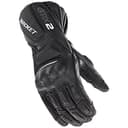
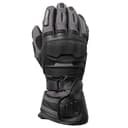
- Cheap leather with a hard knuckle— the Joe Rocket GPX 2.0. Real abrasion material, real knuckle hardware, no certificate. This is the tier to buy from if these are your only gloves.
- Cheap purpose-built gloves — summer mesh, winter insulated, waterproof — the Fly Racing CoolPro, the ILM winter glove, the Tourmaster Super-Tour. Each trades something away to do one job well. Mesh trades abrasion coverage for airflow; insulation trades dexterity for warmth. Buy these as a second pair, not a first.
- Marketplace armored gloves under twenty dollars — the Kemimoto and Scoyco pairs. Knuckle protection and touchscreen fingers for spare-change money, with budget materials and entry-level durability. These are a spare in the top box or the gloves you keep for a passenger. Treating them as your main pair is the one mistake this page is written to prevent.
One number worth sitting with: the gap between the cheapest glove here and the cheapest certified glove is smaller than the gap between most riders’ helmet and their next helmet. Hands hit the ground in a large share of low-speed crashes because putting them out is reflexive, and unlike a jacket there is no armor pocket to upgrade later. Our gear cost guide prices a full head-to-toe set if you are working out where the money should go first.
How we ranked these seven
- The Joe Rocket GPX 2.0 leads because it is leather, and nothing else at the price is. Goatskin on the palm and the back with a hard knuckle protector, at a price where most of the market is synthetic textile. The honest limits: a short cuff with a basic wrist closure, warmer than mesh in July, and no published EN 13594 rating. It is also a pick on our main glove ranking and the beginner page, because the value argument does not change with the audience.
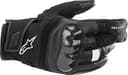
- The Alpinestars SMX-Z Drystar is here as the line, not as a budget glove. It publishes CE EN 13594:2015 Level 1 KP and a named Drystar membrane, with full-grain goat leather at the palm and impact zones, a nylon hard knuckle and touchscreen index and thumb. It is the cheapest glove in our registry that publishes a certification at all, which is the only reason a mid-tier glove appears on a budget page: if you want a certificate, this is what it costs. It is Level 1 rather than Level 2, the short wrist closure covers less of the joint than a gauntlet, and there is no insulation — waterproof is not warm.
- The Fly Racing CoolPro Mesh is the cheap summer answer, with the trade stated. A mesh back that genuinely moves air on the hottest days, knuckle protection and a touchscreen fingertip at a value price. Mesh trades abrasion coverage for airflow — that is the deal, not a defect — and the short cuff gives you little wind protection. It leads our summer glove ranking for the same reasons.
- The ILM Winter Waterproof is the cheapest glove that keeps a commute going into the cold. Waterproof and insulated with a hard knuckle and a touchscreen fingertip, at a price well below the certified waterproof options. Two honest costs: insulation makes it bulky and less dexterous on the controls, and it is a shoulder-season glove rather than a deep-winter one. If your hands genuinely stop working, heated gloves are the answer and insulation is not.
- The Tourmaster Super-Tour is the budget entry to a category where the budget entry is usually junk. Genuine goat leather on the backhand, palm and overlays, an Aqua-barrier waterproof breathable membrane rather than a coating, SuperFabric overlays on the knuckle, fingers and heel, and a waterproof zippered cuff gusset. The reason it is not higher is the one we keep naming: no CE EN 13594 rating is published for it anywhere we could find, so it has to be judged on construction. The molded knuckle is also softer than the polycarbonate and carbon shells on the premium adventure gloves in our ADV ranking.
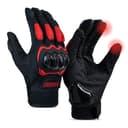
- The Kemimoto summer glove is the cheapest thing on this page we are willing to call a motorcycle glove. Hard knuckle protection, palm padding, breathable and touchscreen compatible, for sub-twenty-dollar money. Budget materials mean limited abrasion coverage and entry-level durability, and it runs small — size up. Buy it as a backup pair or because the alternative today is riding bare-handed, which is the comparison that matters.
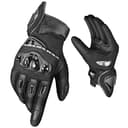
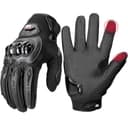
- The Scoyco full-finger glove is the spare pair, described as exactly that. Knuckle protection and touchscreen fingertips at about as little as an armored glove costs, breathable for warm weather, with minimal abrasion protection and budget durability. Keep it in the top box for the day you forget your real gloves. It is not a substitute for leather on a serious ride and we are not going to dress it up as one.
What we did not rank, and why
The KLIM Badlands GTX, which would have been the certified counterexample. It publishes EN 13594:2015 KP Level 1 with GORE-TEX and a carbon knuckle, and it was excluded on availability: on the day this page was written the listing we link to read “only 1 left”, which is below the stock bar we hold new picks to. It remains ranked on the adventure-touring page.
Every “CE-rated” glove with no standard named. A listing that says “CE armor” or “CE approved” without naming EN 13594 and a level is making a claim we cannot check, and our registry records those gloves with a null certification field rather than a guess. That is why several cheap gloves you will see advertised as certified are not described that way here. Our guide to glove certification covers how to read the claim on a listing.
Fingerless and “half” gloves. There are cheap ones and we rank none of them. A fingerless glove leaves the part of the hand most likely to be broken uncovered, and the cost saving against a full-finger glove at this end of the market is a few dollars.