Motorcycle Glove CE Ratings Explained (EN 13594)
Of the 24 motorcycle gloves in our registry, four publish a CE EN 13594 rating. Every one of those four is Level 1. Here is what the standard tests, and how to read a listing that does not mention it.
How this is funded: we earn a commission if you buy through our links, at no extra cost to you. It never changes which gear we recommend, and we’ll tell you plainly when to skip a pick. Full disclosure.
Gloves are the one piece of motorcycle gear with no US standard behind them at all. Helmets have DOT FMVSS 218, which is a legal requirement for on-road sale. Gloves have nothing — so a maker can print “protective”, “armored” or “reinforced” on a listing with no obligation to have tested anything. EN 13594 is the standard that fills that gap, and the honest headline is how rarely it appears: four of the 24 gloves in our registry publish an EN 13594 rating, and all four are Level 1.
What EN 13594 actually tests
It is a materials-and-construction standard, not a crash simulation. A certified glove has been through laboratory tests in four areas, plus one optional fifth:
| Test | What it is measuring | Why it matters on the road |
|---|---|---|
| Abrasion resistance | How long the material survives against an abrasive surface before it is breached | This is the main event for gloves. A hand sliding on asphalt is an abrasion problem long before it is an impact problem |
| Cut resistance | How readily the material is cut through | Road debris, glass and sharp edges on the bike or the barrier you slid into |
| Tear strength | How much force it takes to propagate a tear once the material is nicked | A glove that tears open in the first metre stops protecting for the rest of the slide |
| Seam strength | Whether the stitching holds when the panels are loaded | The most under-rated spec in the category. Excellent leather stitched badly bursts at the seam, and cheap gloves fail here first |
| Knuckle impact (optional — “KP”) | Impact attenuation at the knuckle protector | The difference between a tested protector and a molded plastic lump. A glove can be certified without this test |
Two levels exist. Level 1 is the street tier and Level 2 sets higher thresholds on the same tests, which in practice means heavier, stiffer gauntlets aimed at track and fast-road use. The registry finding is worth repeating: we do not currently track a single glove that publishes Level 2. Every certified glove we rank is Level 1 KP.
What a certified glove looks like in practice
Here is the cheapest glove in our registry that publishes a rating, so you can see what the certificate costs. This is the one we point at on the budget page as the line you cross when certification becomes non-negotiable.
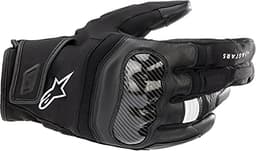
The cheapest certified glove we track
Alpinestars SMX-Z Drystar
CE EN 13594:2015 Level 1 KPThe cheapest glove we found that publishes both halves of the job: a CE EN 13594 2015 Level 1 KP certification and a named waterproof membrane. Full-grain goat leather at the palm and impact zones, a nylon hard knuckle, a hook-and-loop wrist closure and touchscreen index and thumb. For all-day mixed-weather touring this is the sane default, and Alpinestars' own more expensive adventure glove cannot match it on paper.
See the adventure & touring rankingPrice as of October 10, 2026. #ad How we’re funded
It publishes CE EN 13594:2015 Level 1 KPand a named Drystar membrane, with full-grain goat leather at the palm and impact zones and a nylon hard knuckle. Note what the certificate does not cover: the short hook-and-loop wrist closure protects less of the joint than a gauntlet, and there is no insulation at all — waterproof and warm are different claims, and this glove only makes one of them.
The women’s market makes this gap wider rather than narrower, which is why the one certified women’s-pattern glove we track is worth naming explicitly:
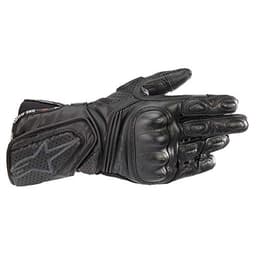
The certified women's-pattern glove
Alpinestars Stella SP-8 V3
CE EN 13594:2015 Level 1 KPThe rare women's glove that is a women's glove rather than a small men's one: goat-leather palm, molded hard knuckle, Arshield palm reinforcement, and a published CE EN 13594 Level 1 KP rating. Most of the women's market cannot say the last part.
See the women's glove rankingPrice as of October 10, 2026. #ad How we’re funded
Same standard, same level, cut on a women’s hand pattern rather than scaled down from a men’s one. It costs roughly four times what the unrated women’s leather gloves do, and that multiple is the honest price of a certificate in a part of the market with far smaller volumes.
How to judge a glove that publishes nothing
Most gloves, including good ones. With no certificate you are reading construction, and four signals carry almost all the information:
- Named leather.“Goatskin”, “cowhide”, “full-grain goat” — a specific material the maker is standing behind. “Premium material” and “durable fabric” are not materials.
- A hard knuckle you can see.A molded shell, not a foam pad under fabric. Remember that without the KP marking there is no test result behind it — but shape still beats no shape.
- A closure that keeps the glove on. A cinched wrist strap at minimum, a gauntlet over the jacket cuff for fast or wet riding. A glove that leaves your hand protects nothing, which makes this the most important uncertified spec there is.
- A named membrane, if it claims to be waterproof.Drystar, GORE-TEX, Aqua-barrier. Unnamed “waterproof” is a coating, and coatings wet out.
The best uncertified glove we rank is a useful illustration, because it is better built than several certified ones and we still rank it below them:
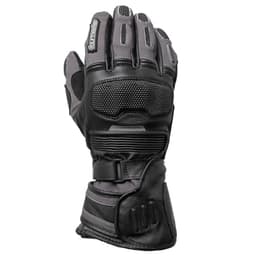
Well built, no certificate — judged on construction
Tourmaster Super-Tour Waterproof Adventure
The budget entry to a category where the budget entry is usually junk. Genuine goat leather backhand, palm and overlays, an Aqua-barrier waterproof breathable membrane, a 3D molded knuckle protector, SuperFabric overlays on the knuckle, fingers and heel, and a waterproof zippered cuff gusset — for a fraction of the Badlands price. No CE rating is published for it, which is the honest reason it is not ranked higher.
See how it ranks against the certified glovesPrice as of October 10, 2026. #ad How we’re funded
Genuine goat leather on the backhand, palm and overlays, an Aqua-barrier waterproof breathable membrane rather than a coating, SuperFabric overlays exactly where a hand lands, and a waterproof zippered cuff gusset — for a fraction of what the certified premium adventure gloves cost. No EN 13594 rating is published for it anywhere we could find, and that is the honest reason it is not ranked higher. A molded knuckle is also softer than the polycarbonate and carbon shells the certified KLIM gloves use.
The three claims to distrust on a glove listing
- “CE approved” with no standard named.CE is a conformity marking that covers many standards, several of which have nothing to do with motorcycling. Without “EN 13594” and a level, the phrase tells you nothing. Our registry records a null certification for these gloves rather than repeating the claim — the site says “Check current listing”, which is the truthful answer.
- “CE Level 1 armor” on a glove.This is usually EN 1621 language — the armor standard — borrowed onto a glove where it does not belong. EN 1621-1 covers limb protectors like knee and elbow armor. Gloves are EN 13594. Our armor ratings guide covers the EN 1621 family properly.
- “Rating pending”.At least one glove in our registry has its EN 13594 rating listed as pending by the maker, which is more honest than most but is not a rating. Treat it as uncertified until the number appears.
What this means for buying
A certificate is worth paying for and it is not the only thing worth paying for. The practical order we would put the decisions in: fit first, because a glove that bunches or slides is a glove you take off; then material and closure, because they decide whether the glove is still on your hand and still intact after the first second; then certification, because it converts the first two from a judgement into a measurement. Where a certified glove exists in the category you need, buy it. Where one does not — which on current evidence is most of the budget market, all of the heated market and almost all of the women’s market — read the construction and know what you are accepting. Our glove buying guide covers cuff length and fit, and gauntlet versus short cuff covers the retention question in detail.
How to read our safety notes. We have not crash-tested any of this gear — nobody honestly can on a review budget. Every helmet and armor pick names the certification the maker publishes (DOT, ECE 22.06, SNELL, or a CE level), which we read from the listing on a dated visit. Certification is the floor, not a guarantee; fit and condition matter as much as the sticker. What the standards actually mean.
Frequently asked questions
What does CE EN 13594 mean on motorcycle gloves?
EN 13594 is the European standard for protective gloves for professional motorcycle riders. A certified glove has been tested in a laboratory for abrasion resistance, cut resistance, tear strength and seam strength, with a separate optional test for impact at the knuckle. There are two performance levels — Level 1 is the street tier and Level 2 is the higher one — and a glove certified with the knuckle impact test carries the suffix 'KP'. It is the only part of a glove description that is a test result rather than a marketing word.
What is the difference between Level 1 and Level 2 gloves?
They are the same tests at different performance thresholds — Level 2 requires more from the glove on abrasion, cut, tear and seam strength than Level 1 does. In practice Level 2 gloves tend to be heavier, stiffer gauntlets built for track and fast-road use, and Level 1 covers the large majority of certified street and touring gloves. Worth knowing: of the four gloves in our registry that publish an EN 13594 rating, all four are Level 1. We do not currently track a single glove that publishes Level 2, which tells you how uncommon the higher tier is in the US market.
What does KP mean on a motorcycle glove?
KP stands for knuckle protector, and it means the glove was tested for impact protection at the knuckles as part of its EN 13594 certification. The knuckle impact test is optional within the standard, so a glove can be EN 13594 certified without it. That matters because 'hard knuckle' on a listing is a description of a shape, not a test result — any molded plastic lump qualifies. 'KP' is the version with a number behind it. All four certified gloves in our registry carry the KP marking.
Are CE ratings required on motorcycle gloves in the US?
No. There is no US legal standard for motorcycle gloves at all — nothing equivalent to DOT FMVSS 218, which is a legal requirement for helmets sold for on-road use. EN 13594 is a European standard and it is voluntary even in Europe for gear sold as general apparel rather than personal protective equipment. That combination — voluntary standard, no US regulator, real testing cost per pattern — is why most gloves on sale in the US publish nothing, and why a published rating is a genuine signal rather than a formality.
Is an uncertified motorcycle glove worth buying?
Often yes, and you have to judge it differently. With no certificate you are reading construction: named leather rather than 'premium material', a hard knuckle protector you can see, a closure that will keep the glove on your hand in a slide, and a named membrane if it claims to be waterproof. A goatskin glove with a molded knuckle and a cinched wrist is a genuinely useful piece of kit. What it is not is equivalent to a certified glove, and a listing that says 'CE approved' without naming EN 13594 and a level is making a claim nobody can check.
Why do so few motorcycle gloves have a CE rating?
Cost per pattern against a standard nobody is enforcing. Certification is a laboratory process paid for per glove design, so a maker with a dozen patterns across men's, women's, summer and winter lines is looking at a dozen test programmes — for a market where no retailer requires the rating and most buyers have never heard of it. The makers who do certify tend to be the ones selling into European markets where the rating is a competitive expectation, which is why the certified gloves in our registry are all from large international brands rather than marketplace sellers.
Does a CE rating mean a glove will not come off in a crash?
No — and this is the gap riders most often miss. EN 13594 tests the glove's materials and seams and, optionally, the knuckle impact. Retention is only partly addressed: the standard includes requirements intended to keep the glove on, but no certificate can account for a wrist closure you left loose. A glove that leaves your hand in the first metre of a slide protects nothing, regardless of what it is certified to. Cinch the wrist strap properly every time, and prefer a gauntlet over the jacket cuff for fast or wet riding.
Where do I find the CE rating on a glove?
On the label sewn inside the cuff, or on the maker's own specification page — not usually in the marketplace listing title. The label will carry the standard number, the year, the level and the KP marking if the knuckle was tested, for example 'EN 13594:2015 Level 1 KP'. If the maker's own product page does not state it, assume it is not certified: a brand that has paid for testing puts the result in the specification block. Our registry records the exact published wording for each glove, and records a null value rather than a guess where nothing is published.
Sources
- Alpinestars — SMX-Z Drystar Glove (published spec sheet via RevZilla) — Alpinestars' published SMX-Z Drystar spec sheet: "CE EN 13594 2015, Level 1 KP safety certification", "Waterproof Drystar performance technology membrane for breathable all-weather protection", "Full grain goat leather palm and impact zones", "Suede side hand reinforcements", "Nylon hard knuckle", "Hook and loop wrist closure", "Touchscreen compatible index finger and thumb", sizes SM-3XL. Read from an authoritative retailer because the alpinestars.com product URL for this model returned 404 on this date (accessed September 10, 2026)
- KLIM — Badlands GTX Long Glove (CE Certified) — KLIM's published Badlands GTX Long specs: "CE Level 1 KP rating certified to EN 13594", "GORE-TEX + GORE Grip Technology" with the "GUARANTEED TO KEEP YOU DRY" promise, "Goat leather construction", "60 Grams 3M Thinsulate insulation on backhand", "Polycarbonate knuckle guard with XRD Impact Protection Foam", ceramic print in the knuckle, palm pad and gauntlet cuff pad, MULT-E-TOUCH screen functionality, sizes SM-3X. KLIM carries the certification in the product name itself (accessed September 10, 2026)
- KLIM — Adventure GTX Short Glove — KLIM's published Adventure GTX Short specs: "CE CERTIFIED TO EN13594:2015, KP LEVEL 1", "GORE-TEX + GORE GRIP", "GOAT LEATHER/STRETCH WOVEN CONSTRUCTION", "SHORT DESIGN FOR UNDER-CUFF USE", "CARBON FIBER KNUCKLE PROTECTOR", "PORON XRD PALM UNDER CARBON FIBER KNUCKLE PROTECTOR", "3D SILICONE FINGER PADS", "CERAMIC PRINT IN SLIDE AREAS", MULT-E-TOUCH functionality, sizes SM-3X. No insulation is listed (accessed September 10, 2026)
- KLIM — Baja S4 Glove — KLIM's published Baja S4 specs: the certification line reads "Pending CE Level 1 KP rating certified to EN 13594" — pending, not granted. Also "Perforated goat leather palm and fingers for airflow", "KARBONITE micromesh 500D 4-way stretch nylon backhand/thumb", "3D mesh backhand for airflow with temper foam for protection", "TPU vented knuckle & palm pad", "Perforated 3mm XRD Impact Protection Foam thumb & palm base pad", "Perforated 5mm XRD wrist pad", MULT-E-TOUCH functionality, sizes SM-3X (accessed September 10, 2026)
- Tourmaster — Super-Tour ADV Waterproof Gloves (published spec sheet via MotorcycleGear.com) — Tourmaster's published Super-Tour Waterproof Adventure spec sheet: "Aqua-barrier waterproof, breathable membrane inside keeps you dry", "Genuine goat leather backhand, palm, and overlays", "3D Molded knuckle protector", "Superfabric overlays on knuckle, fingers and heel", "Dual hook and loop adjustable wrist closure", "Waterproof zippered cuff gusset", "Touchscreen-compatible index finger and thumb", "3M Scotchlite Reflective accents", sizes S-3XL. No CE certification is published; read from an authoritative retailer because the tourmaster.com product URL returned 404 on this date (accessed September 10, 2026)
- Alpinestars — Andes V3 Drystar Glove — Alpinestars' published Andes V3 Drystar glove specs: "Goat leather and textile construction", "Drystar waterproofing: 5000mm waterproof protection", "Breathability: 5000g/m2", "Viscoelastic protective armor on the knuckles", "Reflective panels for improved visibility", "Touchscreen-compatible fingertips", sizes S, M, L, XL, 2XL, 3XL. No CE EN 13594 certification is published anywhere on the page (accessed September 10, 2026)
Keep reading
Best budget motorcycle gloves
The page where this finding bites hardest: not one budget-tier glove in our registry publishes a rating.
See the budget picksBest motorcycle gloves
The main ranking, where certification and construction are weighted together.
See the main picksCE armor ratings explained
The EN 1621 family — limb, back, chest and airbag protectors — which is a different standard entirely.
Read the armor guideCE clothing classes explained
EN 17092 and the AAA to C garment classes, and why almost no jacket sold in the US publishes one.
Read the garment guideHow to choose motorcycle gloves
Cuff length, closure, palm construction and fit — the decisions certification does not make for you.
Read the buying guideBest adventure & touring gloves
Where three of the four certified gloves in our registry live, alongside the uncertified alternatives.
See the ADV picks