CE Clothing Classes Explained: AAA, AA, A, B and C (EN 17092)
EN 17092 grades the garment, not the armor inside it. Of the 27 jackets in our registry, exactly two publish a class — and both of them are the same brand.
How this is funded: we earn a commission if you buy through our links, at no extra cost to you. It never changes which gear we recommend, and we’ll tell you plainly when to skip a pick. Full disclosure.
There are three completely separate CE certificates that can appear on motorcycle clothing, and conflating them is the most common mistake riders make when reading a listing. EN 1621 grades the armor. EN 13594 grades gloves. EN 17092 grades the garment itself — the fabric and the seams between you and the road. This page is about the third one, which is both the most useful and the least often published.
The five classes
EN 17092 tests a finished garment on abrasion resistance, tear strength and seam strength, and sorts the result into one of five classes. The sub-part number you sometimes see — EN 17092-3, for instance — is the part of the standard that defines that class, which is why KLIM writes “CE AA rating certified to EN 17092-3” rather than just “AA”.
| Class | What it is for | What it means in practice |
|---|---|---|
| AAA (EN 17092-2) | The most demanding riding — the highest armored class | Heavy leather suits and the most substantial textile gear. Rare on general-sale gear, and heavy by design |
| AA (EN 17092-3) | Touring, adventure and sport-touring | The class most good adventure shells aim at. Both KLIM jackets we track and two of the pants sit here |
| A (EN 17092-4) | Urban, commuting and warm-weather garments | The lightest armored class. Where mesh and summer gear lands when it is certified at all |
| B (EN 17092-5) | Abrasion protection without provision for impact protectors | An abrasion layer with no armor pockets — a shirt or an underlayer. Not a lower rung of the A ladder |
| C (EN 17092-6) | Garments whose job is to hold impact protectors in place | Armored base layers and protector harnesses. No abrasion requirement at all — the armor is the product, the garment is the carrier |
The thing to take from that table is that B and C are not weaker versions of A. They describe different kinds of product, and a class-C armored shirt sitting under a textile jacket is doing exactly the job it was certified for. Our armored base layer page covers that category.
The registry finding: almost nothing publishes a class
We counted our own catalogue rather than guessing, and the result is stark.
- Jackets: 2 of 27.Only the KLIM Carlsbad and the KLIM Latitude publish an EN 17092 class on the maker’s own product page, and both are CE AA certified to EN 17092-3. Every other jacket we track publishes nothing — including premium jackets that ship with CE Level 2 armor inside them.
- Pants: 4 with a full class.The KLIM Carlsbad Pant and Baja S4 Pant publish CE AA to EN 17092-3; the Tourmaster Adventure Lite and Adventure Lite Mesh pants publish CE A to EN 17092-4. The Alpinestars Andes V3 Drystar pant publishes the words “CE-Certified Garment” and “A Class” without naming the standard, which we record as exactly that rather than tidying it into a class.
- Everything else: nothing.Which is why our spec tables so often read “Check current listing” in that field. That is the registry telling you the truth rather than filling a gap.
Note the direction of that gap: it is the pants that publish classes, not the jackets. Most riders buy an armored jacket first and treat lower-body gear as optional, so the one category where the published evidence is better is the one most people skip. That is worth knowing before you spend the next several hundred dollars on a jacket upgrade.
What a fully graded garment looks like
Here is the one pant in our registry where nothing had to be inferred — both certificates published, on the maker’s own page:
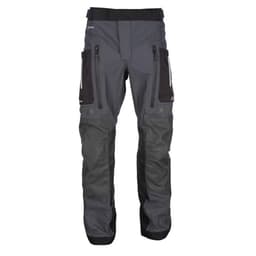
Both numbers published: AA garment, Level 2 armor
KLIM Carlsbad Pant
CE AA EN 17092-3 garment; KLIM Rogue CE Level 2 hip and knee armorThe pant that publishes both numbers this page shops on: a CE AA rating certified to EN 17092-3 for the garment, and KLIM Rogue CE Level 2 armor at the hip and the knee. The shell is a GORE-TEX Performance Shell laminate, so there is no drop liner to wet out, with 630D CORDURA twisted-yarn overlays in the abrasion zones and goat leather inside the knees. Expensive, and the only pant here where nothing had to be inferred.
See the full riding pants rankingPrice as of October 10, 2026. #ad How we’re funded
KLIM publishes a CE AA rating certified to EN 17092-3 for the garment and Rogue CE Level 2 vented hip and adjustable knee armor included in the box, over a GORE-TEX Performance Shell laminate with 630D CORDURA twisted-yarn overlays in the abrasion zones. It is also the most expensive pant we rank, no thermal liner is listed, and an adventure cut with full armor is more pant than a short commute needs. That is what the complete answer costs.
The same class is achievable without the waterproof membrane, which is the useful proof that the garment class and the weather protection are unrelated claims:
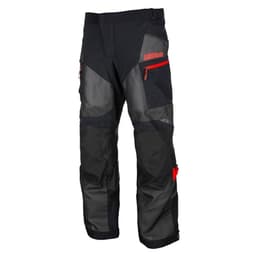
AA class with full-time mesh ventilation
KLIM Baja S4 Pant
CE AA EN 17092-3 garment; D3O CE Level 1 LP1 knee and hip armorA mesh pant with a CE AA rating certified to EN 17092-3, which is the combination hot-weather riders are told does not exist. KLIM gets there with a Schoeller-dynatec mesh chassis, KARBONITE micromesh stretch zones in 1000D CORDURA, SuperFabric on the knees and D3O CE Level 1 LP1 vented armor at the knee and hip. It has no weather protection at all by design; KLIM's own answer is the Enduro S4 overshell.
Compare it against the waterproof pantsPrice as of October 10, 2026. #ad How we’re funded
KLIM publishes CE AA to EN 17092-3 on a pant whose chassis is vented through Schoeller-Dynatec mesh panels, with SuperFabric on the knees and D3O CE Level 1 LP1 knee and hip armor. No membrane and no liner are listed at all. An AA-class garment that is also a hot-weather garment is the strongest available argument against “I cannot wear real gear in summer”.
And at the other end, the cheapest graded option we track:
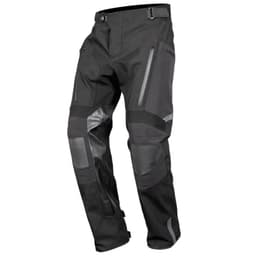
The cheapest published class: A, with Level 1 hip armor
Tourmaster Adventure Lite Pants
CE A EN 17092-4 garment; Armanox CE Level 1 hip and knee armorThe cheapest pant on this page that publishes a garment class — CE-certified A to EN 17092-4 — and it ships with Armanox CE Level 1 armor at both the hip and the knee, on a laminated 420D waterproof shell rather than a drop liner. That is a specification most pants at twice the price do not match line for line, and the reason a mid-price Tourmaster is ranked above better-known names.
See where it sits in the rankingPrice as of October 10, 2026. #ad How we’re funded
Tourmaster publishes CE A to EN 17092-4plus Armanox CE Level 1 hip and knee armor on a laminated 420D waterproof shell, at roughly a third of the KLIM’s price. A is the lowest of the three armored classes and the hip armor being included at all is unusual at this money — cheaper pants routinely give you knees and nothing else.
How to read a garment that publishes no class
Most of the market, so this is the skill that matters more. Four signals, in order of how much they tell you:
- Named fabric with a denier figure.“630D CORDURA”, “600D Carbolex with 1000D ripstop overlays”, “1.2 mm cowhide”. A maker who publishes a denier is a maker who knows what the fabric is. “Durable textile” is not a fabric.
- Overlays where a body lands. Shoulders, elbows, hips, outer knees, and the seat. Reinforcement panels in those five places are the cheap version of what an abrasion test measures.
- Armor included, with the EN 1621 level stated.Not “armor pockets”, not “CE armor” with no level. Our armor ratings guide covers reading that half of the label, and the foam-pad substitution that catches most riders out.
- Seams you can see.Double or triple stitching at the main structural seams. Seam strength is one of the three things EN 17092 tests and the thing cheap garments fail first — good fabric stitched badly bursts.
The trap: “CE approved” with nothing named
CE is a conformity marking covering hundreds of standards, most of which have nothing to do with motorcycling. A jacket listing that says “CE approved” or “CE certified” with no standard number is making a claim nobody can check, and it is frequently referring to the armor inside rather than the garment. What you want to see is a standard number and a class or level: “EN 17092-3, AA” or “EN 1621-1 Level 2”. Where our registry cannot find one, the field is null and the site says “Check current listing” — which is less satisfying than a number and more honest than inventing one. Our methodology page explains why we built it that way, and our jacket buying guide walks the rest of the decision.
How to read our safety notes. We have not crash-tested any of this gear — nobody honestly can on a review budget. Every helmet and armor pick names the certification the maker publishes (DOT, ECE 22.06, SNELL, or a CE level), which we read from the listing on a dated visit. Certification is the floor, not a guarantee; fit and condition matter as much as the sticker. What the standards actually mean.
Frequently asked questions
What does EN 17092 mean on a motorcycle jacket?
EN 17092 is the European standard for motorcycle protective garments — the jacket or pant itself, as distinct from the armor inside it. A certified garment is tested on abrasion resistance, seam strength and tear strength, and placed in one of five classes: AAA, AA, A, B or C. AAA is the highest and is aimed at the most demanding use; AA is the broad touring and adventure class; A is the lighter class typical of urban and warm-weather gear. B and C are special cases. The class appears on the garment's own label and on the maker's specification page — not usually in a marketplace listing title.
What is the difference between EN 17092 and EN 1621?
They cover different parts of the same jacket. EN 17092 grades the garment — how long the fabric and its seams survive against the road. EN 1621 grades the impact protectors: EN 1621-1 for limb armor at shoulders, elbows, hips and knees, EN 1621-2 for back protectors, EN 1621-3 for chest and EN 1621-4 for airbags. A jacket can carry CE Level 2 armor with no garment class at all, or an AA garment class with only Level 1 armor. They are separate certificates and one tells you nothing about the other.
What do the classes AAA, AA, A, B and C actually mean?
AAA, AA and A are the three armored classes, in descending order of required abrasion, tear and seam performance — AAA for the most demanding riding, AA for touring and adventure use, A for lighter urban and summer garments. Class B is a garment tested for abrasion but not designed to carry impact protectors — think an abrasion shirt with no armor pockets. Class C is the opposite: a garment whose job is to hold impact protectors in position, with no abrasion requirement of its own, which is what an armored base layer or an underarmour suit is. B and C are not steps on the same ladder as the A classes; they describe different products.
Is EN 17092 required in the US?
No. There is no US standard for motorcycle clothing at all, and EN 17092 is a European standard that applies to garments sold as personal protective equipment in that market. Nothing stops a maker selling an uncertified jacket in the US, and most do. That is why the class is a useful signal when it appears and why its absence is not evidence of a bad jacket — it is frequently evidence that the jacket was never submitted for testing, because no US retailer or regulator asked for it.
How many motorcycle jackets actually publish a CE class?
Very few. Of the 27 jackets in our own registry, exactly two publish an EN 17092 class on the maker's product page — the KLIM Carlsbad and the KLIM Latitude, both CE AA certified to EN 17092-3. Every other jacket we track publishes nothing, including several premium ones with CE Level 2 armor inside them. Pants are slightly better: four publish a class, two at AA and two at A. That ratio is the single most useful thing on this page, because it tells you that for most of the market you are buying construction and reputation rather than a tested grade.
Is an AA jacket twice as good as an A jacket?
No — the classes are performance bands, not a linear scale, and the step between them is not a multiple of anything. An AA garment has to survive more abrasion and hold its seams under more load than an A garment, which generally means heavier fabric, more overlay panels in the impact zones and more substantial stitching. The practical consequence is weight and heat: an AA adventure shell is a lot of jacket for a short commute in August, and an A-class mesh jacket you actually wear in 95°F weather protects you more than an AA shell left at home.
Does a CE class tell me if a jacket is waterproof?
Not at all. EN 17092 says nothing about water, wind, breathability or warmth — it is an abrasion, tear and seam standard. A GORE-TEX laminate and an AA class are two unrelated claims that happen to appear together on expensive adventure gear, because the same makers care about both. Read them separately: the class tells you about the crash, the membrane tells you about the weather. Our rain gear guide covers the waterproofing side, and the membrane names worth trusting.
What should I do if a jacket publishes no class?
Judge the construction, which is what you would be doing in most of the market anyway. Four signals carry most of the information: named fabric with a denier figure — 600D, 630D CORDURA — rather than 'durable textile'; overlay panels in the shoulders, elbows and hips where a body lands; armor included rather than empty pockets, with the EN 1621 level stated; and leather weight or a named laminate if the jacket claims either. A jacket with CE Level 2 armor, 630D overlays and no garment class is a real piece of kit. It is just not a graded one.
Sources
- KLIM — Carlsbad Jacket — KLIM's published Carlsbad Jacket specification: "GORE-TEX PERFORMANCE SHELL", "GUARANTEED TO KEEP YOU DRY", "CE AA RATING CERTIFIED TO EN 17092-3", "630D CORDURA TWISTED YARN OVERLAYS ON SHOULDERS, ELBOWS", "FPL400 MAIN CHASSIS FABRIC SAME AS BADLANDS PRO", "D3O CE LEVEL 2 LP2 PRO ELBOW/SHOULDER ARMOR INCLUDED", "D3O CE LEVEL 2 BACK PAD INCLUDED", "ADJUSTABLE ARMOR PAD POCKETS", "REMOVABLE ARMOR PADS", "KIDNEY BELT COMPATIBLE (SOLD SEPARATELY)", "2 DOUBLE-HEADED FOREARM VENTS", "2 CHEST VENTS", "2 BACK EXHAUST VENTS OFFSET FOR BETTER AIRFLOW", "COLLAR TAB BACK FOR INCREASED AIRFLOW TO UPPER CHEST", "3M SCOTCHLITE C790 CARBON BLACK REFLECTIVE MATERIAL", "DOUBLE-HEADED FRONT ZIPPER", "YKK ZIPPERS". Sizes SM through 3X. No thermal liner is listed (accessed September 18, 2026)
- KLIM — Latitude Jacket — KLIM's published Latitude Jacket specification: "GORE-TEX PERFORMANCE SHELL", "GUARANTEED TO KEEP YOU DRY", "CE AA rating certified to EN 17092-3", "600D Cordura overlays on shoulders", "Perforated goat leather overlays on elbows", "KLIM Rogue CE Level 1 vented elbow & shoulder armor (Level 2 upgrade available)", "KLIM Rogue CE Level 1 vented back pad (Level 2 upgrade available)", "Upgraded action-back shoulders for increased mobility", "Seamless underarm design for comfort & mobility", "Articulated sleeves and cuffs for comfortable interface with gloves", "2 Massive adjustable wrist vents w/ dual zippers", "2 Chest vents", "2 Back exhaust vents", "Collar tab back for increased airflow to upper chest", "Front zipper storm flap for wind/water protection", "1 Concealed document pocket behind backpad". Sizes SM through 4X (accessed September 18, 2026)
- KLIM — Carlsbad Pant — KLIM's published Carlsbad Pant specification: "GORE-TEX PERFORMANCE SHELL", "630D CORDURA twisted yarn overlays in abrasion zones", "Goat leather on inside of knees for grip/protection", "CE AA rating certified to EN 17092-3", "KLIM Rogue CE Level 2 vented hip/adjustable knee armor", "2 Thigh intake vents", "2 Thigh exhaust vents", "Jacket-pant zip connection", "Waterproof fly zipper gusset", "Zipper/snap adjustable cuff". No thermal liner is listed (accessed September 17, 2026)
- KLIM — Baja S4 Pant — KLIM's published Baja S4 Pant specification: "CE AA RATING CERTIFIED TO EN 17092-3", "D3O CE LEVEL 1 LP1 VENTED ADJUSTABLE KNEE ARMOR", "D3O CE LEVEL 1 LP1 VENTED HIP ARMOR", "REMOVABLE ARMOR PADS", "KARBONITE MICROMESH 4-WAY STRETCH 1000D CORDURA IN STRETCH ZONES", "SUPERFABRIC ON KNEES", "PERFORATED GOAT LEATHER ON INSIDE OF KNEES", "DURABLE 750D CORDURA FABRIC FOR CARGO POCKETS, CUFFS, WAIST", "FULL TIME CHASSIS VENTILATION THROUGH SCHOELLER-DYNATEC MESH PANELS", "DESIGNED TO KIT WITH ENDURO S4 PANT FOR COOL/WET WEATHER". No membrane or liner is listed (accessed September 17, 2026)
- KLIM — Badlands Pro Pant — KLIM's published Badlands Pro Pant specification, cited for the pant this page names but does not rank: "GORE-TEX 3-LAYER PRO SHELL", "Custom-engineered variable-density Superfabric on knees", "CE AA rating certified to EN 17092-3", "KLIM Rogue EXP CE Level 2 vented expanded protection hip/knee armor", "2 Thigh intake vents", "2 Thigh exhaust vents", "2 Lower leg side vents", and the sizing note that "Size 30 and down have compact size knee armor, size 32 and up have standard size knee armor" (accessed September 17, 2026)
- Tourmaster — Adventure Lite Pants — Tourmaster's published Adventure Lite Pants specification: "Constructed from a waterproof, breathable 420D laminated polyester shell", "Armanox CE-certified Level 1 armor at the hips and knees", "CE-certified A EN 17092-4 for abrasion, impact, and tear resistance", "TSGS F27108 ultra-abrasion-resistant knee laminate", "Inner knee leather panels", "Silicone grip inside the waist", "Waterproof zippers at the lower legs", "Strategic 4-way stretch panels". No vents are listed (accessed September 17, 2026)
- Tourmaster — Adventure Lite Mesh Pants — Tourmaster's published Adventure Lite Mesh Pants specification: "Poly mesh outer shell with reinforced 420D polyester overlays", "Armanox Level 1 CE-certified armor at the hips and knees", "Certified to CE standard A EN 17092-4 for abrasion, impact, and tear resistance", "TSGS F27108 abrasion-resistant knee laminate", "Leather reinforcement on the inner knees", "Extra-wide leg openings with a zipper and hook-and-loop closure", "Strategically placed 4-way stretch fabric". No liner or membrane is listed (accessed September 17, 2026)
- Alpinestars — Andes V3 Drystar Pants — Alpinestars' published Andes V3 Drystar Pants specification, in full: "CE-Certified Garment", "A Class", "Direct vent openings", "Drystar", "5000mm", "Waterproof", "Fixed membrane", "Thermal insulation", "Detachable thermal layer", with the description stating "100% waterproofing and high levels of breathability", "added protection in strategic areas" and compatibility with the Andes Drystar Jacket; sizes S-5XL in Regular, Short and Long. No EN standard is named for the garment class and no armor type or EN 1621-1 level is published anywhere on the page (accessed September 17, 2026)
- Tourmaster — Overpant Evo — Tourmaster's published Overpant Evo specification: "600D Carbolex polyester and 1000D Ripstop overlays for durability", "4-way stretch panels", "Armanox CE Level 1 knee armor with adjustable fit", "Large thigh vents with YKK zippers", "Reflective piping", "Full-length YKK zipper for easy entry and exit", "8-inch zipper for seamless jacket connection". No hip armor, no membrane and no garment class is listed (accessed September 17, 2026)
Keep reading
CE armor ratings explained
The other half of the label: EN 1621-1 to -4, Level 1 versus Level 2, and the foam-pad problem.
Read the armor guideBest motorcycle riding pants
Where the published classes actually live — four of the pants we rank state one, and the rest do not.
See the riding pantsBest jackets with armor included
Jackets that ship with real CE armor rather than empty pockets, which is the more common failure.
See the jacket picksGlove CE ratings explained
EN 13594, Level 1 and the KP suffix — the glove standard, which is a third separate certificate.
Read the glove guideDo you need motorcycle riding pants?
The honest case for lower-body gear, and what jeans actually do in a slide.
Read the pants guideKLIM Carlsbad vs Latitude
The two jackets in our registry that publish a class, compared spec by spec.
Read the comparison