How Much Does a Motorcycle Helmet Weigh?
The 18 helmets in our registry that publish a weight run from 982 g to 1,850 g. The other 19 publish nothing — which is the more interesting fact, and it limits what any lightness ranking can tell you.
How this is funded: we earn a commission if you buy through our links, at no extra cost to you. It never changes which gear we recommend, and we’ll tell you plainly when to skip a pick. Full disclosure.
Short answer: most certified street helmets weigh between about 1,250 g and 1,850 g — roughly 2.8 to 4.1 lb. In our own registry the 18 helmets that publish a figure run from 982 g for a fiberglass-composite open-face to 1,850 g for a premium modular.
The longer answer is more useful, and it starts with an admission about our own data. Only 18 of the 37 helmets we track publish a weight at all. Nineteen publish nothing, and the ones that do skew premium — because a low number is a selling point and a high one is not. That means our own lightest-helmets ranking measures disclosure as much as it measures grams, which we say on that page too.
Published weights by type
Read as bands rather than precise boundaries. Every figure here is what the maker publishes for that model, recorded in our registry on a dated visit.
| Type | Published range in our registry | Why it sits there |
|---|---|---|
| Open-face / 3/4 | About 982 g at the light end | No chin bar, less shell, less EPS. The lightest helmet we track by some 270 g |
| Composite full-face | Roughly 1,255–1,640 g | Carbon, carbon-aramid and glass composites buy stiffness per gram. This is where the money goes |
| Retro / wide-eyeport full-face | Roughly 1,400–1,460 g | Simpler shapes and smaller shell volumes, with no drop-down visor mechanism to carry |
| Polycarbonate full-face | Roughly 1,488–1,680 g | Polycarbonate needs more material for the same job. This is the value-helmet band |
| Adventure / dual-sport | Roughly 1,683–1,696 g | A peak, a larger eye port and goggle provision all add shell and hardware |
| Modular / convertible | Roughly 1,692–1,850 g | A hinge, a latch and a second shell section that has to be part of the structure. Nothing in this class is light |
What weight buys, and what it does not
Lighter does not mean less protective, and this is the misreading that matters. Weight is mostly a function of shell material, and the lighter materials are the more expensive ones. The lightest full-face in our registry publishes DOT plus ECE 22.06 — a more demanding certification than most of the heavier helmets on the same shelf carry. Meanwhile the heaviest helmet we track is a convertible whose extra grams are hinges and latches, not protection.
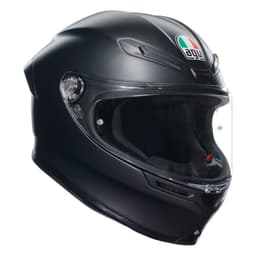
The lightest full-face we track, at about 1,255 g
AGV K6 S
DOT + ECE 22.06One of the lightest full-carbon-aramid lids you can buy at ~1,255 g, and it's certified to the newer ECE 22.06 standard on top of DOT. The sport-touring helmet for riders who notice weight on a long day.
See the full lightest rankingPrice as of October 10, 2026. #ad How we’re funded
About 1,255 g of carbon-aramid with DOT plus ECE 22.06 and a wide eyeport. It is premium money and the sportier padding is firmer than a plush touring interior — which is the other thing grams cost you, because comfort padding has mass.
What weight genuinely buys at the budget end is more interesting, because it shows the rule is not absolute:
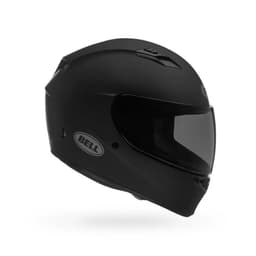
About 1,488 g — light for a budget polycarbonate full-face
Bell Qualifier
DOTThe plain Qualifier — the DLX MIPS model without MIPS or the ProTint shield. DOT approved, three shell sizes, about 1,488 g, and one of the best-value certified full-faces on the market.
See the budget helmet rankingPrice as of October 10, 2026. #ad How we’re funded
A DOT-approved polycarbonate shell in three shell sizes at about 1,488 g, which undercuts several composite helmets costing three times as much. Three shell sizes is the mechanism: a small head gets a small shell rather than a large shell padded out, and padding is weight. That is the single most under-appreciated weight spec there is — shell count, not shell material.
Why a badly fitted helmet feels heavy
If a helmet feels heavy in the shop, check these three things before you blame the figure on the box:
- Shell size. A maker offering one or two shell sizes across five head sizes is padding the small ones out. More padding is more mass sitting further from your head, which is worse than the same mass in the shell.
- Head shape. An intermediate-oval helmet on a long narrow head loads the forehead and leaves gaps at the cheeks, so the helmet rocks and the weight feels mobile. Our head-shape guide covers how to tell.
- Aerodynamics.A helmet that lifts or buffets behind your screen is loading your neck far more than 200 g ever will. This is also why a tall screen can make a light helmet feel worse than a heavy one on a naked bike.
The one place where grams unambiguously matter is a long day in heat. Heat and neck fatigue compound, which is why our hot-weather ranking treats weight as one of its four criteria and why the touring page weighs it against sealing and noise.
The open-face exception
If weight is your overriding priority, no full-face will match an open-face, and you should know exactly what the saving is bought with.
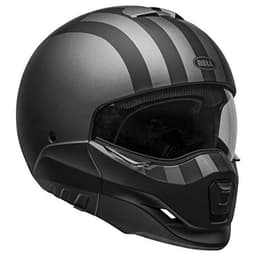
About 1,452 g, with a chin bar that is not impact-rated
Bell Broozer
DOTA DOT-approved open-face with a chin bar you can bolt on and take off. Useful for riders who want two looks from one helmet — but Bell publishes no impact rating for the removable chin bar, so treat it as a wind deflector, not a full-face conversion.
See the open-face rankingPrice as of October 10, 2026. #ad How we’re funded
A DOT-certified helmet at about 1,452 g whose chin bar bolts off for town riding. Bell publishes no impact rating for that removable chin bar — it is a wind and debris deflector, not a full-face conversion, which is the single most important thing to understand about the format. The lightest helmet in our whole registry, at about 982 g, is a true open-face with no chin bar and no shield as standard. Our honest answer on open-face safety lays out what that coverage costs.
How to compare two published weights without fooling yourself
Three rules, because the numbers are less comparable than they look:
- Treat differences under about 50 g as noise. Makers rarely state whether the figure includes the shield, the liner or which shell size it refers to, and that ambiguity is worth more than 50 g.
- Compare within a type. A modular will always lose to a full-face and an open-face will always win. The useful comparison is composite full-face against composite full-face.
- Treat “no published weight” as information. It usually is not a light helmet. Our registry records a null rather than an estimate, and the card says “Check current listing” — which is why the lightest ranking can only rank 18 of 37 helmets, and says so.
One last thing worth weighing against grams: an intercom adds roughly the mass of a small phone and no published helmet weight includes it. The two integrated-comms helmets we track publish 1,730 g and 1,750 g, heavy for their materials, and some of that is electronics. If you care about weight, a separate unit you can take off is a genuine argument.
How to read our safety notes. We have not crash-tested any of this gear — nobody honestly can on a review budget. Every helmet and armor pick names the certification the maker publishes (DOT, ECE 22.06, SNELL, or a CE level), which we read from the listing on a dated visit. Certification is the floor, not a guarantee; fit and condition matter as much as the sticker. What the standards actually mean.
Frequently asked questions
How much does a motorcycle helmet weigh?
Most certified street helmets land between about 1,250 g and 1,850 g — roughly 2.8 to 4.1 lb. In our own registry the 18 helmets that publish a figure run from 982 g for a fiberglass-composite open-face up to 1,850 g for a premium modular. As a rough guide: open-face and 3/4 helmets sit around 1,000 to 1,100 g, composite full-faces around 1,250 to 1,550 g, polycarbonate full-faces around 1,450 to 1,700 g, and modulars 1,700 g and up because a hinge and a second shell section weigh something.
Why do so few helmets publish a weight?
Because nobody requires them to, and a weight is a number buyers can compare — which is a reason not to publish one if yours is unflattering. Only 18 of the 37 helmets in our registry carry a published weight, and they cluster at the premium end where a low figure is a selling point. That has a consequence we state on our own lightest-helmets ranking: it measures disclosure as much as it measures grams. A heavy helmet that publishes 1,810 g is being more transparent than a lighter one that publishes nothing.
Does a lighter helmet mean a less safe helmet?
No, and this is the most common misreading of helmet weight. Weight comes mostly from shell material, and the lighter materials are generally the more expensive ones: carbon, carbon-aramid and glass-composite shells are lighter than polycarbonate at the same strength. The lightest full-face in our registry — about 1,255 g — publishes DOT plus ECE 22.06, which is a more demanding certification than most of the heavier helmets carry. What weight does correlate with is price, not protection.
Is helmet weight measured with or without the visor?
It varies, and makers rarely say — which is the practical limit on comparing two published figures. Some publish a shell-only or medium-shell weight, some include the shield and liner, and a few publish a figure for one specific size without saying which. A 50 g difference between two listed weights is inside that noise. A 300 g difference is real. Our registry records the figure exactly as the maker publishes it and does not normalise anything, because normalising would mean inventing a measurement we did not take.
Does helmet weight actually matter?
On a long ride, yes, and not for the reason riders expect. A 400 g difference is small in absolute terms but it sits on top of your neck at the end of a lever, and it is being accelerated by every head movement and every gust of turbulence for hours. The effect is cumulative neck fatigue on day-long rides, and it is worse in heat and worse behind a screen that buffets. For a 20-minute commute it is close to irrelevant. If your rides are measured in hours rather than minutes, grams are worth money.
Which type of motorcycle helmet is the lightest?
Open-face, by a wide margin — there is no chin bar, less shell and less EPS. The lightest helmet in our registry is a fiberglass-composite 3/4 at about 982 g, which is some 270 g under the lightest full-face we track. That is a real comfort advantage and it is bought with the coverage a chin bar provides, which is a trade we lay out separately. Among full-faces, carbon and carbon-aramid shells are the lightest; among modulars, nothing is light, because the flip-front mechanism has to be strong enough to be part of the structure.
How heavy is too heavy for a motorcycle helmet?
There is no threshold anyone publishes, and we are not going to invent one. What we can say from the registry is that the heaviest street helmets we track are around 1,800 to 1,850 g and they are all modulars or convertibles, where the weight buys a mechanism riders genuinely want. If a helmet feels heavy in the shop, check the fit before you blame the grams: a helmet that is a size too large or the wrong head shape sits badly and loads your neck unevenly, which feels exactly like weight.
Does a Bluetooth intercom add much weight?
A bolt-on unit adds roughly the weight of a small phone, split between the module on the side of the shell and the battery — and the published helmet weight never includes it. Helmets with comms built in do carry the weight in their figure: the two integrated-comms helmets in our registry publish 1,730 g and 1,750 g, which is heavy for their shell materials and is partly the electronics. If grams matter to you, that is a genuine argument for a separate unit you can take off for a track day or a short summer ride.
Sources
- 49 CFR 571.218 — FMVSS No. 218, Motorcycle helmets — The US federal helmet standard: peak-acceleration, penetration and retention requirements; applies to all on-road motorcycle helmets (accessed July 21, 2026)
- UNECE — Vehicle Regulations (UN Regulation No. 22 / ECE 22.06) — The UN regulation behind ECE 22.06, which added rotational/oblique-impact testing over 22.05 (accessed July 21, 2026)
- Snell Memorial Foundation — Standards — Snell's motorcycle helmet standards: M2025D/M2025R are the current generation and M2020D/M2020R the previous one (D = DOT markets, R = ECE markets) (accessed July 21, 2026)
- NHTSA — How to Choose the Right Motorcycle Helmet — NHTSA consumer guidance on DOT certification and spotting novelty helmets (accessed July 21, 2026)
- SHARP — UK Government Helmet Safety Ratings — UK Department for Transport independent helmet safety star ratings (accessed July 21, 2026)
- MotoCAP — Independent Motorcycle Clothing & Helmet Assessment — Independent Australian lab rating protective clothing and helmets for protection and comfort (accessed July 21, 2026)
Keep reading
Lightest motorcycle helmets
Every certified helmet in the registry that publishes a weight, ranked by grams — with the disclosure caveat stated on the page.
See the lightest picksMotorcycle helmet brands explained
What a brand does and does not tell you — including which brands publish weights and which stay quiet.
Read the brands guideTypes of motorcycle helmet
Full-face, modular, open-face and dual-sport — the format decides more of the weight than the brand does.
Read the types guideMotorcycle helmet sizing
Why a badly fitted helmet feels heavy, and how to measure properly before blaming the grams.
Read the sizing guideBest touring helmets
Where weight actually costs you something — the all-day rides that turn 300 g into neck ache.
See the touring picksDOT, ECE and SNELL explained
Why the most demanding certification does not mean the heaviest helmet, and what each test measures.
Read the certification guide