Are Open-Face Motorcycle Helmets Safe?
A certified open-face helmet passes the same impact standard as a full-face. It just covers less of your head — and the part it leaves out is the part a lot of riders land on.
How this is funded: we earn a commission if you buy through our links, at no extra cost to you. It never changes which gear we recommend, and we’ll tell you plainly when to skip a pick. Full disclosure.
The short answer: a certified open-face helmet is a real helmet that protects most of your head to the same standard a certified full-face does, and leaves your jaw, chin and face uncovered. Both halves of that sentence are true, and almost every argument about open-face helmets happens because somebody is only saying one of them.
What the certification actually covers
DOT FMVSS 218 is the legal floor for on-road helmet sale in the US. It tests impact attenuation at specified sites on the shell, penetration resistance, the retention system under load, and peripheral vision clearance. It does not require a chin bar, and it does not test one. That means an open-face helmet can comply fully and legitimately — and it means a DOT marking tells you nothing about facial coverage either way.
ECE 22.06, the European homologation, goes further than DOT in several respects: more impact points, a rotational-acceleration measurement, and testing of the shield and accessories. It also uses a labelling convention worth knowing, because it is the one place in this whole subject where the industry is explicit: a helmet homologated as “P” has a chin guard tested for protective performance, and one homologated as “J” is a jet-style helmet with no protective chin guard. Some modular helmets carry both marks. An open-face carries J. Our certification guide goes through each standard in detail, and our ECE 22.06 ranking covers the helmets that publish the newer mark.
What is uncovered, specifically
Not “your face” as a vague region. Four things, each with a different consequence:
| Area | What an open-face leaves exposed | Can it be mitigated? |
|---|---|---|
| Jaw and chin | Entirely uncovered on a true open-face. This is the structural difference between the formats and the one that cannot be engineered away | No. A bolt-on chin bar is not an impact-rated chin bar — see below |
| Eyes | No protection at all without a shield or goggles. Stones, insects and road grit at 60 mph are the everyday version of this risk, not the crash version | Yes, fully, with a face shield or sealed goggles. Sunglasses are not a substitute |
| Lower face and teeth | Uncovered. These are the injuries that are survivable and life-changing, and the ones riders tend not to think about when weighing a helmet | No |
| Hearing | Not a coverage issue but a real one: an open-face is louder, and noise damage accumulates permanently over years of riding | Yes, with filtered earplugs that publish an SNR. Treat them as part of the helmet |
The statistic we will not quote
If you have researched this question you have seen a percentage — some share of motorcycle crash impacts said to land on the chin or face. We are not going to repeat it, because we cannot trace it to a primary source we have read. The figure circulates with several different values attached, with inconsistent definitions of what counts as a chin impact, and usually with no citation at all. That is not good enough for a page about whether a piece of safety equipment is adequate.
What does not need a disputed statistic: the chin and jaw are structurally exposed, they sit low and forward where the ground is in a low-side, and facial injuries are serious. The absence of a clean number is also itself informative — nobody publishes one because the data on US crash impact locations is far thinner than the confidence of internet arguments suggests. Our methodology page explains the standard we hold claims to, and it is the reason this page is shorter on numbers than most.
Removable chin bars: the thing to understand before you buy
There is a category of helmet that looks like it solves this problem and does not. A clip-on or bolt-on chin bar is generally not impact-rated, and the maker does not claim it is. That is different from a modular helmet, where the chin bar is a hinged part of a certified structure and some models publish both the P and J homologations.
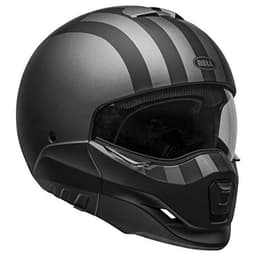
The convertible, honestly described
Bell Broozer
DOTA DOT-approved open-face with a chin bar you can bolt on and take off. Useful for riders who want two looks from one helmet — but Bell publishes no impact rating for the removable chin bar, so treat it as a wind deflector, not a full-face conversion.
See the full open-face rankingPrice as of October 10, 2026. #ad How we’re funded
The Bell Broozer is DOT certified, weighs about 1,452 g, includes a face shield and takes its chin bar off for town riding. Bell publishes no impact rating for that removable chin bar. Bought understanding that — as a well-made open-face with a wind and debris deflector that can be fitted for the highway — it is a genuinely useful helmet. Bought as “a full-face that opens up”, it is a misunderstanding that could matter a great deal. Our modular versus full-face comparison covers the format where the chin bar is part of the certified structure.
If you are going to ride an open-face, do these three things
This site is not in the business of telling riders what to want. An open-face is a defensible choice for slow riding, severe heat, and riders who will genuinely wear one when they would not wear a full-face — and a helmet on your head beats a better one in the garage. What is not defensible is riding one without closing the gaps you can close.
First, buy one with a real face shield. Eye protection is the one uncovered area you can fully fix, and a snap-on visor that flaps at speed is not the same as a proper shield.
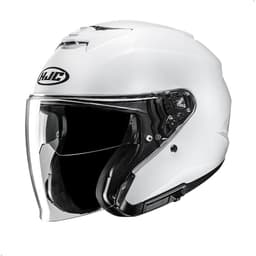
Open-face with a shield and a sun visor
HJC i31
DOTThe modern take on an open-face: DOT-approved, with a drop-down internal sun visor and a proper face shield rather than a snap-on peak. The sensible commuter choice if you want an open lid that still keeps rain and bugs off.
See helmets with a sun visorPrice as of October 10, 2026. #ad How we’re funded
Second, buy a certified one, not a novelty shell. The cheapest genuinely DOT-certified open-face in our registry costs less than a tank of fuel on most bikes, which removes the only argument anyone has for an uncertified lid. If you are not sure how to tell them apart on a listing, that is a guide of its own.
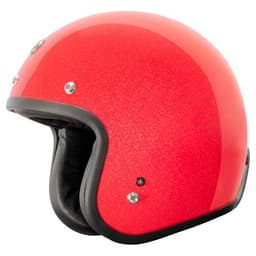
The certified budget option
TORC T-50
DOT FMVSS 218The cheapest DOT-certified open-face we'd actually put on a head. A polycarbonate shell, multi-density EPS and a D-ring strap — the basics done right, with none of the extras.
See the budget helmet rankingPrice as of October 10, 2026. #ad How we’re funded
Third, wear earplugs. An open-face at highway speed is loud, there is no published noise rating for any helmet to compare against, and hearing damage does not heal. Our earplugs guidecovers which options publish an SNR figure and which just say “noise-reducing”.
The one argument we think is wrong
“A full-face feels claustrophobic.” Sometimes that is true and permanent, and an open-face is the right answer. Far more often it is a fit problem being described as a format problem: a helmet in the wrong head shape presses on the forehead and feels like a vice, and a helmet one size too small feels like suffocation. Both are fixable, and both are commonly mistaken for an objection to the whole format. Our head-shape guide covers how to tell, and the sizing guidecovers the measurement. Try a well-fitted full-face in the right shape before you conclude you cannot wear one — and if you still cannot, buy the open-face, with the shield and the earplugs, and ride.
How to read our safety notes. We have not crash-tested any of this gear — nobody honestly can on a review budget. Every helmet and armor pick names the certification the maker publishes (DOT, ECE 22.06, SNELL, or a CE level), which we read from the listing on a dated visit. Certification is the floor, not a guarantee; fit and condition matter as much as the sticker. What the standards actually mean.
Frequently asked questions
Are open-face motorcycle helmets safe?
A certified open-face helmet is a real helmet: it passes the same DOT FMVSS 218 impact and retention tests a certified full-face passes, and it protects the crown, sides and back of your head to the same standard. What it does not do is cover your jaw, chin and the lower half of your face, and it offers no protection to your eyes unless you add a shield or goggles. So the honest answer is that it is safe in the sense that matters legally and incomplete in the sense that matters practically — the question is not whether it works, but whether you accept the coverage it does not give you.
What percentage of motorcycle crash impacts hit the chin?
We are not going to give you a number, and you should be suspicious of pages that do. The figure you see repeated across the internet traces back to a single small study and gets quoted with wildly different values, different definitions of 'chin impact' and no consistent primary source. We hold every factual claim on this site to a source we have read, and this one does not clear that bar. What is not in dispute is simpler and sufficient: the chin and jaw are structurally exposed on an open-face helmet, they are close to the ground in a typical low-side, and the facial injuries involved are serious and expensive to repair.
Is a 3/4 helmet safer than a half helmet?
Yes, materially — and the gap is bigger than the names suggest. A 3/4 or open-face helmet covers the crown, the sides down past the ears and the back of the skull, which is most of the head. A half helmet or 'shorty' typically covers the crown and stops above the ears, leaving the temples and the base of the skull exposed, and a great many of them are sold as novelty items with no certification at all. If you want the minimum-coverage look with a real helmet underneath it, an open-face is where the line is. We do not rank half helmets on this site.
Do open-face helmets have DOT approval?
Many do, and the certification is exactly the same one a full-face carries. DOT FMVSS 218 is a self-certification standard that tests impact attenuation, penetration resistance, the retention system and peripheral vision — it does not require a chin bar, so an open-face helmet can comply fully. That is the thing riders most often misunderstand: a DOT sticker on an open-face is not a weaker version of the DOT sticker on a full-face. It is the same test, applied to a helmet that covers less. Our certification guide explains what the mark does and does not measure.
Can you wear glasses or sunglasses with an open-face helmet?
Yes, and it is one of the genuine practical advantages — there is no eye port to push your frames against and nothing to work around when you put the helmet on. The flip side is that sunglasses are not eye protection at motorcycle speeds: they are not impact-rated, they do not seal, and they will not stop a stone or an insect. If you ride an open-face, treat a face shield or proper goggles as part of the helmet rather than an accessory, and keep a clear option for after dark.
Are open-face helmets quieter or louder than full-face helmets?
Louder, usually substantially, and it is the most under-discussed cost of the format. A full-face shell channels air around a closed volume; an open-face leaves the air to swirl directly past your ears with no chin bar or shield to manage it. Nobody publishes a helmet noise rating — not the makers, not SHARP, not MotoCAP — so there is no figure to compare, but the mechanism is not controversial. If you ride an open-face at highway speed, filtered earplugs with a published SNR are not optional kit, because noise damage is cumulative and permanent.
Is a removable chin bar as good as a full-face?
No, and this is the most important thing on this page. Helmets with a bolt-on or clip-on chin bar — as distinct from a modular helmet with a hinged chin bar — are generally not impact-rated in the chin region, and the maker does not claim they are. Bell, for example, publishes no impact rating for the Broozer's removable chin bar. Treat it as a wind and debris deflector that happens to look like a chin bar, which is a genuinely useful thing. Treat it as a full-face conversion and you have bought protection that does not exist.
When is an open-face helmet the right choice?
When your riding is genuinely low-speed and short-distance, when the heat is severe enough that airflow is a real safety factor in itself, or when you need peripheral vision and audibility more than facial coverage — slow technical riding, parking-lot work, city errands in August. It is also the right choice for a rider who will wear an open-face every ride and would leave a full-face at home, because a helmet you are wearing beats one in the garage. What it is not is a highway helmet, and it is not the choice to make because a full-face feels claustrophobic before you have tried one that fits.
Sources
- 49 CFR 571.218 — FMVSS No. 218, Motorcycle helmets — The US federal helmet standard: peak-acceleration, penetration and retention requirements; applies to all on-road motorcycle helmets (accessed July 21, 2026)
- UNECE — Vehicle Regulations (UN Regulation No. 22 / ECE 22.06) — The UN regulation behind ECE 22.06, which added rotational/oblique-impact testing over 22.05 (accessed July 21, 2026)
- NHTSA — How to Choose the Right Motorcycle Helmet — NHTSA consumer guidance on DOT certification and spotting novelty helmets (accessed July 21, 2026)
- NHTSA — Motorcycle Helmet Effectiveness Revisited (DOT HS 809 715) — Helmets ~37% effective at preventing rider fatalities (accessed July 21, 2026)
- SHARP — UK Government Helmet Safety Ratings — UK Department for Transport independent helmet safety star ratings (accessed July 21, 2026)
- Snell Memorial Foundation — Standards — Snell's motorcycle helmet standards: M2025D/M2025R are the current generation and M2020D/M2020R the previous one (D = DOT markets, R = ECE markets) (accessed July 21, 2026)
Keep reading
Best open-face motorcycle helmets
Every certified 3/4 helmet we rank, with the coverage each one does and does not give you.
See the open-face picksOpen-face vs full-face
The buying decision rather than the safety question — weight, noise, airflow and what each format costs.
Read the comparisonDOT, ECE and SNELL explained
What each certification actually tests, and why a DOT sticker on an open-face is the same sticker as on a full-face.
Read the certification guideTypes of motorcycle helmet
Full-face, modular, open-face, half and dual-sport — what each format is for, in one place.
Read the types guideMotorcycle earplugs
Why an open-face makes hearing protection non-optional, and the only noise figure anyone in this category publishes.
Read the earplugs guideBest helmets for cruiser riders
Where most open-face buying actually happens, with the full-face options that keep the same silhouette.
See the cruiser picks