Bell Qualifier DLX MIPS vs HJC i10
MIPS against SNELL M2020 at roughly the same money — the two helmets almost every value shopper ends up choosing between, and the reason the answer isn't obvious.
These two helmets appear on more of our pages than any other pair on the site, and they keep landing in the same shortlist because they answer the same question — “what is the most protection I can buy without spending premium money?” — from two different directions.
The Bell Qualifier DLX MIPS is DOT-certified and adds MIPS, a low-friction layer inside the helmet designed to let the shell rotate slightly against your head during an angled impact. The HJC i10 is DOT-certified and adds SNELL M2020, a demanding independent test standard that the helmet had to physically pass at a laboratory before it could carry the sticker. One is a design feature aimed at a specific injury mechanism. The other is an outside body confirming the helmet met a tougher set of thresholds than the law requires.
Neither is a substitute for the other, and neither is a bad answer. Here is the spec comparison and the honest read on which rider each one suits.
How this is funded: we earn a commission if you buy through our links, at no extra cost to you. It never changes which gear we recommend, and we’ll tell you plainly when to skip a pick. Full disclosure.
The MIPS one
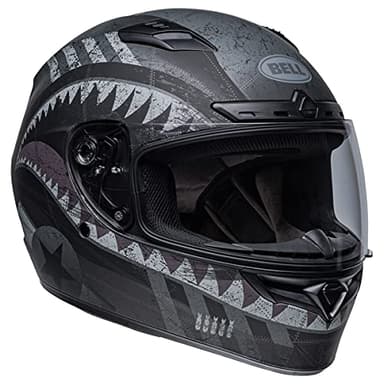
Bell Qualifier DLX MIPS
The value pick that adds MIPS — a low-friction liner designed to reduce rotational forces in an angled impact — to a DOT-certified full-face at a mid price. The most safety tech per dollar in this list.
Price as of October 19, 2026. #ad How we’re funded
The SNELL one
HJC i10
The rare budget full-face that carries a SNELL M2020 rating on top of DOT — the voluntary top-tier test most sub-$150 helmets skip. The strongest safety-per-dollar case for a first helmet.
| Spec | Bell Qualifier DLX MIPS | HJC i10 |
|---|---|---|
| Certification | DOT FMVSS 218 | DOT + SNELL M2020 |
| Headline feature | MIPS rotational liner | SNELL M2020 independent certification |
| Independent lab test? | No — DOT is manufacturer self-certification with NHTSA spot re-testing | Yes — Snell tests and re-tests samples to carry the mark |
| Rotational-impact measure | MIPS low-friction layer | Not a MIPS helmet |
| Claimed weight | Check current listing | Check current listing |
| Head shape | Intermediate oval, true to size | Intermediate oval, true to size |
| Price tier | Mid | Budget |
| Best suited to | Value buyers who want rotational-impact tech | New riders who want the most certification per dollar |
What MIPS actually is, and what it isn’t
MIPS — the Multi-directional Impact Protection System — is a thin slip layer fitted between the comfort liner and the EPS. In an angled impact, which is what most real-world crashes are, the head does not just decelerate: it also twists. The slip layer is designed to let the helmet move a few millimeters relative to your head during that first instant, so less of the rotational energy transfers to your brain.
The important honesty here: MIPS is a design feature, not a certification.No government or independent standards body grants it. It is licensed by its maker to helmet brands that fit it. That does not make it worthless — rotational injury is a real and well-documented mechanism, and it is precisely what ECE 22.06 added oblique-impact testing to address. It does mean that “has MIPS” and “passed an independent test” are different claims, and the Qualifier DLX MIPS makes the first one.
What SNELL M2020 actually is, and what it isn’t
SNELL certification comes from the Snell Memorial Foundation, an independent non-profit. It is entirely voluntary — no US law requires it — and it works the way you would want a certification to work: the Foundation tests helmet samples against its own published protocol, which is more demanding than the federal minimum, and then keeps buying and re-testing production units. A manufacturer cannot self-declare it.
The honesty here too: SNELL is not a rotational standard. Its protocol is built around severe linear impacts, penetration and retention. A SNELL helmet has demonstrably cleared a harder test than DOT requires; it has not, by virtue of that sticker, been assessed for the angled-impact mechanism MIPS targets. Our DOT vs ECE vs SNELL guide lays out what each protocol does and does not cover.
DOT is the floor under both
Both helmets carry DOT (FMVSS 218), which is legally required for any helmet sold for on-road motorcycle use in the US. Worth knowing how that works: DOT is a self-certification regime. The manufacturer declares compliance, and NHTSA buys samples off shelves and re-tests them, with recalls and penalties where a helmet fails. It is a real standard with real enforcement, and it is also the reason a second, independently-tested mark like SNELL carries weight.
So which one?
Buy the HJC i10 if this is your first helmet
It is the cheaper of the two and it carries the mark that an outside laboratory had to grant. For a new rider buying a first lid on a tight budget, “an independent body tested this and it passed a harder test than the law demands” is the most defensible thing you can buy per dollar. It is our budget pick on best beginner helmets for exactly that reason.
Buy the Bell Qualifier DLX MIPS if rotational protection is your priority
If you have read about oblique impacts and want the specific countermeasure — and you are comfortable that it is a design feature rather than an independent pass — the Qualifier DLX MIPS is the value route to it. It also brings Bell’s wider shell-size range and a more equipped feature set than the price suggests. It is our value pick on best motorcycle helmets.
If the budget stretches, you can stop choosing
The real answer to “MIPS or SNELL” is that a step up buys you a helmet certified to ECE 22.06, which builds oblique-impact testing into the standard itself rather than into an add-on layer. That is the argument for the premium full-face picks if the money is there. At this price point, it is not, and the two helmets above are the honest options.
What actually matters more than either
Fit. Both helmets are intermediate-oval and both are described as running true to size, but head shape varies more between people than between these two helmets. A helmet that does not match your head shape will develop a pressure point within an hour and you will ride less in it, which is the worst safety outcome of all. Measure your head, check the shape, run the roll-off test — our helmet sizing guide walks through all three. Then pick between MIPS and SNELL.
Frequently asked questions
Is MIPS better than SNELL?
They are not the same kind of thing, so neither is straightforwardly better. SNELL M2020 is an independent certification: a laboratory outside the manufacturer tested the helmet against a published protocol tougher than the US legal minimum, and it passed. MIPS is a design feature — a low-friction layer aimed at reducing rotational energy transfer in an angled impact — licensed by its maker, not granted by a standards body. A SNELL helmet has cleared a harder linear-impact test. A MIPS helmet has a specific countermeasure for a different injury mechanism. If you want both addressed by one standard, that is what ECE 22.06 does, and it costs more.
Are both of these helmets road-legal in the US?
Yes. Both carry DOT certification to FMVSS 218, which is the legal requirement for a helmet sold for on-road motorcycle use in the US. Everything else — SNELL, MIPS, ECE — is additional to that legal floor, not a replacement for it.
Which one is better for a beginner?
The HJC i10, in most cases. It is the cheaper of the two and it carries SNELL M2020, meaning an independent laboratory tested it rather than the manufacturer declaring compliance. For a first helmet on a limited budget that is the strongest thing you can get per dollar. The Bell is the better buy if you specifically want MIPS and have the extra to spend.
Do I need MIPS on a motorcycle helmet?
You do not need it — no law or standard requires it, and helmets without it are legal and certified. Rotational injury is a real mechanism, though, which is why the current European standard, ECE 22.06, added oblique-impact testing. MIPS is one manufacturer's approach to the same problem at a lower price point. It is a reasonable thing to want; it is not a thing to buy a worse-fitting helmet to get.
How much do these two weigh?
Neither maker publishes a shell weight for these models, so we do not quote one. Anywhere you see a specific gram figure for either of these helmets, ask where it came from — in this price band, published weights are the exception rather than the rule. Where a maker does publish it, we list it; where they do not, our spec tables say 'Check current listing' rather than guessing.
Sources
- 49 CFR 571.218 — FMVSS No. 218, Motorcycle helmets — The US federal helmet standard: peak-acceleration, penetration and retention requirements; applies to all on-road motorcycle helmets (accessed July 21, 2026)
- NHTSA — How to Choose the Right Motorcycle Helmet — NHTSA consumer guidance on DOT certification and spotting novelty helmets (accessed July 21, 2026)
- Snell Memorial Foundation — Standards — Snell's motorcycle helmet standards: M2025D/M2025R are the current generation and M2020D/M2020R the previous one (D = DOT markets, R = ECE markets) (accessed July 21, 2026)
- Snell Memorial Foundation — M2020 Standard (PDF) — The full M2020 test protocol (accessed July 21, 2026)
- UNECE — Vehicle Regulations (UN Regulation No. 22 / ECE 22.06) — The UN regulation behind ECE 22.06, which added rotational/oblique-impact testing over 22.05 (accessed July 21, 2026)
Keep reading
Safest budget motorcycle helmets
Every helmet DOT-certified from a real helmet maker, and every one under about $150.
See the budget picksDOT vs ECE vs SNELL explained
What each certification actually tests, which are legally required, and how to spot a novelty helmet.
Read the guideBest beginner motorcycle helmets
Certified, well-equipped helmets that don't cost a fortune — the right first lid for a new rider.
See the beginner picksBest full-face helmets
The safest style, compared on shell material, certification and weight across every budget.
See the full-face picks