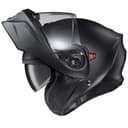
There is no industry decibel standard for helmets, so nobody can hand you comparable numbers. Here is what actually reduces wind noise, and the certified helmets built around it.
Start with the thing most “quietest helmet” articles won’t tell you: there is no standardized helmet noise test. Unlike impact performance, which DOT, ECE and SNELL all measure under published protocols, wind noise has no regulated measurement. Any decibel figure you read comes from one reviewer, on one bike, with one screen, at one speed, with a microphone placed somewhere they chose. Those numbers cannot be compared across reviews, and we are not going to invent our own and pretend otherwise.
What we cando is identify the design features that reduce noise at its source, and rank the certified helmets that are actually built around them. Wind noise in a helmet comes mostly from three places: turbulent air entering under the bottom edge at your neck, air leaking around the shield gasket and vents, and turbulence generated by the shell shape itself as it interacts with your bike’s screen. Everything below addresses at least two of those.
One more piece of honesty. The single biggest variable in how loud your ride is is not the helmet— it’s your windscreen height and your riding position, because a screen that dumps turbulent air directly at your helmet’s lower edge will make any helmet loud. The second biggest is whether you wear earplugs. A $900 helmet without earplugs is louder than a $200 helmet with them. Buy the plugs first.
How this is funded: we earn a commission if you buy through our links, at no extra cost to you. It never changes which gear we recommend, and we’ll tell you plainly when to skip a pick. Full disclosure.
Quick picks
Ranked on certification, spec and buyer fit. Select a row to jump to the full write-up. We haven’t crash-tested this gear — here is exactly what we do instead.
#
Gear
Best for
Price
1
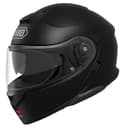
Shoei Neotec 3
DOT + ECE 22.06
The benchmark touring modular. Shoei's AIM shell, DOT plus ECE 22.06 with P/J dual homologation (legal to ride with the chin bar up), and the quietest flip-front we know of. Expensive, and worth it for high-mileage touring.
Shoei's dedicated touring full-face: AIM shell, an internal sun visor, a deep neck roll and comms integration designed in rather than bolted on. If you ride 400-mile days with a shield down, this is the reference.
The full-face most experienced riders land on: Shoei's hand-laid AIM+ shell, DOT plus a SNELL M2020 rating, and a quiet, refined fit. You're paying for finish and certification, and it shows.
HJC's premium touring modular: a composite shell, a Pinlock-ready shield in the box and an internal sun visor, at a price that undercuts the Japanese and European flagships by hundreds.
A genuine 3-in-1: run it as a full-face, flip it to a modular, or remove the chin bar for an open-face. DOT and ECE 22.05 certified, with a drop-down sun visor — versatile for riders who can't decide.
The benchmark touring modular. Shoei's AIM shell, DOT plus ECE 22.06 with P/J dual homologation (legal to ride with the chin bar up), and the quietest flip-front we know of. Expensive, and worth it for high-mileage touring.
Strengths
+DOT + ECE 22.06 with P/J dual homologation — rated open AND closed
+Class-leading wind noise control and sealing for long days
+Sena SRL3 comms integrate cleanly without breaking the shell lines
Trade-offs
−The most expensive modular here by a wide margin
−Heavier than a full-face at ~1,850 g, as all modulars are
Safety standard
DOT + ECE 22.06
Construction
AIM multi-composite shell
Claimed weight
1,850 g
Key feature
DOT + ECE 22.06 (P/J)
Fit / sizing
Intermediate oval; long-oval friendly
Best for
Touring riders who want a certified, genuinely quiet flip-front
Specs and certification read from the manufacturer and retailer listing, on July 21, 2026. “Check current listing” means the maker doesn’t publish that figure — we won’t guess it.
#2Best full-faceDOT
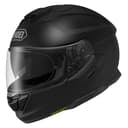
Shoei GT-Air 3
Shoei's dedicated touring full-face: AIM shell, an internal sun visor, a deep neck roll and comms integration designed in rather than bolted on. If you ride 400-mile days with a shield down, this is the reference.
Strengths
+Shoei AIM multi-fiber shell — DOT certified for the US market
+Drop-down internal sun visor and a deep neck roll for sealing
+Designed around Shoei's SRL comms so nothing hangs off the shell
Trade-offs
−Premium price, and the US listing carries DOT only — no SNELL
−About 1,714 g; the sun-visor mechanism adds weight over a bare racing lid
Safety standard
DOT
Construction
AIM multi-fiber composite shell
Claimed weight
1,714 g
Key feature
DOT, internal sun visor
Fit / sizing
Intermediate oval; touring-plush interior
Best for
High-mileage touring riders who want a quiet, well-sealed full-face
Specs and certification read from the manufacturer and retailer listing, on August 11, 2026. “Check current listing” means the maker doesn’t publish that figure — we won’t guess it.
#3Best sport-touringDOT + SNELL M2020D
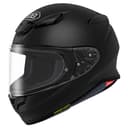
Shoei RF-1400
The full-face most experienced riders land on: Shoei's hand-laid AIM+ shell, DOT plus a SNELL M2020 rating, and a quiet, refined fit. You're paying for finish and certification, and it shows.
Strengths
+DOT + SNELL M2020D — both the US legal floor and the voluntary top-tier test
+Hand-laid AIM+ multi-fiber shell, light for a full glass-composite lid (~1,640 g)
+Refined ventilation and a genuinely quiet ride at highway speed
Trade-offs
−Premium price — you pay for the shell and the SNELL rating
−Intermediate-oval fit doesn't suit every head shape
Safety standard
DOT + SNELL M2020D
Construction
AIM+ multi-fiber composite shell
Claimed weight
1,640 g
Key feature
DOT + SNELL M2020D
Fit / sizing
Intermediate oval; runs true to size
Best for
Riders who want the safest all-round street helmet and will pay for it
Specs and certification read from the manufacturer and retailer listing, on July 21, 2026. “Check current listing” means the maker doesn’t publish that figure — we won’t guess it.
#4Best value modularDOT
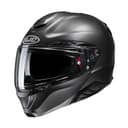
HJC RPHA 91
HJC's premium touring modular: a composite shell, a Pinlock-ready shield in the box and an internal sun visor, at a price that undercuts the Japanese and European flagships by hundreds.
Strengths
+DOT approved with an advanced composite (PIM) shell
+HJ-37 Pinlock-prepared shield included — no separate anti-fog purchase
+Drop-down sun visor and a comms-ready interior
Trade-offs
−HJC doesn't publish a shell weight for the RPHA 91
−Flip-front hinge means more wind noise than a sealed full-face
Safety standard
DOT
Construction
PIM advanced composite shell
Claimed weight
Check current listing
Key feature
DOT, Pinlock shield included
Fit / sizing
Intermediate oval; touring fit
Best for
Touring riders who want a composite flip-front without flagship pricing
Specs and certification read from the manufacturer and retailer listing, on August 11, 2026. “Check current listing” means the maker doesn’t publish that figure — we won’t guess it.
#5Best budgetDOT + ECE 22.05
ScorpionEXO GT930 Transformer
A genuine 3-in-1: run it as a full-face, flip it to a modular, or remove the chin bar for an open-face. DOT and ECE 22.05 certified, with a drop-down sun visor — versatile for riders who can't decide.
Strengths
+DOT + ECE 22.05 with dual homologation
+Converts full-face → modular → open-face (chin bar removes)
+Drop-down sun visor and a comms-ready shell
Trade-offs
−Heavier (~1,810 g) thanks to the convertible hardware
−Open-face mode has no chin protection — a fair-weather-only setting
Safety standard
DOT + ECE 22.05
Construction
Advanced polycarbonate shell
Claimed weight
1,810 g
Key feature
DOT + ECE 22.05
Fit / sizing
Intermediate oval; convertible
Best for
Riders who want one helmet that converts between styles
Specs and certification read from the manufacturer and retailer listing, on July 21, 2026. “Check current listing” means the maker doesn’t publish that figure — we won’t guess it.
What actually makes a helmet quiet
Four things, roughly in order of how much difference they make.
1. The neck roll and the bottom edge
Most wind noise enters from below, not from the front. Air moving past your shoulders becomes turbulent and gets forced up into the gap between your neck and the helmet’s lower edge, where it resonates inside the shell. A deep, densely-padded neck roll that actually contacts your neck closes that path. This is the single biggest design factor, and it is why touring helmets are quieter than racing helmets that are otherwise more aerodynamic.
2. The chin curtain
The fabric flap under the chin bar does the same job for air coming up the front. It is a $15 part that most riders remove because it feels claustrophobic, and removing it measurably increases noise. If your helmet came with one and it’s in a drawer, that is the cheapest quiet-helmet upgrade available to you right now.
3. Shield and vent sealing
A shield that closes onto a continuous gasket with even pressure seals; one that closes onto a hard eyeport lip whistles. Premium helmets use a central locking mechanism that pulls the shield in rather than just holding it down. Vents matter too — a helmet whose vents genuinely close is quieter with them shut than a helmet whose “closed” position still passes air. This is the one place where the goal of this page and the goal of a summer helmet point in opposite directions: the open paths that cool you are the open paths you hear, which is why not one helmet from our hot-weather ranking appears on this one.
4. Shell shape and shell count
A shell that generates less turbulence at its own edges is quieter, and a helmet available in more shell sizes fits more heads without gaps. A well-fitted medium shell on a medium head is quieter than the same helmet in a padded-out large, because every gap is a noise path.
Why modulars appear on a quiet-helmet list
Counter-intuitively, two of the quietest helmets we know of are flip-fronts. A modular has more joints, which should make it louder — but the premium touring modulars are engineered around sealing precisely because their makers know the hinge is a liability. The Shoei Neotec 3 in particular is built with a multi-stage seal around the chin bar. A cheap modular, by contrast, is genuinely one of the loudest things you can put on your head. The category doesn’t determine noise; the engineering budget does. We’ve laid out the rest of that trade on modular vs full-face, and put the Neotec 3 directly against Shoei’s own touring full-face in GT-Air 3 versus Neotec 3 — where the flip-front turns out to be the better-certified of the two and the heavier one by about 136 g.
The things that will actually make your ride quieter
Earplugs.Foam plugs cost pennies and reduce noise more than any helmet upgrade. Riders worry they’ll mask traffic; in practice they lower the wind noise floor so you hear engines and horns better. Our earplugs guidecovers what an SNR figure actually means, why filtered plugs suit riding better than foam, and the fact that no helmet anywhere carries a noise rating — which is why this page ranks sealing rather than decibels.
Your windscreen height.A screen that directs air at your helmet’s lower edge is the worst case. Either lower it so clean air hits your chest, or raise it so the turbulent wake passes above your head. The in-between is the loud zone.
Refit the chin curtain and breath guard. Free, and immediately effective.
Close the vents on the highway. Obvious, routinely forgotten.
Zip your jacket collar. An open collar creates turbulence right where the neck roll is trying to seal.
What we are not claiming
We have not run a decibel test, we do not own an anechoic chamber, and we have not ridden every one of these helmets on your bike. The ranking above is based on published design specifications and the documented physics of helmet noise, not on a measurement we performed. That is the same standard we hold ourselves to on every page — see how we research.
How to read our safety notes. We have not crash-tested any of this gear — nobody honestly can on a review budget. Every helmet and armor pick names the certification the maker publishes (DOT, ECE 22.06, SNELL, or a CE level), which we read from the listing on a dated visit. Certification is the floor, not a guarantee; fit and condition matter as much as the sticker. What the standards actually mean.
Frequently asked questions
What is the quietest motorcycle helmet?+
There's no verifiable single answer, because helmet noise has no standardized test — every decibel figure published online comes from one reviewer's bike, screen, speed and microphone placement, and none of them are comparable. What is verifiable is which helmets are designed around the features that reduce noise: a deep sealing neck roll, a chin curtain, a properly gasketed shield and multiple shell sizes. The premium touring helmets in this roundup are built around all four.
Why is my helmet so loud?+
Usually it isn't primarily the helmet. The most common cause is a windscreen at the wrong height, dumping turbulent air directly onto the helmet's lower edge — that makes any helmet loud. Second is a missing chin curtain or neck roll. Third is an open jacket collar creating turbulence right where the helmet is trying to seal. Fix those three before buying a new helmet.
Do earplugs make more difference than a quiet helmet?+
Yes, comfortably. Foam earplugs cost almost nothing and reduce sound across the whole spectrum. Riders often worry about missing traffic sounds, but wind noise at highway speed is loud enough to mask engines and horns anyway — plugs lower the noise floor so those sounds become easier to pick out, not harder. Long-term, sustained wind noise at highway speeds is a genuine hearing-damage risk.
Are modular helmets louder than full-face helmets?+
Cheap ones are, noticeably — a flip-front has more joints and more paths for air to get in. Expensive touring modulars are the exception, because their makers engineer multi-stage seals around the chin bar precisely because they know the hinge is a weakness. Two of the quietest helmets on the market are flip-fronts. The category doesn't determine noise; the sealing engineering does.
Does a heavier helmet mean a quieter one?+
Not directly. What correlates with quietness is sealing quality and shell fit, not mass. Some of the heavier features that come with quiet helmets — thick neck rolls, multi-layer gaskets, sun visor mechanisms — do add weight, which is why quiet touring helmets tend to be heavier than racing helmets. But adding mass on its own does nothing; a heavy, badly-sealed budget helmet is loud.
Sources
49 CFR 571.218 — FMVSS No. 218, Motorcycle helmets — The US federal helmet standard: peak-acceleration, penetration and retention requirements; applies to all on-road motorcycle helmets (accessed July 21, 2026)