How Bell’s range is structured
Bell’s lineup breaks into four rough tiers, and understanding them saves a lot of comparison-shopping.
Entry: the Qualifier family
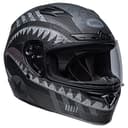
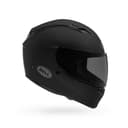
The plain Qualifier is a DOT-approved polycarbonate full-face in three shell sizes at roughly 1,488 g. The Qualifier DLX MIPS adds a MIPS low-friction layer for rotational-impact management and a ProTint photochromic shield option. That MIPS step is the most meaningful upgrade in Bell’s whole range relative to its price, which is why the DLX MIPS is our overall pick rather than the flagship. It is worth understanding what you are buying there, though: MIPS is a design feature, not a certification, and the distinction changes how much weight to give it against a helmet that carries a second tested standard instead. If you want the cheapest certified Bell, the plain Qualifier does the job — see our budget helmet picks for how it compares to the rest of that market.
Style: Eliminator and Custom 500
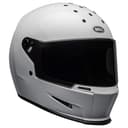
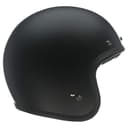
These two exist because a lot of riders want a helmet that suits a cruiser or a custom bike. The Custom 500 is the classic 1954 3/4 silhouette in a fiberglass composite shell — five shell sizes, about 982 g, and no chin bar at all. The Eliminator is a full-face with an enormous eyeport that reads visually like an open-face while keeping chin protection. Both are DOT-certified. If styling is driving the purchase, the Eliminator is the one that doesn’t ask you to give up the chin bar.
Adventure: MX-9 Adventure MIPS
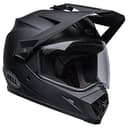
Bell’s ADV helmet is the value benchmark in that category: DOT plus ECE 22.06 plus MIPS at a mid-range price. It is heavy at around 1,696 g and the shell is polycarbonate, which is exactly where the money was saved. For a rider who wants ECE 22.06 without paying flagship prices, nothing else in this category is close — more on that in our dual-sport roundup.
Flagship: Race Star DLX Flex
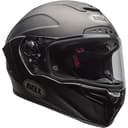
3K carbon shell, the Flex three-layer impact liner, DOT and SNELL certification, roughly 1,540 g in a size M. This is Bell’s answer to the European race helmets and it is priced against them. You are buying the carbon layup, the additional voluntary certification and the Panovision shield — not a different federal test result.
What Bell does and doesn’t publish
Bell is better than most manufacturers about publishing shell weights and shell counts, which is why more of the spec cells on this page carry real numbers than on some of our other roundups. Where Bell doesn’t publish something — the Broozer’s removable chin bar has nopublished impact rating, for instance — we say so rather than filling the gap. That specific blank matters: a removable chin bar with no rating is a wind deflector, not chin protection.
MIPS: worth it or not?
MIPS is a low-friction layer between the shell’s liner and your head that allows a small amount of rotation during an angled impact. It addresses rotational forces, which the DOT standard does not test for and which ECE 22.06 does. It is not a certification and it is not a substitute for one. On Bell’s range it typically adds a modest amount to the price, which makes it one of the better-value optional features you can buy.