Apex & Armor

Best Heated Motorcycle Jackets, Liners and Vests

Every maker in this category sells you heating zones. Only some of them publish watts — and watts is the only number that tells you how much heat the garment can actually make.

By Stephen V.Last updated How we research

Heated gear is the only category on this site where the thing you are buying is measured in watts, and it is also the category where that number is hardest to find. Marketing counts heating zones, because zones sound like coverage. Watts tell you how much heat there is to spread across them. A seven-element jacket pulling 42 watts is not warmer than a five-element vest pulling 54. So every pick below leads with the figure its maker publishes, and the one pick whose maker publishes no wattage at all is ranked last and told you so.

There is a second thing this page has to say before it sells you anything, and it matters more than the ranking: none of these garments is protective equipment, and not one of them publishes a CE rating of any kind. No EN 17092 abrasion class, no EN 1621 impact level, nothing. A heated liner goes under your riding jacket. A heated soft-shell goes under it too, even though it looks like outerwear and zips like outerwear. If a heated jacket ends up being the outermost thing between you and the road, you have accidentally gone riding in a hoodie with a plug on it. Our guide to CE armor ratings explains what those numbers mean and why their absence here is the whole point.

Everything below was read on 1 October 2026from the maker’s own product page — Firstgear, Gerbing, Tourmaster and ORORO — and every pick was confirmed in stock at the retailer we link before it was given a buy row. We have not worn these garments through a winter and we are not going to pretend we have; our methodology page says exactly what our recommendations are built from. If the cold you are fighting is in your hands rather than your chest, start with heated glovesinstead — for most riders that is the cheaper fix and the one that actually keeps you operating the controls.

How this is funded: we earn a commission if you buy through our links, at no extra cost to you. It never changes which gear we recommend, and we’ll tell you plainly when to skip a pick. Full disclosure.

Quick picks

Ranked on certification, spec and buyer fit. Select a row to jump to the full write-up. We haven’t crash-tested this gear — here is exactly what we do instead.

#GearBest forPrice
1
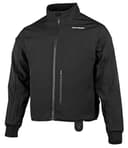
Firstgear Gen4 Heated Jacket Liner

Firstgear Gen4 Heated Jacket Liner

The most heat published by any liner here, and the cheapest of the three 12-volt liners: Firstgear states a 106-watt output across seven carbon panels covering chest, abdomen, arms, collar and the entire back. Buy this one unless you specifically want Gerbing's lifetime element warranty.

Best overall
$181.61 · View on Amazon

Price as of October 1, 2026. #ad How we’re funded

2
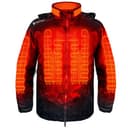
Gerbing Heated Jacket Liner 12V

Gerbing Heated Jacket Liner 12V

The liner that publishes the most complete electrical picture on this page — 135°F at 77 watts, 12V DC, 6.4 amps — and the only heated garment here whose maker offers a lifetime warranty on the heating elements themselves. It is also the hub your heated gloves, pants and socks plug into.

Best for a full wired system
$245.99 · View on Amazon

Price as of October 1, 2026. #ad How we’re funded

3
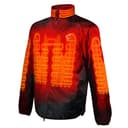
Tourmaster Synergy BT Pro-Plus 12V Heated Jacket

Tourmaster Synergy BT Pro-Plus 12V Heated Jacket

The only heated garment here you can buy and use with nothing else in the basket: the controller is built into the jacket, with a Bluetooth app as the second way in. Tourmaster also publishes what each setting actually reaches — 126, 113 and 100°F — which no one else on this page does.

Best with nothing else to buy
$249.99 · View on Amazon

Price as of October 1, 2026. #ad How we’re funded

4
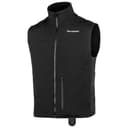
Tourmaster Synergy BT Pro-Plus 12V Heated Vest

Tourmaster Synergy BT Pro-Plus 12V Heated Vest

The same built-in controller and Bluetooth app as the Synergy jacket, for less, in the shape most riders should actually buy: core-only, no sleeve wiring to route, and the identical published setting temperatures of 126, 113 and 100°F.

Best heated vest
$199.99 · View on Amazon

Price as of October 1, 2026. #ad How we’re funded

5
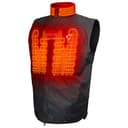
Gerbing Heated Vest Liner 12V

Gerbing Heated Vest Liner 12V

The core-only Gerbing: 135°F at 54 watts across five Microwire zones, with the same lifetime element warranty as the jacket liner and a pre-wired connector that feeds heated pants. The right Gerbing for a rider who already has warm gloves.

Best vest on a Gerbing system
$198.99 · View on Amazon

Price as of October 1, 2026. #ad How we’re funded

6
Gerbing 12V Heated Jacket Liner 2.0

Gerbing 12V Heated Jacket Liner 2.0

Electrically the same garment as the original Gerbing liner — 135°F at 77 watts, seven Microwire zones — rebuilt as something you would wear off the bike: water-resistant ripstop shell, two-way zipper, removable hood and a packable pocket. You pay for the jacket, not the heat.

Best off the bike as well
$271.38 · View on Amazon

Price as of October 1, 2026. #ad How we’re funded

7
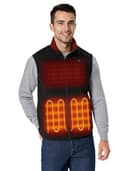
ORORO Men's Heated Fleece Vest (4 Heating Zones)

ORORO Men's Heated Fleece Vest (4 Heating Zones)

The answer for a rider who will not wire the bike. Four carbon zones including both hand pockets, run off ORORO's own 7.4-volt pack — which publishes 4800 mAh and up to 10 hours on low. It is cold-weather apparel rather than motorcycle gear, and it is honest about being a heating layer.

Best without wiring the bike
$119.99 · View on Amazon

Price as of October 1, 2026. #ad How we’re funded

The picks in full

#1Best overall

Firstgear Gen4 Heated Jacket Liner

The most heat published by any liner here, and the cheapest of the three 12-volt liners: Firstgear states a 106-watt output across seven carbon panels covering chest, abdomen, arms, collar and the entire back. Buy this one unless you specifically want Gerbing's lifetime element warranty.

Strengths

  • 106-watt output — the highest figure any maker on this page publishes
  • Seven flexible carbon panels at chest, abdomen, arms, collar and entire back
  • Moisture-wicking shell with stretch side and back panels, so it layers without bulk

Trade-offs

  • The Heat-troller controller is a separate purchase, so the price on the card is not the whole bill
  • Firstgear publishes the watt output but no voltage or amp draw — 106 W is also the biggest load here on a small charging system
  • No CE abrasion or impact rating is published: this is a layer, not your protective jacket
Safety standardCheck current listing
ConstructionNon-coated moisture-wicking shell with flexible carbon heat panels
Key feature106 W across 7 carbon panels
Fit / sizingXS-2XL plus L/XL/2XL Tall; the linked listing is Large
Best forCold-weather and winter riders who want the most published output per dollar

Specs and certification read from the manufacturer and retailer listing, on October 1, 2026. “Check current listing” means the maker doesn’t publish that figure — we won’t guess it.

#2Best for a full wired system

Gerbing Heated Jacket Liner 12V

The liner that publishes the most complete electrical picture on this page — 135°F at 77 watts, 12V DC, 6.4 amps — and the only heated garment here whose maker offers a lifetime warranty on the heating elements themselves. It is also the hub your heated gloves, pants and socks plug into.

Strengths

  • Publishes max heat AND the load: 135°F at 77 W, 12V DC 6.4 A
  • Seven Microwire zones at collar, chest (2), sleeves (2) and back (2)
  • Lifetime warranty on the Microwire heating elements, and the liner feeds Gerbing's glove, pant and sock connections

Trade-offs

  • Battery harness AND temperature controller are both sold separately — two purchases before it heats
  • 6.4 amps is a real draw on a small bike's charging system, especially with heated grips already fitted
  • No CE abrasion or impact rating is published — it goes under your riding jacket, not instead of it
Safety standardCheck current listing
ConstructionMini-rip shell with taffeta lining and Microwire heating elements
Key feature135°F at 77 W; 12V DC 6.4 A
Fit / sizingXS-4XL with Long variants in S/M/L/XL; the linked listing is Large
Best forRiders building a full wired heated system they intend to keep for a decade

Specs and certification read from the manufacturer and retailer listing, on October 1, 2026. “Check current listing” means the maker doesn’t publish that figure — we won’t guess it.

#3Best with nothing else to buy

Tourmaster Synergy BT Pro-Plus 12V Heated Jacket

The only heated garment here you can buy and use with nothing else in the basket: the controller is built into the jacket, with a Bluetooth app as the second way in. Tourmaster also publishes what each setting actually reaches — 126, 113 and 100°F — which no one else on this page does.

Strengths

  • Built-in 3-setting LED soft-touch controller plus a Bluetooth app — no separate Heat-troller to buy
  • Publishes the temperature of every setting: High 126°F, Medium 113°F, Low 100°F
  • Wind- and water-resistant soft-shell outer with Lycra stretch side panels, so it works as a standalone layer off the bike

Trade-offs

  • 42 W is roughly half the Gerbing liner's 77 W and under half the Firstgear's 106 W, spread across the same seven elements
  • It looks like a riding jacket and is not one: Tourmaster publishes no CE class and no impact armor for it, so a protective jacket still goes over the top
  • The 12V lithium battery that frees it from the bike is sold separately
Safety standardCheck current listing
Construction100% polyester wind- and water-resistant soft shell, 100% nylon liner, carbon fiber elements
Key feature42 W, 7 elements, controller built in
Fit / sizingX-Small to 3X-Large
Best forRiders who want heat working on the first cold morning without ordering a controller

Specs and certification read from the manufacturer and retailer listing, on October 1, 2026. “Check current listing” means the maker doesn’t publish that figure — we won’t guess it.

#4Best heated vest

Tourmaster Synergy BT Pro-Plus 12V Heated Vest

The same built-in controller and Bluetooth app as the Synergy jacket, for less, in the shape most riders should actually buy: core-only, no sleeve wiring to route, and the identical published setting temperatures of 126, 113 and 100°F.

Strengths

  • Controller is in the garment — same 3-setting LED touch control and Bluetooth app as the jacket, at a lower price
  • Publishes the full electrical spec: 12V DC, 37.2 W, 3.1 A, and the temperature of each setting
  • No sleeves means no elbow wiring and nothing fighting your jacket's armor placement

Trade-offs

  • Four elements against the jacket's seven — nothing on the arms, which is where most riders feel the cold first
  • 37.2 W is the lowest published output of the seven garments here
  • No CE class or armor is published, and the 12V battery for off-bike use costs extra
Safety standardCheck current listing
Construction100% polyester wind- and water-resistant soft shell with carbon fiber elements
Key feature37.2 W, 4 elements, controller built in
Fit / sizingX-Small to 3X-Large
Best forRiders who want a self-contained heated core layer with no controller to order

Specs and certification read from the manufacturer and retailer listing, on October 1, 2026. “Check current listing” means the maker doesn’t publish that figure — we won’t guess it.

#5Best vest on a Gerbing system

Gerbing Heated Vest Liner 12V

The core-only Gerbing: 135°F at 54 watts across five Microwire zones, with the same lifetime element warranty as the jacket liner and a pre-wired connector that feeds heated pants. The right Gerbing for a rider who already has warm gloves.

Strengths

  • 135°F at 54 W, 12V DC 4.5 A — a third less current than the jacket liner for core-only heat
  • Five Microwire zones (collar, chest x2, back x2) with the same lifetime element warranty
  • Drop tail back and a pre-wired connector for Gerbing heated pant liners

Trade-offs

  • Harness and controller are still separate purchases, same as the jacket liner
  • No sleeves, so arms are left to the jacket's own insulation
  • Gerbing says to wear it close to the body over a thin base layer, which rules out stacking it over a sweater
Safety standardCheck current listing
ConstructionMini ripstop nylon shell with Microwire heating elements
Key feature135°F at 54 W; 12V DC 4.5 A
Fit / sizingXS-3XL; the linked listing is Large
Best forRiders on a wired Gerbing system who want core heat and are already sorted for hands

Specs and certification read from the manufacturer and retailer listing, on October 1, 2026. “Check current listing” means the maker doesn’t publish that figure — we won’t guess it.

#6Best off the bike as well

Gerbing 12V Heated Jacket Liner 2.0

Electrically the same garment as the original Gerbing liner — 135°F at 77 watts, seven Microwire zones — rebuilt as something you would wear off the bike: water-resistant ripstop shell, two-way zipper, removable hood and a packable pocket. You pay for the jacket, not the heat.

Strengths

  • Identical published heat to the original liner: 135°F at 77 W, 12V DC 6.4 A, seven Microwire zones
  • Water-resistant mini ripstop shell, two-way main zipper and a packable pocket for a pannier
  • Same lifetime warranty on the Microwire heating elements

Trade-offs

  • Costs more than the original liner for no extra heat whatsoever
  • The removable hood is useless under a helmet — it is there for off the bike, and it is bulk you carry either way
  • Harness and temperature controller still sold separately, and no CE rating is published
Safety standardCheck current listing
ConstructionWater-resistant mini ripstop shell, nylon taffeta lining, Microwire elements
Key feature135°F at 77 W; packable, removable hood
Fit / sizingXS-4XL including long variants; the linked listing is Large
Best forTouring riders who want one heated layer for the bike and the campsite

Specs and certification read from the manufacturer and retailer listing, on October 1, 2026. “Check current listing” means the maker doesn’t publish that figure — we won’t guess it.

#7Best without wiring the bike

ORORO Men's Heated Fleece Vest (4 Heating Zones)

The answer for a rider who will not wire the bike. Four carbon zones including both hand pockets, run off ORORO's own 7.4-volt pack — which publishes 4800 mAh and up to 10 hours on low. It is cold-weather apparel rather than motorcycle gear, and it is honest about being a heating layer.

Strengths

  • No harness, no controller, no wiring — it works on a borrowed bike and in a cold car park
  • Four zones including the left and right hand pockets, which no wired motorcycle liner here heats
  • ORORO's own Mini 5K pack publishes 4800 mAh at 7.4 V and up to 10 hours — 3 h high, 6 h medium, 10 h low — on a 4-hour charge

Trade-offs

  • ORORO publishes no wattage at all, so there is no way to compare its output with the 12V garments above
  • The heat stops when the pack does; a wired liner's does not
  • Fleece is a mid-layer, not an outer shell at speed, and no CE rating is published — this is general winter apparel pressed into motorcycle service
Safety standardCheck current listing
ConstructionFleece with carbon fiber heating elements and NTC protection
Key feature4 battery zones; 7.4 V pack, up to 10 h
Fit / sizingThe linked listing is Large in black; battery inclusion varies by listing, so read the title
Best forRiders who want heat on any bike, with no harness, controller or wiring

Specs and certification read from the manufacturer and retailer listing, on October 1, 2026. “Check current listing” means the maker doesn’t publish that figure — we won’t guess it.

What a heated garment is not

We put this first because it is the mistake this category invites. Four of the seven picks above are called liners, which is unambiguous — nobody wears a liner on its own. The other three are a jacket, a vest and a fleece vest, and all three look like something you could ride in.

They are not. We read all seven maker pages on 1 October 2026 and not one publishes an abrasion class, an impact level, or any CE marking whatsoever. Tourmaster describes the Synergy BT Pro-Plus jacket as “100% polyester wind- and water-resistant soft-shell fabric” with a nylon liner, a microfleece collar and rib-knit cuffs. That is an accurate description of a very nice soft-shell jacket and it is also a description of a garment with no armor pockets, no abrasion panels and no published class. Compare it to anything on our jackets with armor page, where the question is which CE level is in the box rather than whether there is armor at all.

The practical rule is short. Buy heated gear to replace your mid-layer, never to replace your jacket. That also tells you how to size it: snug, over a thin base layer, with enough room left in your riding jacket that the shoulder and elbow armor still sits where it should. Stuffing a heated liner into a jacket that was already a close fit pushes armor off the joint, which is a real safety cost for a comfort upgrade. Our guide to how riding gear should fit covers checking armor placement in the riding position rather than standing in front of a mirror.

Watts, not zones

Here is the whole category in one table of published figures, every one read from the maker’s own page on 1 October 2026:

  • Firstgear Gen4 jacket liner— 106 W, seven carbon panels (chest, abdomen, arms, collar, entire back)
  • Gerbing jacket liner and Jacket Liner 2.0— 135 °F at 77 W, 12V DC 6.4 A, seven Microwire zones (collar, chest ×2, sleeves ×2, back ×2)
  • Gerbing vest liner— 135 °F at 54 W, 12V DC 4.5 A, five Microwire zones (collar, chest ×2, back ×2)
  • Tourmaster Synergy BT Pro-Plus jacket— 12V DC, 42 W, 3.5 A, seven carbon fiber elements (chest, sleeves, back, collar)
  • Tourmaster Synergy BT Pro-Plus vest— 12V DC, 37.2 W, 3.1 A, four carbon fiber elements (chest, back, collar)
  • ORORO heated fleece vest— four carbon zones (both hand pockets, mid-back, collar). No wattage published anywhere on the page.

Read that list and the ranking explains itself. The Firstgear liner publishes two and a half times the output of the Tourmaster jacket across the same number of elements. Divide watts by elements — our arithmetic, not the makers’ — and you get roughly 15 W per panel on the Firstgear, 11 W on the Gerbing jacket liner, 11 W on the Gerbing vest, 9 W on the Tourmaster vest and 6 W on the Tourmaster jacket. Seven elements fed by 42 watts is seven mildly warm patches; seven elements fed by 106 watts is a different garment.

One useful cross-check on all of this: where a maker publishes both watts and amps, the two agree on 12 volts almost exactly. Gerbing’s 77 W at 6.4 A, its 54 W at 4.5 A, Tourmaster’s 42 W at 3.5 A and 37.2 W at 3.1 A all divide out to within a rounding error of 12 V. These are real electrical specifications rather than marketing numbers, which is exactly why the two gaps are worth naming: Firstgear publishes a watt figure but no voltage and no current, and ORORO publishes no watt figure at all.

Your charging system has a budget, and you are already spending it

Watts are not free. A 106-watt liner on a 12-volt system draws roughly 8.8 amps — again our arithmetic, since Firstgear does not publish the current — which is the largest single load on this page. Gerbing publishes 6.4 A for its 77 W liner and 4.5 A for the 54 W vest. Tourmaster’s figures are the gentlest at 3.5 A and 3.1 A.

Whether that matters depends entirely on your bike. A large touring machine will not notice any of it. A small or older single with a modest alternator, already running heated grips and auxiliary lights, can absolutely run a deficit at idle in traffic — and the first symptom is a battery that will not start it the next morning. If you do not know your bike’s surplus output, the honest move is the Tourmaster or the vest rather than the biggest liner you can find. More watts you cannot feed is not more heat.

This is also the one real argument for the battery-powered ORORO vest that has nothing to do with convenience: it draws nothing from the bike at all.

12 volts from the bike, or a battery in a pocket

Every pick here is one or the other, and the choice is bigger than the brand.

Wired to the bikemeans the heat lasts exactly as long as the ride does. That is the entire case, and for touring it is decisive — nothing about a nine-hour day in the cold is improved by a garment that quits at hour three. The costs are a fused harness to the battery, a controller, and the fact that you are physically tethered to the motorcycle: step off at a fuel stop and you unplug. Five of the seven picks above are wired, and both Tourmaster garments can also run from an optional 12 V lithium pack, sold separately, if you want it both ways.

Battery-poweredmeans no installation, no controller and no tether. It works on a borrowed bike, a rental, and in a cold car park afterwards. The cost is a hard ceiling on runtime: ORORO’s own Mini 5K pack publishes 4800 mAh at 7.4 V and up to 10 hours — 3 hours on high, 6 on medium, 10 on low — on a four-hour charge. Read that honestly and the three hours on high is the number that matters, because high is the setting you will use on the morning you bought it for. This is the same trade our heated gloves page works through on the hands, and the conclusion is the same: battery for short cold rides, 12 volts for long ones.

Jacket, liner or vest

Shape decides more than badge here, so it is worth being deliberate.

A jacket linerheats arms as well as core. That sounds obviously better and usually is, but it comes with wiring down the sleeves, which is the part most likely to fight your riding jacket’s elbow armor and the part that fails first on any heated garment. A vest heats the core only, and the honest physiology is that a warm core does a surprising amount for how cold your hands and feet feel, because your body stops shutting down circulation to the extremities to protect it. For a lot of riders, a heated vest plus good gloves beats a heated liner plus mediocre gloves.

A standalone heated jacket like the Tourmaster is the third shape: a soft-shell you can wear as a jacket when you are not riding, with the controller built in. It is genuinely the most convenient thing here and the lowest output, and it is the one most likely to be mistaken for protective gear. All three shapes are ranked above; none of them is the right answer for everyone.

The controller is a second purchase, and nobody mentions it

This is the detail that turns a $180 liner into a $250 one. Gerbing states plainly that “all Gerbing installations require a Battery Harness and Temperature Controller for operation (sold separately)” — that is two items, and it applies to the jacket liner, the 2.0 and the vest liner alike. Firstgear’s liner works with “either a Single or Dual Heat-troller”, also a separate purchase. None of those costs is in the price you see on the cards above, because the cards show the live price of the garment we link and nothing else.

The two Tourmaster garments are the exception and it is their strongest argument: the controller is built into the garment — a 3-setting LED soft-touch control, plus a Bluetooth app as a second way in. Tourmaster is also the only maker here that publishes what each setting actually reaches: 126 °F on high, 113 °F on medium, 100 °F on low. Gerbing publishes a single max-heat figure of 135 °F and Firstgear publishes none. If you want to buy one box and have heat on the first cold morning, the Tourmaster is the pick, and you are paying for that in watts.

One thing worth knowing if you expect to grow the system: Gerbing describes its jacket liner as the “home base” for glove, pant and sock connections, and the vest liner ships with a pre-wired connector for pant liners. If heated trousers are plausibly in your future, that is a reason to start on Gerbing even though it is not our first pick.

What the ranking is saying

  • The Firstgear Gen4 liner is first because it is both the cheapest 12-volt liner here and the one with the most published heat. 106 watts across seven carbon panels covering chest, abdomen, arms, collar and the entire back, in a moisture-wicking shell with stretch side and back panels so it layers without bulk, with a one-year warranty. Buyer-first, that combination ends the argument. The two honest limitations: the Heat-troller is extra, and 106 W is the biggest demand on this page if your bike’s charging system is marginal.
  • The Gerbing liner is second on the strength of what Gerbing stands behind. It publishes less output than the Firstgear — 135 °F at 77 W — and it publishes more detail, including the 6.4-amp draw, which nobody else at the top of this page does. It carries a lifetime warranty on the Microwire heating elements themselves, and it is the hub a full heated system plugs into. If you intend to own this garment in 2036, buy it instead.
  • The Tourmaster Synergy BT Pro-Plus jacket is third for convenience and nothing else. No controller to order, published setting temperatures, a wearable soft-shell. 42 watts across seven elements is the thinnest spread here, and the garment’s resemblance to a riding jacket is the single most dangerous thing on this page. Ranked, with that said out loud.
  • The Tourmaster vest is the best vest herebecause it brings the built-in controller and the app down to a lower price, in a shape with no sleeve wiring to route. Four elements instead of seven means nothing on the arms, and 37.2 W is the lowest published figure on the page — but it is also 9 watts per element against the jacket’s 6, so the core actually gets more.
  • The Gerbing vest liner is the vest for a Gerbing system. 135 °F at 54 W over five zones, a third less current than the jacket liner, the same lifetime element warranty, and a pre-wired connector that feeds heated pants. Gerbing says to wear it close to the body over a thin base layer, which is a real constraint worth reading before you plan to stack it over a sweater.
  • The Jacket Liner 2.0 is the same heat in a better jacket. Identical published specification to the original — 135 °F at 77 W, 6.4 A, seven Microwire zones — rebuilt with a water-resistant ripstop shell, a two-way zipper, a removable hood and a packable pocket. It costs more for no extra warmth, so it earns its place only if you want one heated layer that works at the campsite too. The hood is useless under a helmet and we would take it off.
  • The ORORO fleece vest is last on the list and first for a specific rider: anyone who will not fit a harness. Four zones including both hand pockets — which no wired motorcycle liner here heats — and a published 10 hours on low from a 7.4 V pack. It is ranked last because ORORO publishes no wattage, so there is no way to put it on the same axis as everything above it, and because fleece is a mid-layer rather than anything that handles 70 mph air. It is general winter apparel doing a motorcycle job, and we would rather say that than dress it up.

What we did not rank, and why

Heated grips are not on this page and they beat everything on it for a lot of riders, because cold hands stop you operating the controls long before a cold chest stops you riding. They are also permanently attached to one bike and do nothing for the back of your hand, which is the side the wind hits. We work the grips-versus-gloves question through properly in our cold-weather gear guide, and the short version is that the cheapest real upgrade is usually handguards.

Gerbing’s 12V EX Pro heated jacketis the outer-shell member of the Gerbing range and would have been an interesting fourth Gerbing. It is not ranked on availability: on 1 October 2026 the retailer we link listed it as “Only 2 left in stock” in the one size the search returned, which is not a listing we will send readers to. The Gerbing EX Pro 12V heated pants are in stock on the same date, and are named here rather than ranked because trousers are a different purchase and this page is about the upper body.

The Warm & Safe 110 W liner and the 7.4 V Tour Master Synergy jacket both exist, both are motorcycle-specific, and both were excluded on stock depth on 1 October 2026 — “Only 2 left” on the Warm & Safe and “Only 4 left” on the 7.4 V Synergy. The Warm & Safe figure is interesting enough to record: 110 watts would be the highest published output in this whole category if the listing were stocked.

SAVIOR HEAT and KEMIMOTO battery vestsare both cheaper than the ORORO and both were in stock on this date, and both are left unranked for the same reason: the listing titles do not map cleanly onto a single named model on the maker’s own site, so we cannot tie a specific ASIN to a specific published specification. We rank the SAVIOR HEAT and Kemimoto gloves on our heated gloves page, where that mapping is unambiguous. If your budget is under $100 and you want a battery vest, both brands are a reasonable gamble — we just will not pretend we verified which model you are getting.

Armored base layers get confused with heated ones often enough to be worth a sentence. They are the opposite product: no heat, but actual CE-rated impact protection, which nothing on this page has. If what you actually wanted was protection under a jacket rather than warmth, our armored base layers page is the one you want.
How to read our safety notes. We have not crash-tested any of this gear — nobody honestly can on a review budget. Every helmet and armor pick names the certification the maker publishes (DOT, ECE 22.06, SNELL, or a CE level), which we read from the listing on a dated visit. Certification is the floor, not a guarantee; fit and condition matter as much as the sticker. What the standards actually mean.

Frequently asked questions

What is the best heated motorcycle jacket?

For most riders, the Firstgear Gen4 Heated Jacket Liner. Firstgear publishes a 106-watt output across seven flexible carbon panels covering the chest, abdomen, arms, collar and entire back — the highest figure any maker on this page publishes — and it is also the cheapest of the three 12-volt liners we rank. If you want the most complete published electrical specification and a lifetime warranty on the heating elements, the Gerbing Heated Jacket Liner 12V is the alternative at 135°F and 77 W on a 6.4-amp draw. If you want heat working the day it arrives with no controller to order separately, the Tourmaster Synergy BT Pro-Plus has the controller and a Bluetooth app built into the garment, at 42 W.

Does a heated motorcycle jacket count as protective gear?

No, and this is the most important thing on this page. We read all seven maker pages on 1 October 2026 and not one publishes a CE abrasion class (EN 17092), a CE impact rating (EN 1621), or any CE marking at all. A heated liner or vest replaces your mid-layer and goes under your riding jacket. That includes the garments that look like outerwear: the Tourmaster Synergy BT Pro-Plus is a wind- and water-resistant polyester soft-shell with no armor pockets and no published class. Buy heated gear for comfort and keep a certified jacket over the top of it.

How many watts should a heated motorcycle jacket have?

More watts means more available heat, and the published range in this category is wide: 106 W on the Firstgear Gen4, 77 W on both Gerbing jacket liners, 54 W on the Gerbing vest, 42 W on the Tourmaster Synergy jacket and 37.2 W on the Tourmaster vest. The number to think about is watts divided by elements, because that is the heat each panel actually gets — roughly 15 W per panel on the Firstgear against 6 W on the Tourmaster jacket, both across seven elements. The ceiling is your motorcycle, not the garment: 106 W on a 12-volt system is about 8.8 amps, and a small bike already running heated grips may not have that to spare.

Do I need a controller for a heated jacket liner?

For Gerbing and Firstgear, yes, and it is a separate purchase that is not in the price on the card. Gerbing states that all its installations require both a Battery Harness and a Temperature Controller, sold separately — that applies to the jacket liner, the Jacket Liner 2.0 and the vest liner. Firstgear's liner works with either a Single or a Dual Heat-troller, also sold separately. The two Tourmaster Synergy BT Pro-Plus garments are the exception: the controller is built into the garment as a 3-setting LED soft-touch control, with a Bluetooth app as a second way to adjust it. Budget for the controller before you compare prices across brands.

Is a heated vest or a heated jacket liner better for motorcycling?

A liner heats your arms as well as your core, which is more heat and more wiring — the sleeve runs are what fight your riding jacket's elbow armor and what tends to fail first. A vest heats the core only, and that does more than it sounds like it should: keeping the core warm stops your body restricting circulation to your hands and feet to protect it. For a lot of riders a heated vest plus genuinely good gloves is a better buy than a heated liner plus mediocre ones. Vests also draw less current, which matters on a bike with a small charging system.

Can I use a heated jacket without wiring it to the bike?

Yes, two ways. Both Tourmaster Synergy BT Pro-Plus garments run from a direct-to-bike 12 V connection or from an optional 12 V lithium battery, sold separately. Or buy a garment designed around a battery from the start: the ORORO heated fleece vest runs on ORORO's own 7.4 V Mini 5K pack, published at 4800 mAh and up to 10 hours — 3 hours on high, 6 on medium, 10 on low — charging in about four hours. The trade is a hard runtime ceiling. Wired heat lasts as long as the ride does, which is why every long-distance touring rider we would listen to runs 12 volts.

How much current does a heated jacket draw from the motorcycle?

Where makers publish it: Gerbing's jacket liners draw 6.4 amps at 12V DC for 77 watts, its vest liner 4.5 amps for 54 watts, and Tourmaster's Synergy jacket and vest 3.5 and 3.1 amps for 42 and 37.2 watts. Firstgear publishes the 106-watt output but neither voltage nor current, which works out to roughly 8.8 amps on a 12-volt system — that division is ours, not Firstgear's. Whether your bike can spare it depends on the surplus output of its charging system with the headlight, heated grips and anything else already running. A big tourer will not notice; a small single in traffic at idle can run a deficit, and the symptom shows up as a flat battery rather than as cold.

Do heated jackets work with an airbag vest?

It depends which way round your airbag is worn, so settle that before you buy either. Some airbag vests are designed to go over your riding jacket and some to go underneath it — our airbag vest page covers both patterns. An airbag worn over the jacket is unaffected by a heated liner inside it. An airbag worn under the jacket is competing for the same space as a heated liner, and an airbag needs room to inflate, so check what your airbag's maker says about what may be layered over it rather than assuming. If there is only room for one extra layer under your jacket, keep the airbag: it is the one that is protective equipment.

Sources

  • Firstgear — Heated Jacket Liners — Firstgear's published heated jacket liner specification: "106-Watt output", "Seven heat panels cover the chest, abdomen, arms, collar and entire back", "Soft and flexible carbon panels, shaped for maximum heat transfer", "High tech, moisture wicking fabric with stretch side and back panels", "Lightweight, non-coated shell" with a "fleece inner collar", "One-year manufacturer's warranty", and dual-zone heating usable with "either a Single or Dual Heat-troller" (the controller is a separate item). Sizes XS, S, M, L, XL, 2XL plus L Tall, XL Tall and 2XL Tall. Firstgear publishes the watt output but NO voltage and NO amp draw on this page, where Gerbing and Tourmaster publish both; and it publishes no CE abrasion or impact rating of any kind (accessed October 1, 2026)
  • Gerbing — Heated Jacket Liner, 12V Motorcycle — Gerbing's published specification: "Max Heat: 135° @ 77W", "12V DC 6.4 Amp", "seven Microwire heating zones: collar, chest (2), sleeves (2) and back (2)", "Mini-rip shell", "Taffeta lining", "YKK zippers", and the note that "All Gerbing installations require a Battery Harness and Temperature Controller for operation (sold separately)". The liner is described as the "home base" for the glove, pant and sock connections. Gerbing offers "a lifetime warranty on the performance of their patented Microwire Heating Elements". Sizes XS through 4XL including S/Long, M/Long, L/Long and XL/Long. No CE abrasion or impact rating is published (accessed October 1, 2026)
  • Tourmaster — Synergy BT Pro-Plus 12V Heated Jacket — Tourmaster's published specification: "12v DC", "42w draw", "3.5a current", "7 flexible carbon fiber heating elements" at the "chest, sleeves, back, and collar", three heat settings published as actual temperatures — High "126°F/52°C", Medium "113°F/45°C", Low "100°F/38°C" — and dual control via a built-in 3-setting LED smart soft-touch controller or a Bluetooth-enabled app. Construction: "100% polyester wind- and water-resistant soft-shell fabric" with a "100% nylon fixed liner, microfleece collar, and rib-knit cuffs" and Lycra side stretch panels. Power is by "12v direct-to-bike connection or 12v lithium battery (sold separately)". Sizes X-Small through 3X-Large. NO CE class and NO impact armor is published for this garment, despite it being an outer soft-shell jacket rather than a liner (accessed October 1, 2026)
  • Tourmaster — Synergy BT Pro-Plus 12V Heated Vest — Tourmaster's published specification: "12v DC", "37.2w draw", "3.1a current", "4 flexible carbon fiber heating elements positioned at the chest, back, and collar", and the same three published setting temperatures as the jacket — High "126°F/52°C", Medium "113°F/45°C", Low "100°F/38°C" — with "dual control with a built-in 3-setting LED smart touch controller or Bluetooth-enabled app compatibility". Construction: "100% polyester wind- and water-resistant soft-shell fabric" with a "100% nylon fixed interior" and Lycra side stretch panels. Power by direct-to-bike 12V or an "optional 12v lithium battery (sold separately)". Sizes X-Small through 3X-Large. No CE rating is published (accessed October 1, 2026)
  • Gerbing — Heated Vest Liner, 12V Motorcycle — Gerbing's published specification: "Max Heat: 135° F @ 54W", "Power: 12V DC 4.5 Amp", five Microwire heating zones (collar, chest x2, back x2), a "Mini Ripstop nylon" shell, a drop tail back, YKK zippers and a pre-wired connector for pant liners. Gerbing states it is designed to be worn close to the body — under an outer jacket or over a thin polyester base layer — for the fastest heat transfer. Battery Harness and Temperature Controller sold separately; lifetime warranty on the Microwire elements. Sizes XS through 3XL. No CE rating is published (accessed October 1, 2026)
  • Gerbing — 12V Heated Jacket Liner 2.0 — Gerbing's published specification for the 2.0: "Max Heat: 135° @ 77W" and "12V DC 6.4 Amp" — electrically identical to the original liner — with the same seven Microwire-powered zones (collar, chest x2, sleeves x2, back x2) and the same lifetime warranty on the heating elements. What differs is the garment: "Premium Water-Resistant Mini Ripstop Shell", "Nylon Taffeta Lining", a two-way main zipper, hemmed cuffs, a removable hood and a packable pocket. Battery Harness and Temperature Controller are again sold separately. Sizes XS through 4XL including long variants. No CE rating is published (accessed October 1, 2026)
  • ORORO — Men's Heated Fleece Vest (4 Heating Zones) — ORORO's own product page publishes the zone count and the zone locations — "4 Heating Zones on Left & Right Hand Pockets, Mid-back and Collar" — and names the element as premium carbon fiber with NTC protection technology. The product name ORORO publishes is "Men's Heated Fleece Vest (4 Heating Zones)" and the garment is described as a heating LAYER rather than an outer shell. No wattage is published anywhere on the page, and no CE abrasion or impact rating: this is general cold-weather apparel, not motorcycle gear (accessed October 1, 2026)
  • ORORO — Mini 5K Battery (4800 mAh) & Charging Cable — The published specification for the battery ORORO's heated layers run on: 4800 mAh capacity, "7.4V output", run time "Up to 10 hours" varying by setting — "3 hrs high, 6 hrs medium, 10 hrs low" — a 4-hour charge with a 5V3A charger, one DC output plus USB-A out and USB Type-C in, 3.07 x 2.48 x 0.98 inches and 6.53 oz. ORORO states the cell is UL and CE safe and rechargeable up to 800 times. This is the figure that bounds every battery-powered heated garment: the heat stops when the pack does (accessed October 1, 2026)

Keep reading

More in Jackets