How Should Motorcycle Gear Fit?
Armor only protects the part of you it is actually sitting over. Which means a jacket that fits perfectly standing in a shop can put the elbow pad on your forearm the moment you reach for the bars.
How this is funded: we earn a commission if you buy through our links, at no extra cost to you. It never changes which gear we recommend, and we’ll tell you plainly when to skip a pick. Full disclosure.
Almost every fit guide for motorcycle gear is written as if you were standing in a shop with your arms by your sides. You will not be doing that on the bike, and the difference between those two postures is where most badly-fitting riding gear comes from.
There is one principle underneath every rule on this page, and it is worth stating before anything else: armor only protects the part of you it is actually sitting over. A CE Level 2 elbow protector on your forearm is a Level 2 protector for your forearm. Everything below is a way of checking that the protection you paid for is where you think it is, in the position you will actually be in.
The helmet is the one piece this guide does not cover, because it works differently enough to need its own page — start with helmet sizing and head shape for that.
Jackets: check it sitting down, hands on the bars
A riding jacket is cut differently from a normal coat: shorter at the front, longer at the back, with sleeves that are too long standing up because they are the right length when you reach forward. If a riding jacket feels correct with your arms down, it is probably a size too big.
Four checks, all done in the riding position:
- Shoulder armor over the point of the shoulder. Reach for the bars and feel for the protector through the fabric. If it has slid inboard toward your neck or outboard down your arm, the jacket is too large or the shoulder seam is in the wrong place for your frame.
- Elbow armor over the elbow.This is the one that moves most. Bend your arms into the riding position and feel where the pad sits — on a lot of jackets it slides toward the forearm, and some makers provide an adjustable elbow pocket specifically to fix it.
- The back protector flat against your back. It should not bow away from you when you lean forward, and it should not fold. A protector that has to deform to fit the pocket is not lying flat against you.
- Grab test. Take hold of the fabric at the upper arm. If you can gather a large handful, there is enough room for the armor to rotate right off the joint in a slide.
The other end of the mistake is real too. A jacket you cannot reach the bars in, or that pulls across the shoulders, will make you tired and you will stop wearing it. Snug, not restrictive.
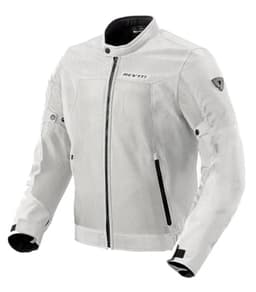
A jacket that fits the way this page describes
REV'IT! Eclipse 2 Mesh
The mesh jacket to beat for hot-weather value: huge airflow from a premium brand, CE armor at the shoulders and elbows included, and a back-protector pocket ready to upgrade. Genuinely breezy without feeling flimsy.
See the mesh jacket rankingPrice as of September 22, 2026. #ad How we’re funded
The “size up for layers” trap
This deserves its own heading because it is the single most common way riders undo their own protection. Buying a size up so a thick hoodie fits underneath means that for the eight months of the year you are not wearing the hoodie, the jacket is a size too big and the armor has moved.
There are two correct solutions. Buy a jacket that is designedwith room for a mid layer — touring and adventure jackets are cut that way deliberately, and our ADV and touring ranking is full of them. Or keep the jacket close-fitting and use a thin technical base layer underneath rather than a bulky one. Either way, try the jacket on wearing whatever you actually intend to ride in.
Gloves: the palm decides it, the cuff finishes it
Gloves are the piece riders most often buy too big, because a roomy glove feels comfortable for the thirty seconds you try it on and awful three hours into a ride.
- No loose material in the palm. Bunched fabric moves against your hand instead of with it, and that is what produces hot spots and blisters. A correct glove feels like a layer of your hand.
- A small gap at the fingertips. Enough that you are not pressing into the end of the finger, little enough that you can still operate the levers with precision.
- New leather should feel firm. It gives as it breaks in. A leather glove that feels roomy in the shop will be sloppy within a month.
- Pull test on the closure.Fasten the wrist strap and have someone pull the glove off by the fingers. If it comes away easily, it will come off in a slide — and a glove on the road is not protecting a hand.
Cuff choice is a fit question too: a gauntlet goes over the jacket sleeve and a short cuff goes under it, and mixing those up leaves a gap at the wrist. Our gauntlet vs short-cuff guide covers which to use when.
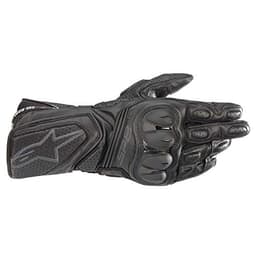
Our default fit reference for gloves
Alpinestars SP-8 V3
The best all-around leather gauntlet here: a full-gauntlet cuff, a hard knuckle, and CE certification, with enough airflow to run three seasons. The default do-everything sport-touring glove.
See the full glove rankingPrice as of September 22, 2026. #ad How we’re funded
Boots: heel lift is the whole test
Two questions and you are done. Does your heel lift when you walk? If it does, the boot is too big, and your foot will slide forward inside it under braking. Can you move your toes? If not, it is too small, and your feet will be cold on any ride longer than an hour because circulation is being restricted.
Beyond that: try them with riding socks, not the thin pair you happened to wear to the shop, and do not confuse stiff with badly fitting. A sport-touring boot with an ankle brace and a shin plate is meant to resist your ankle moving sideways, so it will feel unfriendly for the first few rides. That is the protection working. What is not acceptable is pressure on the ankle bone or the instep, which will not break in.
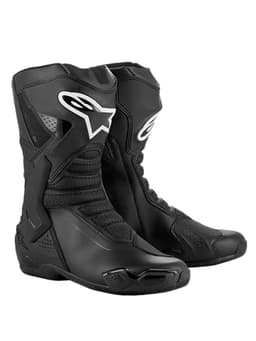
Stiff out of the box, and that is the point
Alpinestars SMX-6 V3
The do-everything sport-touring boot: ankle and shin protection, a locking heel/toe structure and enough comfort to walk in. The default upgrade from sneakers for street riders.
See the boot rankingPrice as of September 22, 2026. #ad How we’re funded
Pants and lower-body armor: check it in the crouch
Sitting on a bike pulls your pant legs up, sometimes by several inches. That means knee armor positioned perfectly while you stand can be over your shin at the first corner— which is why most decent riding pants have knee pockets with two or three height positions.
Sit on the bike, feel for the protector, move it until it is over the kneecap in that position, and only then judge the pant. Then check for hip armor while you are there: several pants ship with a hip pocket and nothing in it, which our riding pants ranking is explicit about. An EN 1621 insert fills it for very little money.
The same logic applies to armored jeans, with one extra note: denim stretches with wear far more than technical textile does, so a pair that held the armor in place when new may not a year later. Re-check it occasionally.
A five-minute check you can do today
- Put your full kit on and sit on the bike with your hands on the bars.
- Feel for the shoulder, elbow, back and knee protectors, in that order. Each one should be over the joint it is named after.
- Fasten every closure and pull — gloves at the fingers, boots at the heel, jacket at the shoulder. Anything that shifts easily will shift in a crash.
- Fix what you can with the adjustments the gear already gives you. Anything that cannot be fixed by adjustment is a sizing problem, and it is worth knowing that now rather than afterwards.
If that exercise turns up empty armor pockets rather than misplaced armor, that is the cheaper problem to have — our armor inserts page covers what drops into them, and our beginner gear guide puts the whole kit in buying order.
How to read our safety notes. We have not crash-tested any of this gear — nobody honestly can on a review budget. Every helmet and armor pick names the certification the maker publishes (DOT, ECE 22.06, SNELL, or a CE level), which we read from the listing on a dated visit. Certification is the floor, not a guarantee; fit and condition matter as much as the sticker. What the standards actually mean.
Frequently asked questions
How tight should a motorcycle jacket be?
Tight enough that the armor does not move, loose enough that you can reach the bars and breathe. The test is not how it looks standing up — it is whether the shoulder and elbow protectors are still over your shoulder and elbow when you are sitting on the bike with your hands on the grips. If you can grab a large handful of fabric at the shoulder, or the elbow pad slides down your forearm when you reach forward, the jacket is too big regardless of what the label says. A correctly fitted riding jacket feels closer than a normal coat and is cut short at the front and long at the back for exactly that reason.
How tight should motorcycle gloves be?
Snug across the palm with no loose material bunching in it, and close at the fingertips without pressing on them — a small gap you can just pinch is about right. Loose material in the palm is what causes hot spots and blisters on a long ride, because it moves against your hand rather than with it. New leather gloves should feel firm and will give slightly as they break in, so a glove that feels roomy in the shop will be sloppy in a month. Then check the closure: if the wrist strap does not hold the glove on against a firm pull, the glove can come off in a slide.
How tight should motorcycle boots be?
Your heel should not lift when you walk and your foot should not slide forward under braking, with enough room to move your toes. Try boots on with the socks you will actually ride in, and expect a sport-touring boot to feel stiff and unfriendly out of the box — that stiffness is the protective structure, not a sizing error, and it softens with use. A boot that is too loose lets the foot move inside it, which is uncomfortable and is also the mechanism by which a boot comes off in a crash.
Should I size up my riding gear for layers?
Only into a jacket designed for it, and only with the layers on when you try it. The failure mode is buying a size up to fit a hoodie underneath, then riding in summer with nothing under it — at which point the jacket is a size too big, the armor has moved off your shoulders and elbows, and the protection you paid for is sitting next to the bone rather than over it. Touring jackets are cut with room for a mid layer already, which is the correct way to solve this. If you need a thermal layer under a close-fitting jacket, use a thin technical base layer rather than a bulky one.
Where should knee armor sit on riding pants?
Over your kneecap in the riding crouch, not in the standing position. Sitting on a bike pulls the pant leg up, so armor positioned correctly while standing can end up over your shin at the first corner. Sit on the bike, feel for the protector through the fabric, and adjust it using whatever adjustment the maker provides — most good riding pants have knee armor pockets with two or three height positions for exactly this reason. Then zip the pant to your jacket if they connect, because a connected pant cannot ride down in a slide.
Does a helmet fit the same way as the rest of the gear?
It follows the same principle — protection has to be in contact with you to work — but the method is different enough that it has its own guide. A helmet is sized on head circumference and then on internal shape, it should press evenly with no hot spots, and it should not rotate independently of your head when you take hold of it and try to turn it. A helmet that moves is not doing what its retention system was tested to do. Our helmet sizing and head shape guides cover the measurement and the shape question in detail.
How do I know if my armor inserts are the right size?
Measure the pocket before you order, because that is the constraint that catches most people out. Back protector inserts in particular are sold in a couple of sizes and jacket pockets vary a great deal — a Level 2 plate that does not fit the pocket is a plate that sits in a drawer. Once fitted, check that the protector covers the area it is meant to when you are in the riding position, and that it does not fold or bow when you lean forward. A protector that has to deform to fit is not sitting flat against you.
Sources
- MotoCAP — Independent Motorcycle Clothing & Helmet Assessment — Independent Australian lab rating protective clothing and helmets for protection and comfort (accessed July 21, 2026)
- NHTSA — How to Choose the Right Motorcycle Helmet — NHTSA consumer guidance on DOT certification and spotting novelty helmets (accessed July 21, 2026)
- 49 CFR 571.218 — FMVSS No. 218, Motorcycle helmets — The US federal helmet standard: peak-acceleration, penetration and retention requirements; applies to all on-road motorcycle helmets (accessed July 21, 2026)
- 49 CFR 571.218 S5.5 and S5.6 — projections and labeling — The federal standard's own wording. S5.5 Projections: "A helmet shall not have any rigid projections inside its shell. Rigid projections outside any helmet's shell shall be limited to those required for operation of essential accessories, and shall not protrude more than 0.20 inch (5 mm)." S5.6 Labeling requires each helmet to be permanently and legibly labeled with the manufacturer's name, the discrete size, the month and year of manufacture, and care instructions covering materials, cleaning agents and modification warnings; and requires a certification label carrying "DOT" at least 0.38 inch high, "FMVSS No. 218" at least 0.09 inch, and "CERTIFIED" at least 0.09 inch, positioned 1 to 3 inches from the bottom rear edge of the helmet. S5.1 caps peak acceleration at 400 g, with time above 200 g limited to 2.0 ms and above 150 g to 4.0 ms; S5.2 requires the penetration striker not to contact the headform; S5.3 requires the retention system to hold specified loads without separating (accessed September 18, 2026)
Keep reading
How to size a motorcycle helmet
The one piece of fit this guide deliberately does not cover, because it needs a page of its own. Start with a tape measure.
Read the sizing guideMotorcycle helmet head shapes
Why two helmets in the same stated size fit completely differently, and how to work out which shape your head is.
Read the head shape guideBest motorcycle armor inserts
Measure the pocket, then buy the plate. These are the drop-in EN 1621 protectors that fit standard jacket pockets.
Compare insertsCE armor ratings explained
What EN 1621 and EN 17092 actually measure — useful context for why armor placement matters as much as armor level.
Read the ratings guideBeginner motorcycle gear guide
The head-to-toe buying order by budget, with a pick for each piece — read alongside this page before you order anything.
Read the beginner guideHow long does motorcycle gear last?
Fit changes as gear ages — a stretched jacket and a compressed protector are both fit problems. Here are the replacement clocks.
Read the longevity guide