How to Stop a Motorcycle Helmet Fogging Up
Fog is a temperature problem, not a cleanliness problem. That is why wiping the shield never works and why one specific fix works almost every time.
How this is funded: we earn a commission if you buy through our links, at no extra cost to you. It never changes which gear we recommend, and we’ll tell you plainly when to skip a pick. Full disclosure.
Fog is condensation, and condensation is a temperature problem. Your breath is warm and nearly saturated with water vapour; the inside of your shield is colder than that; the vapour turns back into water on the cold surface. That single sentence explains everything about the problem, including why every obvious fix fails. Wiping it clears the water that is already there and changes nothing about the surface temperature, so it fogs again in seconds. Cleaning the shield more thoroughly does nothing, because the shield was not dirty.
It also explains the most dangerous part. Fog is worst at a standstill — at a junction, at a light, pulling out of a side road. At speed, airflow through the vents carries warm air out of the helmet and the airstream keeps the outer face of the shield near ambient. Stop, and both of those stop with you. So the fix has to work with no airflow, which immediately rules out most of the advice you will read.
The fix that actually works: a sealed second lens
An anti-fog insert is a thin lens that mounts on pins inside your shield and seals against it with a silicone bead. That seal traps a layer of air between the two lenses, and the trapped air insulates the inner one — so the surface you are breathing on stays above the dew point and the vapour has nowhere to condense. It is the same principle as double glazing, and it works for the same reason: not a coating that gets used up, but a physical barrier that does not depend on airflow, speed, weather or how recently you treated the shield.
Two things to know before you buy one. First, fitment is specific— an insert is cut and pinned for a particular shield model, so you buy the one coded to your helmet’s visor. Second, check your shield hasthe pins: many mid-range and premium helmets are sold prepared for an insert and some include one in the box, while plenty of budget shields have no mounting provision at all and cannot take one. That is a genuine reason to care about it when you choose the helmet — it is one of the four features we tell people to prioritise in our helmet buying guide.
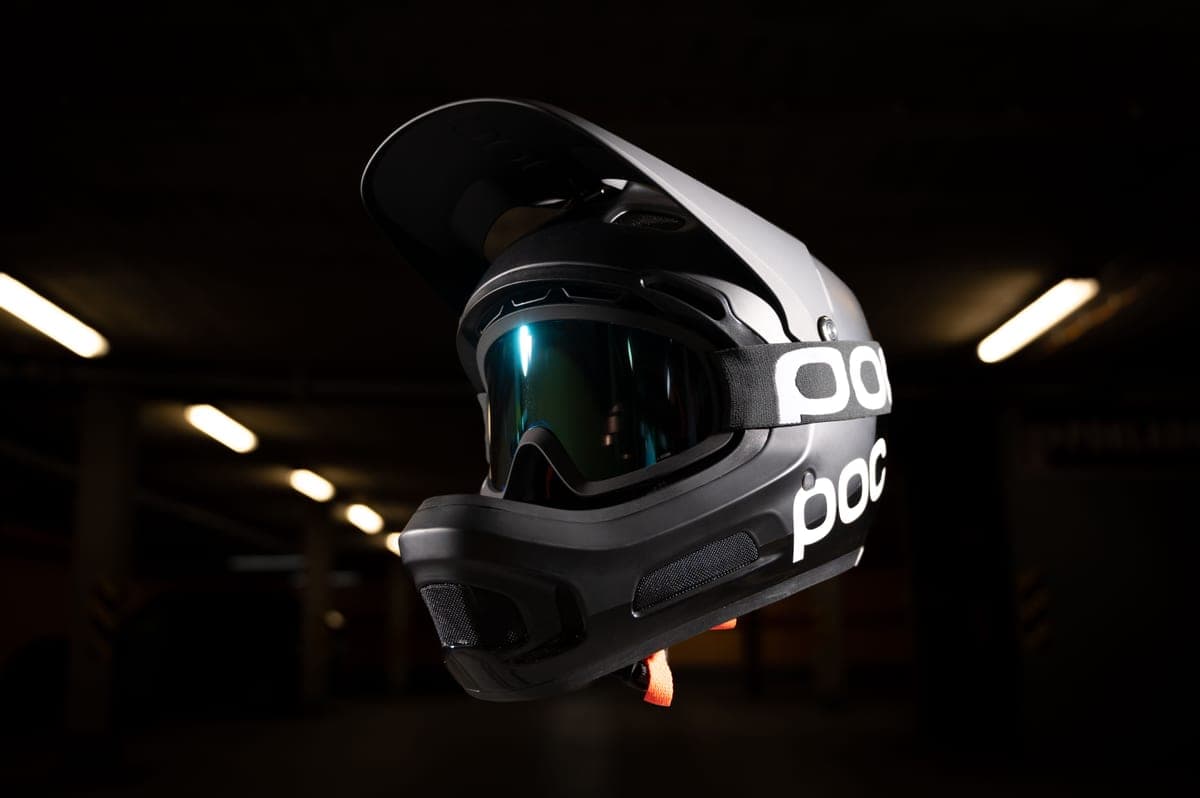
The permanent fix
Pinlock Anti-Fog Insert Lens
The one helmet accessory we would call close to essential in cold or wet weather. A second lens held on two pins with a sealing bead, so the inner surface never gets cold enough to condense your breath. Buy the lens listed for your exact visor — Pinlock codes each one (the DKS number) to a shield.
How visors and inserts workThen fix the airflow you control
An insert does the heavy lifting. These four habits remove most of what is left, and three of them cost nothing.
- Leave the chin curtain and breath deflector in. They are the parts riders remove first because they look like padding. They are not: the breath guard sits under your nose and directs exhaled air down and out of the chin vent rather than up across the shield. If your helmet came with one and you took it out, that is very likely your whole problem.
- Keep your neck tube or balaclava below your nose. Pulling it up over your mouth and nose is the single most common self-inflicted cause of fog, because it routes every breath straight up into the shield instead of letting it escape downward. If you need face coverage in winter, use something cut for it with a breathable mouth panel, and accept the trade honestly — see our cold-weather guide.
- Open the vents, including the chin vent. Riders close vents in winter and then wonder why the shield fogs. The chin vent exists specifically to put cold air on the inside of the shield. Cold face, clear vision.
- Crack the shield at stops, not at speed. One notch open while stationary vents accumulated warm air and clears a fogged shield faster than anything else. Close it before you move off: an open shield at highway speed is wind, rain, grit and insects, and in heavy rain it puts water on the inside, which is worse than what you were fixing.
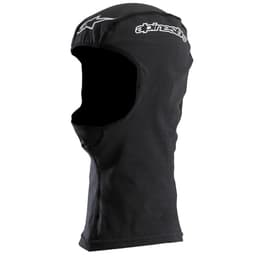
If you need face coverage
Alpinestars Open-Face Balaclava
The under-helmet layer that does two jobs at once: it closes the helmet-to-collar gap that lets cold air in, and it absorbs the sweat and hair product that would otherwise go straight into the liner. Heavyweight moisture-wicking fabric with flat-lock seams so it does not press under a snug helmet.
See the cold-weather kitPrice as of October 4, 2026. #ad How we’re funded
Anti-fog sprays: what they do and what they do not
A spray is a surfactant coating. It does not stop condensation forming — it stops the water forming into droplets, making it sheet into a thin even film you can see through instead of a scatter of lenses you cannot. That is a real effect and a genuinely useful one. The limitation is that the coating is consumable: it wipes off with a cloth, washes off in rain, and degrades every time you clean the shield. So it works, until the morning it has quietly worn off.
Use one made for visors, apply it to a shield that is properly clean, and treat it as the backup for the shield you cannot fit an insert to — a dark shield, a goggle lens, a drop-down sun visor. Household anti-fog products and dish soap are not it: polycarbonate is soft and most shields carry a coating that household chemistry strips.
Cleaning, which is where most shields get ruined
Cleaning does not stop fog. It is on this page because the attempt to stop fog is how most shields get scratched, and a scratched shield scatters light at night in a way that is genuinely worse than fog.
- Soak off whatever is on it with lukewarm water first — never dry wipe a shield with insects on it, because you are dragging grit across polycarbonate.
- Use a pH-neutral cleaner made for visors and lenses, on a clean soft microfibre cloth, in straight lines.
- Never use solvents, alcohol, ammonia-based glass cleaner, petrol, bug remover, paper towel or your jacket sleeve.
- Clean an anti-fog insert with water and a microfibre cloth only. The inner lens is softer than the shield and most makers say no cleaner at all.
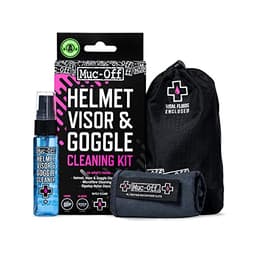
Cleaning pick
Muc-Off Visor, Lens & Goggle Cleaning Kit
You do not need a specialist cleaner — mild soap and lukewarm water do the same job, and we say so on our cleaning guide. What this buys is a 30 ml pH-neutral, solvent-free spray plus a microfibre cloth, in a size that lives in a tank bag for bugs at a fuel stop.
Read the full cleaning guidePrice as of October 4, 2026. #ad How we’re funded
Three things that will not fix it
- Potato, shaving foam, toothpaste. All three circulate as home remedies. Toothpaste is an abrasive, shaving foam is a detergent film, and neither addresses the surface temperature. What they reliably produce is a hazed shield.
- A pinhole-vented shield or a fan insert. Mechanical venting moves air, which helps at speed and is exactly where you did not need help. It does nothing at a standstill, which is where fog matters.
- Buying a more expensive helmet.Sealing and ventilation quality do vary, and a well-sealed touring helmet with the chin curtain in manages breath better than a loose one. But no helmet is fog-proof, because the physics does not care what you paid. What a better helmet reliably gives you is a shield that can take an insert — which is the actual fix.
If you wear glasses
Glasses fog on their own schedule, and the insert does nothing for them because the cold surface in question is on your face rather than in the shield. The things that help are the same in principle: keep the breath going downward rather than up, run the chin vent open, and do not seal your nose and mouth under a neck tube. Beyond that, a helmet that lets you get the glasses on afterthe helmet is on — a flip-front, or an open-face — makes managing them much easier, which is one of the practical arguments on open-face versus full-face and the reason we rank helmets for glasses separately.
How to read our safety notes. We have not crash-tested any of this gear — nobody honestly can on a review budget. Every helmet and armor pick names the certification the maker publishes (DOT, ECE 22.06, SNELL, or a CE level), which we read from the listing on a dated visit. Certification is the floor, not a guarantee; fit and condition matter as much as the sticker. What the standards actually mean.
Frequently asked questions
Why does my motorcycle helmet fog up?
Because the inside of your shield is colder than your breath. Exhaled air is warm and nearly saturated with water vapour; when it touches a surface below its dew point, the vapour condenses into the film you are looking through. That is all fog is. It explains everything about the problem: it is worst on cold mornings, worst in the rain, and worst when you stop — because at a standstill there is no airflow to carry warm air out of the helmet or to warm the outer face of the shield. It is a temperature problem, not a dirt problem, which is why wiping does nothing.
What is the best way to stop a helmet visor fogging?
A sealed anti-fog insert. It is a second lens that fits inside the shield on pins and seals against it with a silicone bead, trapping a thin layer of air between the two. That air gap insulates the inner lens, so the surface you breathe on stays above the dew point and the vapour never condenses. It is the only fix that works reliably at a standstill, which is where fog actually becomes dangerous. The catch is fitment: inserts are cut for a specific shield, so you buy the one coded to your helmet's visor rather than a universal one.
Do anti-fog sprays work on a motorcycle visor?
They work for a while and then they do not. A surfactant coating stops water forming into droplets and makes it sheet instead, so the shield stays optically clear — but the coating is consumable: it wipes off, washes off in rain, and degrades with each clean. In practice it means re-treating the shield regularly and discovering it has worn off on the one cold morning you needed it. If you use a spray, use one sold for visors, apply it to a properly clean shield, and treat it as a backup to an insert rather than an alternative.
Why does my visor fog up at traffic lights but not when riding?
Airflow. At speed, air moving through the helmet's vents carries your warm, moist breath out and the airstream keeps the outer surface of the shield closer to ambient, so condensation does not form or clears quickly. At a standstill all of that stops: your breath accumulates inside the shell and the shield has no airflow over either face. This is also why fog in traffic is the dangerous version — it arrives exactly where you need peripheral vision and the ability to read a junction. A sealed insert is the fix because it does not depend on airflow at all.
Should I ride with my visor cracked open?
As a stopgap at low speed and at stops, yes — venting the warm air is the quickest way to clear a fogged shield without touching it. As a strategy, no. A shield open a notch at highway speed lets in wind, rain, grit and insects, and is noisier. Some riders also crack the shield in heavy rain and end up with water running down the inside, which is worse than the fog. Open it while stationary, close it before you move off, and solve the problem properly with an insert.
Does a balaclava make helmet fogging worse?
It depends entirely on where you put it. Pulled up over your nose and mouth, a neck tube or balaclava routes every breath upward into the shield and makes fogging dramatically worse — this is the single most common self-inflicted cause. Worn below the nose, it does not. If you need to cover your face in cold weather, choose something with a breathable panel at the mouth designed to direct air downward, and keep the helmet's own breath deflector fitted. The warmth is worth having; the routing is what you control.
How do I clean a motorcycle visor without scratching it?
Lukewarm water first to soften whatever is on it, then a pH-neutral visor cleaner on a clean, soft microfibre cloth, wiping in straight lines rather than circles. What ruins a shield: solvents, alcohol, ammonia-based glass cleaner, petrol, bug remover, paper towel, kitchen roll and the sleeve of your jacket. Polycarbonate scratches easily and most shields carry a coating that chemicals strip. An anti-fog insert is softer still — clean it with water and a microfibre cloth only, and never with any cleaner at all unless the maker says you can.
Will a Pinlock insert fit any helmet?
No, and this is the one thing to get right before you buy. An insert is cut and pinned for a specific shield, so you need the one coded to your helmet's visor model — not a universal lens and not the one that fits a friend's helmet. Check whether your shield has the mounting pins at all: many mid-range and premium helmets are sold Pinlock-prepared, some ship with the insert in the box, and some shields have no pins and cannot take one. If yours cannot, your options are a spray, a different shield, or a different helmet.
Sources
- NHTSA — How to Choose the Right Motorcycle Helmet — NHTSA consumer guidance on DOT certification and spotting novelty helmets (accessed July 21, 2026)
- 49 CFR 571.218 — FMVSS No. 218, Motorcycle helmets — The US federal helmet standard: peak-acceleration, penetration and retention requirements; applies to all on-road motorcycle helmets (accessed July 21, 2026)
- UNECE — Vehicle Regulations (UN Regulation No. 22 / ECE 22.06) — The UN regulation behind ECE 22.06, which added rotational/oblique-impact testing over 22.05 (accessed July 21, 2026)
Keep reading
Motorcycle helmet visors explained
Shield types, tints, Pinlock preparation and photochromic options, and what is legal to ride in.
Read the visor guideHow to clean a motorcycle helmet
Shell, shield, vents and liner — what to use on each and the cleaners that destroy a visor coating.
Read the cleaning guideBest helmets with a sun visor
The drop-down internal visor across full-face, modular and open-face, and the cost of the mechanism.
See the sun-visor picksMotorcycle gear for cold weather
The three-layer system, and the neck and face coverage that causes most of the fogging problems.
Read the cold-weather guideBest helmets for commuting
Cold mornings and stop-start traffic are the exact recipe for fog — ranked for the daily ride.
See the commuter picksHow to choose a motorcycle helmet
Type, certification, head shape, size, weight and the four features worth paying for.
Read the buying guide