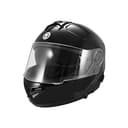
How to buy a cheap helmet without buying a bad one
Three rules. Buy from a company that makes helmets rather than a marketplace brand that assembles them. Confirm the DOT certification and treat any helmet without it as decoration. And spend the money you save on fit rather than on features — a $130 helmet that fits your head shape correctly will do its job better than a $400 helmet in the wrong shape.
How to spot a novelty helmet
NHTSA publishes clear physical tells, and they’re worth memorizing because they don’t require you to trust a sticker. A genuine helmet has an EPS (foam) liner roughly an inch thick or more — you can feel it through the comfort padding. It has a sturdy chin strap attached with solid rivets, not glue or plastic clips. It weighs around three pounds. And it has minimal exterior decoration — spikes, brims and bolt-on ornaments are a novelty signature. If it feels light and thin in the hand, put it down. The federal standard also prescribes exactly what the certification label must say and where it sits on the shell, which is a check you can run before you even pick the helmet up — our guide to spotting a fake helmet quotes the rule.
What you should still expect at this price
A removable, washable comfort liner. A double D-ring or a proper micro-ratchet retention system. Speaker pockets, if you plan to add an intercom. A shield that seals against the eyeport gasket without a visible gap. Every helmet here delivers all four. If a helmet at this price is missing them, there are better options for the same money.
What’s worth paying up for later
When the budget allows, the upgrades that actually change your experience are, in order: a composite shell (less weight, less neck fatigue), more shell sizes (better fit), an internal sun visor (no more shield swaps at dusk), and better sealing (less noise). Those are the four things the premium helmets on our best helmets page are selling. None of them are the impact test.
Budget helmets and ECE
Most helmets at this price carry DOT only. That is entirely legal and sufficient in the US. If you specifically want the newer ECE 22.06 protocol — which adds rotational and multi-point impact testing — expect to move up in price, though the beginner helmet picks include a couple of options that manage both certifications without going premium.
Buy new, and mind the date
Never buy a used helmet. You cannot see EPS damage from a previous impact, and a compressed liner does not spring back — the helmet looks fine and no longer works. On a new helmet, check the manufacture date stamped inside the strap or under the liner; a heavily discounted helmet is sometimes discounted because it has been sitting for three years of its five-year life.