Goat, cow, kangaroo: what the difference actually is
Goatskin
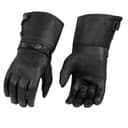
The default for a reason. Goat hide has a dense fiber structure with a naturally high lanolin content, which makes it supple straight out of the box and unusually strong for its thickness. A thin goatskin palm gives you good feel at the lever and abrasion resistance that outperforms a thicker, cheaper hide. It is the material most sport and road gloves use for the palm, and it is why the budget goatskin glove above punches above its price.
Cowhide
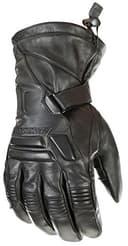
Thicker, tougher, stiffer, cheaper. Cowhide takes longer to break in and gives less feel through the controls, and in return it takes more abuse and lasts longer. It is the standard for cruiser and winter gloves where bulk is not a problem and durability is the point, and it is what most sub-$50 leather gloves are made from.
Kangaroo
The performance material, mostly found in race gloves above the price band on this page. Kangaroo hide has an unusually uniform fiber structure, which means it can be split very thin and still resist abrasion — roughly the same protection at a fraction of the thickness. If you have ever wondered why a top-tier race glove feels like a second skin, this is why. Sourcing and cost keep it out of most road gloves.
Leather plus mesh
The common hot-weather compromise: leather where you land (palm, fingers, the outside edge of the hand) and mesh or perforation everywhere else. It is a real trade rather than a marketing one, and it is the right one for summer. See summer motorcycle gloves for the wider category.
What we actually rank on
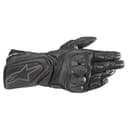
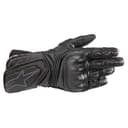
- A published CE rating, where one exists. EN 13594 is the glove standard, and it defines Level 1 and Level 2 with a KP suffix where knuckle protection has been tested separately. Only one glove on this page publishes one — the Alpinestars Stella SP-8 V3, at EN 13594:2015 Level 1 KP — and that is a real advantage rather than a tie-break.
- Palm construction. A single-piece palm with no seam across the heel of the hand is what you want. Seams are where a glove opens up when it is dragged, and the heel of the hand is where the load goes.
- Knuckle protection. A molded hard knuckle spreads and deflects; a foam pad absorbs a small impact and does little for abrasion.
- Cuff and retention. A glove that comes off does nothing. A wrist strap is more important than the cuff length — covered in detail on gauntlet vs short-cuff.
Leather is not automatically waterproof
Untreated leather absorbs water, gets heavy, and dries stiff. Most leather riding gloves are not waterproof and do not claim to be; a leather glove that is waterproof has a membrane inside it, which is why the winter picks above are bulkier than the summer ones. If you ride in sustained rain, either buy a glove with a stated membrane or accept that you will have wet hands — and see our rain gear guide for the cuff-overlap trick that keeps water out of the sleeve.
Caring for leather gloves
- Dry them slowly. Never on a radiator, never in direct sun. Heat drives out the oils and the leather goes hard and cracks. Room temperature, away from a heat source, stuffed loosely with newspaper if they are soaked.
- Condition occasionally, sparingly. A leather conditioner once or twice a season keeps the hide supple. Too much softens it, and soft leather abrades faster.
- Break them in by wearing them. A new leather glove should be snug enough that it feels slightly tight; it will mold to your hand within a few rides. A glove that is comfortable in the shop will be loose in a month.
- Retire them after a slide. A glove that has been dragged along a road has used up the material it was going to use. Inspect the palm and the heel; if the surface is scuffed through, replace them.
When not to buy leather
Two cases. If you ride in genuinely hot, humid conditions and your hands sweat enough that a leather glove becomes slippery inside, a mesh-and-leather hybrid or a proper vented glove is the better answer. And if you ride through winter, a leather glove without insulation and a membrane will not do the job — winter gloves and heated gloves are separate categories for a reason. For everything in between, leather remains the material to beat.