Sena Outrush R Review: The Modular With the Intercom Already In It
Every figure here comes from Sena's own spec sheet, read on a dated visit — including the four it does not publish. We have not worn this helmet and nothing below pretends we have.
How this is funded: we earn a commission if you buy through our links, at no extra cost to you. It never changes which gear we recommend, and we’ll tell you plainly when to skip a pick. Full disclosure.
The verdict: buy the Outrush R if you need a helmet AND comms, and buy a separate intercom instead if you already own a helmet that fits you. Sena publishes DOT certification, Bluetooth 5.1, a four-rider intercom to 900 m, 18 hours of talk time and a drop-down sun visor, on a single-shell polycarbonate ABS modular weighing 1,730 g at size M. That is a complete comms-equipped helmet in one purchase, with nothing bolted to the outside. What it is not is the lightest, the most certified, or a mesh unit — and all three of those have buyers it is wrong for.
One thing before the specs, because it is the whole basis of this page. We have not worn this helmet. We own no units, run no lab and crash-test nothing. Every figure below was read from Sena’s own US product page on a dated visit and is cited at the bottom; where Sena publishes nothing, this page says so rather than filling the gap with a guess or a borrowed figure from a different model. That is the deal across this whole site — our methodology page spells it out, and our editorial policy covers what we will and will not claim.
What Sena publishes
| Spec | Sena’s published figure | What it means for you |
|---|---|---|
| Helmet certification | DOT | FMVSS 218, the US legal floor for street sale. No ECE homologation and no SNELL rating is published for this helmet |
| Electronics approvals | CE, FCC, IC | Radio and electrical approvals. They say nothing about impact protection — a distinction worth holding onto, because a CE mark on a comms module looks like a safety certificate and is not one |
| Shell | Single shell polycarbonate ABS, multi-density EPS | One shell size across the range, so the smallest and largest heads wear the same outer shell with different liner thicknesses. It is the budget construction, and it is why the helmet is heavy |
| Weight | 1,730 g (61 oz) at size M | Heavy in absolute terms. Compare it against a helmet PLUS a bolt-on module rather than against a bare helmet |
| Bluetooth | Bluetooth 5.1 | Current-generation Bluetooth. Not mesh — see the section below, because this is the spec most likely to be the deciding one |
| Intercom | Up to 4 riders, up to 900 m (0.6 miles) in open terrain | “Open terrain” is the published condition and it is doing work: line of sight, no buildings, no bends. Expect considerably less on a wooded road |
| Battery | Lithium polymer, up to 18 h talk time, 2.5 h charge | Two long touring days of talking. The catch is routine, not capacity: the helmet has to come inside to charge |
| Visor system | Inner sun visor; clear shield, scratch- and UV-resistant, quick release | A drop-down sun visor is the single most useful convenience feature on a touring lid, and it is here at this price |
| Sizes / warranty | S to XXL; electronics 2 years, helmet integrity 2 years | Note the two separate warranties — they expire together here, which is exactly the integrated-helmet trade-off in writing |
The four things Sena does not publish
This is the part of a review that usually gets skipped, and on an electronics-in-a-helmet product it is the most informative section on the page. Nowhere on Sena’s own Outrush R page could we find:
- The speaker diameter.Sena publishes speaker sizes for its separate units, where 40 mm and 45 mm drivers are a headline spec. Its absence on an integrated helmet — where you cannot swap the speakers — is the gap we would most like closed.
- The microphone type. Boom or wired, and whether it is replaceable. On a modular this matters more than on a full-face, because the chin bar lifts and the mic has to work in both positions.
- An IP rating.No water-ingress figure of any kind. Until Sena publishes one, read any “waterproof” language for this helmet as water-resistant. Sena publishes IPX7 on some of its separate units, so the brand clearly knows the number is worth having.
- The box contents. Not published, which means we cannot tell you whether a Pinlock insert, a spare shield or a charging cable is included. Check the listing on the day you buy.
None of these absences makes the helmet worse than it is. They do mean a review that states them confidently has got them somewhere other than Sena, and you should treat that number accordingly.
Bluetooth, not mesh — and why that is the deciding spec
Sena publishes no mesh capability for the Outrush R. The word “mesh” does appear on Sena’s page for this helmet, in the comfort section, describing breathable ventilation fabric — not a network. We flag it because it is a genuinely easy misread, and because Sena’s separate units are the brand’s mesh flagships, so a buyer could reasonably assume it carries over.
The practical difference: a Bluetooth intercom builds a chain, and the chain is hierarchical — if the rider in the middle pulls into a fuel station, the riders behind lose the riders ahead. Mesh re-forms itself around whoever is in range. For two riders, or a rider and a passenger, this is irrelevant and Bluetooth is the simpler, cheaper, perfectly good answer. For a group of four moving at different speeds it is the thing you will complain about. If that is your riding, our mesh versus Bluetooth explainer covers it properly and our group-riding picks are separate units for exactly this reason.
Who should buy it
- A rider who needs a helmet and comms at the same time. This is the core case and the one where the Outrush R is genuinely hard to argue with. One purchase, one fitment decision, nothing to install, and a drop-down sun visor thrown in.
- A commuter or a two-up rider. A flip-front you can open at a card reader, comms already paired to one other person, no module to snag on a jacket collar. Our rider-and-passenger page covers that pairing in detail.
- Anyone who has tried fitting a clamp kit and hated it. Installing a module properly means removing cheek pads and routing speaker wires without touching the EPS. Our install guide explains why that last rule is non-negotiable. An integrated helmet removes the whole job.
Who should not
- Anyone who already owns a helmet that fits. Fit is the only thing on a helmet you cannot upgrade later, and replacing a well-fitting helmet to get comms is backwards. Buy a separate unit.
- Group riders. Bluetooth chain, four riders, no mesh. See above.
- Riders who want a third-party impact rating. Sena publishes DOT and nothing beyond it. If you want SNELL or ECE on top of the legal floor, our SNELL-certified list and our ECE 22.06 pageare built from the certifying bodies’ own published lists.
- Weight-sensitive riders.At 1,730 g this is near the top of our registry. Our lightest-helmets ranking is sorted strictly on published grams, and our weight guide explains why 50 g differences are noise and 200 g are not.
The one trade-off nobody puts on the box
An integrated helmet couples two things with different lifespans. A helmet is a wear item with a service life measured in years and in whether it has been dropped — our replacement guide covers that. Intercom hardware is a consumer-electronics generation that turns over faster, and its battery is the first thing in the whole product to degrade. With the Outrush R, when the battery stops holding a charge you are looking at the end of the helmet, not the end of a module. Sena’s two separate two-year warranties — electronics and helmet integrity — are that reality written down.
That is not a reason to avoid it. It is the reason the price gap between this and a bare helmet should be compared against the price of an intercom you would keep through two more helmets, rather than treated as free convenience.
The alternatives worth comparing it against
Three, in the order a buyer actually weighs them. These are registry entries with live prices, not a shopping list — the Bluetooth helmet ranking puts all of them in order.
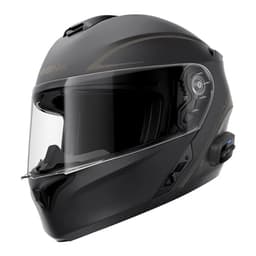
The helmet this review is about
Sena Outrush R
DOT FMVSS 218A modular helmet with the Bluetooth intercom built in and hidden — no bolt-on module, no wind snag. The US version is DOT-certified and Sena publishes Bluetooth 5.1, four-rider intercom and 18 hours of talk time. The cleanest way to get comms without a separate purchase.
See it ranked against every integrated helmetPrice as of October 17, 2026. #ad How we’re funded
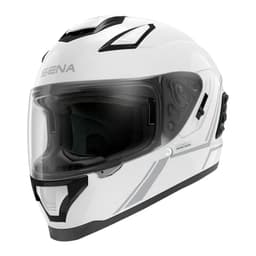
Step up: full-face, and Sena does publish mesh for it
Sena Stryker
DOT FMVSS 218A composite-fiberglass full-face with a Mesh intercom and Sound by Harman Kardon built in. DOT-certified in the US, and the audio is a real step up from bolt-on speakers.
Compare the integrated optionsPrice as of October 17, 2026. #ad How we’re funded
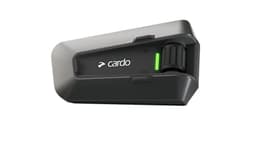
The separate-unit route instead
Cardo Packtalk Edge
The intercom most serious riders point to: Cardo's second-gen Dynamic Mesh (DMC) self-heals as riders drop in and out, JBL speakers sound excellent, and the magnetic Air Mount is the best in the class. The premium pick for group touring.
See the intercom rankingBottom line
The Outrush R does one thing extremely well: it removes the entire separate-intercom decision for a rider who was buying a helmet anyway, at a price that is lower than a helmet plus a mid-tier module. Sena publishes enough to judge it on — DOT, Bluetooth 5.1, four riders, 900 m, 18 hours, 1,730 g — and we would take it seriously for a commuter or a two-up rider. The two reasons to walk away are specific and easy to check against your own riding: it is Bluetooth rather than mesh, and the electronics and the shell reach the end of their lives together. If neither of those describes you, it is a sound buy. If either does, the separate route is the better one, and that decision has its own page.
How to read our safety notes. We have not crash-tested any of this gear — nobody honestly can on a review budget. Every helmet and armor pick names the certification the maker publishes (DOT, ECE 22.06, SNELL, or a CE level), which we read from the listing on a dated visit. Certification is the floor, not a guarantee; fit and condition matter as much as the sticker. What the standards actually mean.
Frequently asked questions
Is the Sena Outrush R worth it?
If you want comms and you are buying a helmet anyway, yes — because the alternative is a helmet plus an intercom, and a separate intercom alone often costs more than the gap. Sena publishes DOT certification, Bluetooth 5.1, a four-rider intercom to 900 m, 18 hours of talk time and a drop-down sun visor on a single-shell polycarbonate ABS helmet weighing 1,730 g at size M. If you already own a helmet that fits you, it is not worth it: buy a separate intercom and keep the helmet. The integrated route also means the electronics and the shell age and get replaced together, which is the real long-term cost.
Does the Sena Outrush R have mesh intercom?
No. Sena publishes Bluetooth 5.1 and a four-rider intercom for this helmet and lists no mesh capability of any kind — the 'breathable mesh' wording on Sena's own page refers to ventilation fabric, not a mesh network. That matters if you ride in a group: Bluetooth intercom chains are hierarchical and drop out when the rider in the middle leaves, where mesh self-heals. If group riding is your main use, look at a separate mesh unit instead of an integrated Bluetooth helmet.
Is the Sena Outrush R DOT approved?
Yes — Sena publishes 'DOT' for the helmet on its US product page, which is FMVSS 218, the federal standard every street helmet sold in the US must meet. Sena lists CE, FCC and IC for the electronics, which are electrical and radio approvals rather than impact ones. What Sena does not publish for this helmet is an ECE homologation or a SNELL certification, so if you want a voluntary third-party impact rating on top of the legal floor, this is not the helmet that carries one.
How heavy is the Sena Outrush R?
Sena publishes '1,730 g (61 oz) (M size)' for the DOT version. That is heavy — it is one of the heaviest helmets we track, and roughly 90 g more than a glass-composite full-face. Two things make it so: a modular chin bar adds hinge hardware, and the comms module, battery and speakers are inside the shell rather than clipped to the outside. The honest framing is that you are not comparing it with a bare helmet, you are comparing it with a helmet plus a bolted-on intercom, which closes most of the gap.
How long does the Sena Outrush R battery last?
Sena publishes up to 18 hours of talk time from a lithium polymer battery, with a 2.5-hour charge. Talk time is the figure makers publish because it is the worst case for the radio; music-only and standby use run longer. Eighteen hours covers two long touring days for most riders, and the practical issue is not the number but the charging routine — an integrated helmet has to be brought inside and plugged in, where a bolt-on module can be pulled off and charged separately.
Sena Outrush R or a separate intercom?
Decide it on which you expect to replace first. Helmets have a service life and electronics generations move faster than shells do — so if you plan to keep a helmet for five years, a separate intercom that survives the next two helmets is the better buy, and it lets you choose mesh. The integrated helmet wins in three cases: you need a helmet anyway, you do not want a module to catch wind or go missing, or you simply will not fit a clamp. We have written that decision up in full.
What does Sena not publish for the Outrush R?
Four things we would want and could not find on Sena's own page: the speaker diameter, the microphone type, an IP water-ingress rating, and the box contents. Sena publishes speaker sizes for its separate units — this is a brand that normally gives you that number — so its absence here is a real gap rather than an oversight on our part. No IP rating also means 'waterproof' claims for this helmet should be read as water-resistant until Sena publishes a figure.
Is the Outrush R good for a passenger?
It is one of the better choices, for the same reason it suits a commuter: a flip-front goes on and off over glasses easily and the intercom is already paired to the rider's unit with nothing to clip on. The weight is the counter-argument — a pillion has less to brace against than a rider does, so 1,730 g is felt more on the back seat. Our passenger helmet page ranks it against the alternatives with that trade-off stated.
Sources
- Sena — Outrush R (maker's product page, US) — Every figure on the Outrush R review, read from Sena's own US product page. Helmet certification: "DOT" (no ECE homologation is listed). Electronics approvals: "CE, FCC, IC". Shell: "Single shell polycarbonate ABS and multi-density EPS". Weight: "DOT: 1,730 g (61 oz) (M size)". Comms: "Bluetooth 5.1", intercom "up to 900 meters (0.6 miles) in open terrain" for up to four riders, talk time "up to 18 hours", charge time "2.5 hours", "Lithium Polymer Battery". Helmet features: an "Inner sun visor", and a clear, scratch- and UV-resistant face shield with a quick-release system. Sizes S to XXL. Warranty: "Electronics: 2 years" and "Helmet Integrity: 2 years". What Sena does NOT publish on this page, and the review says so: no speaker diameter, no microphone type, no IP rating, no mesh-intercom capability of any kind (the "breathable mesh" wording on the page is ventilation fabric), and no box contents (accessed October 15, 2026)
- 49 CFR 571.218 — FMVSS No. 218, Motorcycle helmets — The US federal helmet standard: peak-acceleration, penetration and retention requirements; applies to all on-road motorcycle helmets (accessed July 21, 2026)
- NHTSA — How to Choose the Right Motorcycle Helmet — NHTSA consumer guidance on DOT certification and spotting novelty helmets (accessed July 21, 2026)
- UNECE — Vehicle Regulations (UN Regulation No. 22 / ECE 22.06) — The UN regulation behind ECE 22.06, which added rotational/oblique-impact testing over 22.05 (accessed July 21, 2026)
- SHARP — UK Government Helmet Safety Ratings — UK Department for Transport independent helmet safety star ratings (accessed July 21, 2026)
Keep reading
Sena Stryker vs Outrush R
Sena's two comms-built-in helmets side by side, including the one that cannot join a mesh group.
Read the comparisonBest Bluetooth motorcycle helmets
Where this helmet sits against every other integrated option, plus the certified helmets worth pairing with a separate unit.
See the rankingBuilt-in Bluetooth or a separate intercom?
The decision behind this purchase, framed on one question: which do you expect to replace first?
Read the comparisonWhich Sena should you buy?
The whole Sena range by tier, including the separate units that do what this helmet's module cannot.
See the brand guideBest modular helmets
Flip-front helmets ranked on certification, weight and noise — including the ones that beat this on grams.
See the modular picksMesh vs Bluetooth intercoms
Why a Bluetooth chain drops out when the middle rider leaves, and when that actually matters.
Read the explainerBest helmets for a passenger
The pillion case for a flip-front with comms already in it, and where the weight counts against it.
See the passenger picks