The specs that sell intercoms are the specs a pair cannot use
Walk into this category cold and the numbers shouting at you are rider count and range. Cardo publishes up to 31 riders in a second-generation DMC group and a group range of 8 km. Sena publishes 24-rider Group Mesh and a 2 km working distance. Those are real figures and they are genuinely worth paying for — on a group ride. We spent an entire page on them, because for six bikes strung out over a mountain road they decide whether the ride works: the best intercoms for group riding ranks purely on those two published numbers.
For a rider and a pillion, every one of them is dead weight. Cardo publishes 400 m of range for the cheapest unit it sells, the Spirit. Your passenger is at about half a meter. That puts your pillion at roughly one eight-hundredth of the shortest range Cardo publishes anywhere in its catalog, and no amount of riding is going to change it. Mesh is the same story from a different angle: a mesh network exists to survive riders joining, leaving and falling out of range mid-ride, and a passenger does none of those things — if your pillion leaves the network, you have a much larger problem than audio. Our mesh vs Bluetooth guide works through the mechanics, and the honest conclusion for two-up is the one the guide reaches: below about three riders, a Bluetooth chain has nothing to break.
This is the rare category where the budget answer is not a compromise but the correct answer. A pair who buy two two-rider Bluetooth units are not settling for less. They are declining to pay for network capability they physically cannot use.
What actually decides a two-up intercom
With rider count and range off the table, four published specs are left — and one of them is worth more than the other three combined.
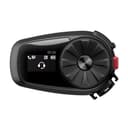
- Speaker driver size.This is the one. Wind noise at highway speed is what eats an intercom, and the thing that fights wind noise is driver diameter and the tuning behind it. Cardo publishes 40 mm speakers on the Freecom 2X and the Spirit HD, and 32 mm on the Spirit — the only unit in its range under 40 mm. Sena publishes a 40 mm driver 7.2 mm thick on the 5S. A passenger sits in the turbulent air behind your shoulders and is often the person who cannot hear, so the driver is where the money should go first.
- Controls you can work in gloves.A passenger will adjust volume constantly for the first few rides, and they are doing it wearing gloves, on the side of a helmet they cannot see, at speed. Sena’s Jog Dial is the best answer to that problem anyone publishes, and the 5S is the cheapest current Sena that still has one. Three-button units and multi-press budget units are all learnable — they are just harder on the person who is not looking at the road and has nothing to brace against.
- Talk time, not standby.Two people in constant conversation drain a battery far faster than a rider taking navigation prompts. Sena publishes 18 hours of talk time for the 5S and up to 20 hours for the Spider RT1 — the two longest figures in this ranking, and both belong to units well below flagship money. Cardo does not publish a headline talk-time figure in the same place for the Spirit family, but does publish fast charging across it: two hours of talk after twenty minutes on the cable, and a full charge within two hours.
- Music sharing, which has a catch.Two-up is the one use case where sharing a music feed genuinely matters — and Cardo publishes an explicit limit on it. See the section below, because it constrains which two units you should buy.
The price on this page is for one unit
Every card on this site links a single pack, on purpose, so that the live price you see is the price of one intercom rather than a bundle that looks cheap per unit and expensive on the receipt. That is the right default for a solo buyer. It is a trap for a two-up buyer, so we are saying it plainly: a rider and a passenger need two units, and the number on the card is half the bill.
Cardo sells the way round this on its own site. The Freecom 2X, the Spirit HD and the Spirit product pages each offer a Single and a Duo purchase option, read on 24 September 2026, and the duo is normally cheaper than two singles. The retailer we link carries both configurations too, and the listing title will tell you which one you are looking at — it is the difference between “single pack” and “dual pack” in the product name. Before you check out, read that title. We have seen this go wrong often enough that it is the first thing we would tell a friend.
One caveat in the other direction: two units do not have to be identical, and a household that already owns one unit does not need to throw it away. Any two Bluetooth intercoms will hold an intercom call with each other through the universal Bluetooth intercom protocol. What you lose by mixing is everything in the next section.
Music sharing only works inside a family — plan both helmets together
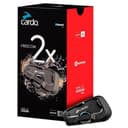
This is the finding that should change how a pair shops, and it comes straight from Cardo’s own product pages, where the same sentence appears on the Freecom 2X, the Spirit HD and the Spirit: “Music sharing is possible between FREECOM x and SPIRIT units, but it is not possible to share music with other generations of Cardo units.” Read that twice if you are two-up, because music sharing is the feature a pair uses on every single ride and almost never uses in a group.
The practical consequence: buy both units at once, from the same family, in the same generation. A Freecom 2X and a Spirit HD will share music by Cardo’s own statement. A Freecom 2X and an older Packtalk from a different generation will talk, but Cardo does not promise they will share a track. If you are pairing a new unit to something that has been in a drawer for four years, assume intercom works and music sharing does not, and be pleasantly surprised if it does.
Sena describes the 5S as keeping you “connected to your riding companion or passenger with HD Sound quality, music sharing, and audio equalizer profiles built right in” — which is as close as either maker comes to naming the pillion on a spec page. Sena does not publish a cross-generation limitation in the same wording Cardo does, so we are not going to invent one. Within a brand and a current generation, plan on it working. Across brands, plan on a plain Bluetooth intercom call and nothing more. Our Cardo vs Sena comparison is the page to read before a household commits to a side.
What the ranking is saying
- The Sena 5S is first because it is the cheapest unit here that gets every two-up decision right. Sena publishes a two-rider intercom — exactly what a pair needs and no more — at up to 700 m, with a 40 mm driver, Bluetooth 5.1, 18 hours of talk time and a 1.5-hour charge, and the glove-friendly Jog Dial that every Sena above it has. The honest limitation is the one that does not apply to you: it will not run a group, and Sena says so.
- The Freecom 2X is the audio pick.Cardo publishes 40 mm Sound by JBL drivers on it, the cheapest point in the Cardo range where the JBL tuning starts, plus up to 800 m, an FM radio and a two-year warranty. It costs meaningfully more than the 5S and the extra buys speaker tuning, not capability. If your passenger has already complained that they cannot hear you, this is where the money goes.
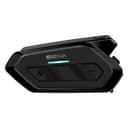
- The Spider RT1 is here for the pair who are not only a pair. If you ride two-up most weekends and join three friends twice a year, this is the cheapest way onto Sena’s current mesh network, and Sena publishes up to 20 hours of talk time on it — more than either 50-series unit and the longest figure on this page. The trade is three buttons instead of a Jog Dial, which is the harder control for the person on the back.
- The Spirit HD is the Cardo for a pair who want the drivers and not the badge. Cardo publishes 40 mm HD speakers on it — the same diameter as the Freecom, without the Sound by JBL branding — at up to 600 m with a six-preset FM radio. The tuning is the cut, and Cardo’s own naming tells you so.
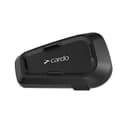
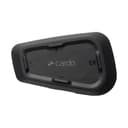
- The Spirit is the cheapest way to own two Cardos. Two riders at up to 400 m, fast charging, the app, firmware updates and the same two-year warranty as the Freecom. The compromise is visible on the spec sheet rather than hidden in the tuning: 32 mm speakers, the only sub-40 mm drivers Cardo sells, and no FM radio where the Spirit HD has one. If the choice is two Spirits or one Freecom, buy two Spirits — an intercom only one helmet has is not an intercom.
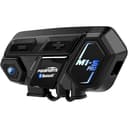
- The Fodsports M1-S Pro is the find-out-if-you-want-it pick. It is the lowest-priced unit on this page by a clear margin, and two of them cost less than one mid-range unit. Buy a pair, ride two-up for a season, and learn whether you are a couple who talk for six hours or a couple who prefer the engine. A surprising number of riders discover the second thing, and it is a much cheaper discovery to make here.
What we did not rank, and why
The Cardo Freecom 4X is our pillion pick on the main intercom pageand it is a very good unit — Cardo publishes four riders at up to 1.2 km with 40 mm Sound by JBL speakers and natural voice operation. It is not ranked here for a reason that has nothing to do with quality: you are paying for two rider slots you will never fill, and the 2X publishes the same 40 mm JBL drivers for less. If you expect to add a third bike to your regular rides, buy the 4X. If it is genuinely the two of you, the 2X is the same audio without the group tax. The head-to-head against Sena’s equivalent is on Freecom 4X vs Spider ST1.
The Packtalk range— Neo, Edge and Pro — is deliberately absent. Every one of them runs the same second-generation DMC network at the same published range, which is a genuinely useful finding for a group buyer and completely irrelevant to a pair. We laid the whole ladder out on the Cardo range page, and the summary for two-up is short: the cheapest Packtalk costs roughly double the 5S and gives a passenger nothing the 5S does not already give them. The one exception is the rider who already knows they want mesh for other reasons, and that rider should be reading the group page, not this one.
The LEXIN B4FM leads our budget intercom pageand would otherwise be a reasonable cheap pair. We recorded on 18 September 2026 that its retailer listing title read “10 Riders” against the four-rider figure our registry entry carries, and we have still not found a LEXIN-published specification that resolves the two. For a pair the rider count is academic — but a maker whose published count we cannot pin down is not one we are going to rank on a page about reading specs carefully.
And helmet-integrated systems are a different purchase rather than a cheaper one. If either of you is buying a new lid anyway, a helmet with the unit designed into the shell is tidier than a module clamped to the side, and our Bluetooth helmets pagecovers those. The catch for a pair is that it locks both of you into replacing the electronics whenever you replace the helmet — and a helmet gets retired after one drop, which is the replacement rule we would not bend for a speaker.