Cardo Freecom 4X vs Sena Spider ST1
Bluetooth done properly against mesh done cheaply. Two mid-tier intercoms at similar money that solve group riding in completely different ways — and the answer depends entirely on who you ride with.
The flagship comparison — Packtalk Edge vs Sena 50S — is the one everybody reads, and for most riders it is the wrong page. Very few people need a flagship intercom. What a lot of people need is the best unit at half that money, and at this level the question changes shape entirely: you are no longer comparing two mesh systems, you are choosing between a well-executed Bluetooth unit and a budget mesh one.
The Cardo Freecom 4X is a four-rider Bluetooth intercom with JBL speakers and an IP67 rating. The Sena Spider ST1 brings Sena’s Open Mesh to the mid-tier alongside Bluetooth, with a Jog Dial control and USB-C charging. Both are genuinely good. They fail in different situations, and the situation you ride in decides this.
If the words mesh and Bluetooth do not yet mean anything specific to you, read mesh vs Bluetooth intercoms first — it explains the failure mode that this whole comparison turns on.
How this is funded: we earn a commission if you buy through our links, at no extra cost to you. It never changes which gear we recommend, and we’ll tell you plainly when to skip a pick. Full disclosure.
Bluetooth, done well
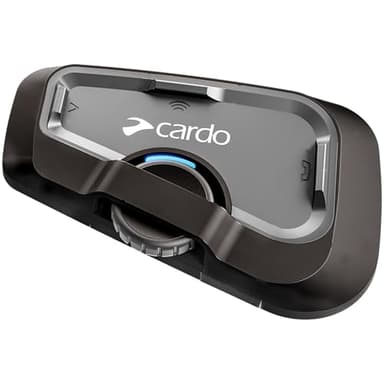
Cardo Freecom 4X
A Bluetooth intercom (not mesh) for up to four riders, with the same 40 mm JBL speakers as the Packtalk Edge. The right Cardo for a rider-plus-pillion or a small fixed group who don't need self-healing mesh.
Mesh, done cheaply
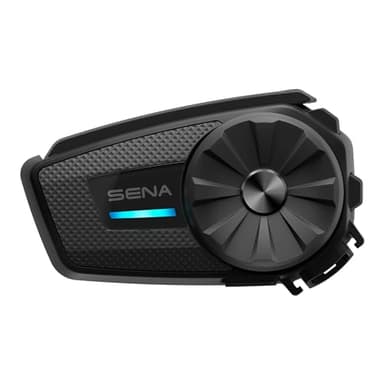
Sena Spider ST1
The value way into Sena Mesh: Open Mesh and Bluetooth in a simpler unit at a lower price than the 50S. If you want mesh's self-healing group audio without the flagship features, this is the entry point.
Price as of October 19, 2026. #ad How we’re funded
| Spec | Cardo Freecom 4X | Sena Spider ST1 |
|---|---|---|
| Network type | Bluetooth intercom, up to 4 riders | Open Mesh plus Bluetooth |
| Group behavior | Fixed chain — one rider dropping can break it | Self-healing mesh — riders join and leave freely |
| Audio | JBL 40 mm speakers | Sena speakers, USB-C charging |
| Controls | Button interface, glove-friendly | Jog Dial — the best-known glove control in the category |
| Weather rating | IP67 rated | Check current listing |
| Best suited to | Rider and pillion, or a fixed group of up to four | Groups that change size, or riders who join others' meshes |
| Price tier | Mid | Mid |
The difference that decides it
A Bluetooth intercom group is a chain. Rider 1 pairs to rider 2, rider 2 to rider 3, rider 3 to rider 4. It works well and it sounds good. But the chain has a specific failure mode: if a rider in the middle stops, turns their unit off, or rides out of range, the riders behind them are cut off from the riders in front. Re-forming the group means someone pulling over and re-pairing.
A mesh network has no chain. Every unit talks to every other unit in range and routes around the gaps automatically. A rider who drops out is simply gone, and the rest of the group carries on. A rider who catches up rejoins by themselves. Nobody stops, nobody re-pairs.
That is the entire argument, and it is why the answer depends on your group rather than on the hardware:
- You ride with a pillion, or the same two friends every time. A chain of two or three that never changes works perfectly. Take the Freecom 4X and enjoy the JBL speakers.
- You ride with a club, a changing group, or people who peel off and rejoin. That is the exact scenario Bluetooth chains handle badly. Take the Spider ST1.
- Your riding friends already run Sena mesh. Take the Spider ST1 — joining an existing Open Mesh group is straightforward, and being the one rider on a different system is genuinely isolating.
Where the Freecom 4X wins
Audio
The JBL 40 mm speakers are the best thing about this unit and the clearest reason to choose it if group flexibility is not your problem. Intercom is one job an intercom does; the other, for most riders most of the time, is music and navigation prompts, and speaker quality is what you actually hear all day.
Weather rating
Cardo publishes an IP67 rating on the Freecom 4X. Sena does not publish a comparable figure for the Spider ST1 in the material we can verify, and our spec table says so rather than assuming one. A stated ingress rating on a device that lives on the outside of your helmet is worth having.
Simplicity
A four-rider Bluetooth intercom is a simpler system with fewer states to be in. Mesh brings its own occasional confusion — which channel, which group, private or open — that a straightforward pairing does not.
Where the Spider ST1 wins
The Jog Dial
Sena’s rotating dial is the most-copied control in this category for a reason: you can find it, turn it and click it in winter gloves without looking. Anyone who has tried to hit a small button on the side of their helmet at 60 mph knows how much that matters. Our intercom buying guide puts glove-operable controls near the top of the list, and this is why.
Mesh at a mid-tier price
Open Mesh in a unit at this price is the Spider’s reason to exist. You are getting the network architecture from the flagship tier without the flagship cost, and you keep Bluetooth alongside it for phone and navigation.
USB-C
Minor until it is not. One cable for your phone, your intercom and increasingly everything else in the tank bag.
What neither of them changes
Both units are universal-mount, which means the speaker pockets in your helmet matter more than either spec sheet. A helmet with shallow or absent speaker recesses will press the speakers against your ears regardless of which unit you buy, and that is a two-hour problem rather than a two-minute one. Check your helmet before you order, and see how to install a motorcycle intercom — including the shortcut involving a knife and the EPS liner that you must never take.
Neither unit is a substitute for a helmet with the intercom designed in, either. If you want to skip the mounting question altogether, Bluetooth helmets covers the built-in option.
The short answer
Freecom 4X for rider-and-pillion and small fixed groups, where the audio quality and the IP67 rating are the specs you will notice, and where a Bluetooth chain never gets stressed.
Spider ST1 for anyone whose riding group changes shape — and for anyone whose friends already run Sena mesh. Mesh at this price is the more future-proof purchase, and the Jog Dial is the better control.
Frequently asked questions
Is mesh always better than Bluetooth for a motorcycle intercom?
No — it is better for groups that change. A Bluetooth intercom forms a chain: if a rider in the middle stops or rides out of range, the riders behind lose the ones in front until somebody re-pairs. A mesh network routes around gaps automatically and lets riders leave and rejoin on their own. For a rider and pillion, or two friends who always ride together, the chain never gets stressed and a good Bluetooth unit like the Freecom 4X is the better buy for the money.
Can a Cardo talk to a Sena?
Over standard Bluetooth intercom protocols, generally yes — cross-brand Bluetooth pairing works, and both companies support it. What does not cross over is mesh: Cardo's DMC and Sena's Mesh are proprietary networks and a Cardo cannot join a Sena mesh group or vice versa. That is why 'what do the people I ride with use?' is a genuinely important question before you buy, and why being the odd one out on a group ride is worth avoiding.
Which has better sound, the Freecom 4X or the Spider ST1?
The Freecom 4X, on the strength of its JBL 40 mm speakers, which are the best thing about the unit. Sound quality is what you actually experience for most of a ride — music, navigation prompts, podcasts — even though intercom is what sells the device. That said, speaker performance depends heavily on how well the speakers sit in your helmet's recesses, and a poorly seated premium speaker will sound worse than a well-seated ordinary one.
How many riders can each of these handle?
The Cardo Freecom 4X handles up to four riders on a Bluetooth intercom connection. The Sena Spider ST1's Open Mesh is designed to scale further and to let riders join and leave without breaking the group, which is the practical advantage of a mesh architecture rather than a raw number. For groups of two or three, both are more than sufficient and the difference does not show up.
Do I need a specific helmet for these intercoms?
Both are universal-mount and work with most helmets, but your helmet's speaker recesses matter more than either spec sheet. A helmet with shallow or absent recesses presses the speakers against your ears, which becomes a real problem after an hour. Check the depth of the pockets before ordering. What you must never do is cut or grind the EPS liner to make a unit fit — removing liner material removes protection at exactly that point.
Is it worth spending more on a flagship intercom instead?
For most riders, no. A flagship buys you the most refined mesh implementation, the best audio and the longest range, and if you tour in large groups regularly that is worth paying for. If you ride with a pillion or a couple of friends, the mid-tier units on this page do the same job at roughly half the price, and the money is better spent elsewhere in your kit. Our budget intercoms page goes one step further down and is worth reading if you are still not sure the category is for you.
Sources
- MotoCAP — Independent Motorcycle Clothing & Helmet Assessment — Independent Australian lab rating protective clothing and helmets for protection and comfort (accessed July 21, 2026)
- SHARP — UK Government Helmet Safety Ratings — UK Department for Transport independent helmet safety star ratings (accessed July 21, 2026)
Keep reading
Mesh vs Bluetooth intercoms
Why a Bluetooth chain drops the whole group when one rider turns off, and what mesh actually changes.
Read the explainerBest motorcycle intercoms
The full ranking for group touring, pillion use and value across every price band.
See the intercom picksHow to install a motorcycle intercom
Clamp or adhesive, where the speakers actually go, and the one shortcut that ruins a helmet.
Read the install guideCardo Packtalk Edge vs Sena 50S
The flagship version of this comparison, if the mid-tier is not enough.
Read the comparison