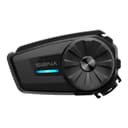
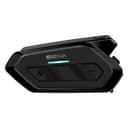
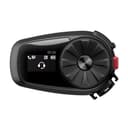
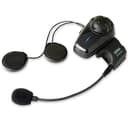
Sena sells ten ways to talk on a motorcycle and names them like part numbers. Here is what the number and the S/R suffix actually tell you, and which unit fits the way you ride.
Sena is the brand most riders end up in, and its lineup is the reason most riders end up confused. A 50S and a 50R cost about the same and look nothing alike. A Spider ST1 and a Spider RT1 are the same product family with different buttons. A 5S costs a fraction of a top-tier unit and does something the cheap old SMH10 does worse. None of that is explained on a shelf tag.
So this page is built around the three questions that actually separate the units, in the order they matter. Does it do mesh, or only Bluetooth? That decides whether the group survives a rider dropping out of range. How many riders does Sena publish for its intercom, and over what working distance? That number is model-specific and it is not the one the price implies — the current 5-series is a two-rider unit, while a much older SMH10 is a four-rider one. And how do you work it in gloves? Sena’s S models get the Jog Dial and its R models get the slim button module, and that single choice is what most owners either love or resent.
Every figure on this page — mesh generation, rider counts, working distance, speaker size, talk time, waterproof rating, module dimensions — was read from Sena’s own product page for that model on 31 August 2026, not from retailer copy. We have not bench-tested these units and we do not run a lab; intercoms carry no safety certification, so nothing here is a protection claim. Our methodology page sets out exactly what that means.
How this is funded: we earn a commission if you buy through our links, at no extra cost to you. It never changes which gear we recommend, and we’ll tell you plainly when to skip a pick. Full disclosure.
Quick picks
Ranked on certification, spec and buyer fit. Select a row to jump to the full write-up. We haven’t crash-tested this gear — here is exactly what we do instead.
#
Gear
Best for
Price
1
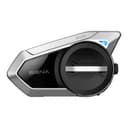
Sena 50S
Sena's mesh benchmark, with Harman Kardon speakers and the signature Jog Dial control that's easy to use in gloves. Sena now publishes Mesh Intercom 3.0 for it — a firmware generation, not new hardware. The main rival to Cardo's Packtalk Edge, and the pick if you prefer Sena's ecosystem and controls.
Sena's current top tier, and the first of its units tuned by Bose rather than Harman Kardon. Mesh Intercom 3.0 plus the cellular Wave intercom, IPX7 waterproofing and the longest talk time Sena publishes anywhere in the range. It is also the most expensive way to join the same mesh network a 50S joins.
The 60 Series without the Bose tuning: Mesh Intercom 3.0, Wave, IPX7 and second-generation Harman Kardon speakers, with the Jog Dial kept. Sena publishes 24 hours of Bluetooth talk time against the 50S's 16 — the battery, not the network, is what the newer platform actually buys you.
The 50S's network and speakers in a low-profile, three-button module. Same Mesh Intercom 3.0, same Harman Kardon 40 mm drivers, no Jog Dial — and Sena publishes slightly shorter talk time. Buy it if you want the 50-series mesh without a dial on the side of your helmet.
The value way into Sena Mesh: Open Mesh and Bluetooth in a simpler unit at a lower price than the 50S. If you want mesh's self-healing group audio without the flagship features, this is the entry point.
The cheapest way onto Sena's mesh network, and the longest-running one: Sena publishes up to 20 hours of talk time here, more than either 50-series unit. Three buttons instead of the Spider ST1's Jog Dial, and no Harman Kardon badge on the speakers — that is where the money went.
The cheapest Sena that still has the Jog Dial. Bluetooth 5.1, 40 mm speakers, 18 hours of talk time on a 1.5-hour charge — and the detail the listings bury: Sena publishes a TWO-rider intercom, not four. For a rider and pillion it is the sensible Sena. For a group it is the wrong one.
The original Sena, and still the only non-mesh unit in the range that Sena publishes a four-rider intercom for. The big Jog Dial, 12 hours of talk time and up to 900 m between riders. Older hardware — but it does a group thing the current 5-series does not.
Sena's mesh benchmark, with Harman Kardon speakers and the signature Jog Dial control that's easy to use in gloves. Sena now publishes Mesh Intercom 3.0 for it — a firmware generation, not new hardware. The main rival to Cardo's Packtalk Edge, and the pick if you prefer Sena's ecosystem and controls.
Strengths
+Mesh Intercom 3.0 with a large, glove-friendly Jog Dial
+Harman Kardon speakers and mics
+Sena publishes 13 h mesh / 16 h Bluetooth talk time and a 2.5 h charge
Trade-offs
−Premium price as a pair
−Mesh interoperability is best within Sena's own network
−Previous top tier: Sena's 60 Series sits above it, and Sena announced the 60S EVO on 18 May 2026 as the successor to the 60S — worth pricing the three against each other
Safety standard
Check current listing
Construction
Harman Kardon 40 mm speakers, Jog Dial
Key feature
Mesh Intercom 3.0 + Harman Kardon audio
Fit / sizing
Universal helmet mount
Best for
Riders in a Sena group who want proven mesh and easy glove controls
Specs and certification read from the manufacturer and retailer listing, on August 31, 2026. “Check current listing” means the maker doesn’t publish that figure — we won’t guess it.
#2Most capable
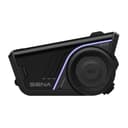
Sena 60S EVO
Sena's current top tier, and the first of its units tuned by Bose rather than Harman Kardon. Mesh Intercom 3.0 plus the cellular Wave intercom, IPX7 waterproofing and the longest talk time Sena publishes anywhere in the range. It is also the most expensive way to join the same mesh network a 50S joins.
Strengths
+Mesh Intercom 3.0 and 2.0 plus Wave — Group Mesh up to 24, Open Mesh across 6 channels
+Sena publishes 27 h Bluetooth / 19 h mesh talk time on a 1.5 h charge
+IPX7 waterproof rating, magnetic mount and a glove-friendly jog dial
Trade-offs
−Top-tier price for the same 2 km working distance a 50S publishes
−Sound by Bose is a tuning claim we cannot verify by ear — we own no units
Safety standard
Check current listing
Construction
40 mm speakers tuned by Bose, IPX7, jog dial
Key feature
Mesh 3.0 + Wave intercom, IPX7
Fit / sizing
Universal helmet mount, dual clamp kits included
Best for
Riders who want Sena's newest hardware and will pay top-tier money for it
Specs and certification read from the manufacturer and retailer listing, on August 31, 2026. “Check current listing” means the maker doesn’t publish that figure — we won’t guess it.
#3Best of the new top tier
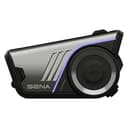
Sena 60S
The 60 Series without the Bose tuning: Mesh Intercom 3.0, Wave, IPX7 and second-generation Harman Kardon speakers, with the Jog Dial kept. Sena publishes 24 hours of Bluetooth talk time against the 50S's 16 — the battery, not the network, is what the newer platform actually buys you.
Strengths
+Mesh Intercom 3.0 and 2.0 plus Wave, Group Mesh up to 24 riders
+Sena publishes 24 h Bluetooth / 17 h mesh talk time on a 1.5 h charge
+IPX7 waterproof rating and second-generation Harman Kardon 40 mm speakers
Trade-offs
−Same 2 km published working distance as the far cheaper 50S
−The 60S EVO sits above it, so this is already the middle of the top tier
Safety standard
Check current listing
Construction
40 mm 2nd-gen Harman Kardon speakers, IPX7, Jog Dial
Key feature
Mesh 3.0 + Wave intercom, IPX7
Fit / sizing
Universal helmet mount
Best for
Riders upgrading from a 50-series who want the newer platform and the Jog Dial
Specs and certification read from the manufacturer and retailer listing, on August 31, 2026. “Check current listing” means the maker doesn’t publish that figure — we won’t guess it.
#4Best low-profile module
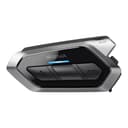
Sena 50R
The 50S's network and speakers in a low-profile, three-button module. Same Mesh Intercom 3.0, same Harman Kardon 40 mm drivers, no Jog Dial — and Sena publishes slightly shorter talk time. Buy it if you want the 50-series mesh without a dial on the side of your helmet.
Strengths
+Mesh Intercom 3.0 — up to 24 riders in Group Mesh, same as the 50S
+Harman Kardon 40 mm speakers, identical to the 50S
+Slim 97 x 48 x 27 mm module; 20 minutes of charge gives 6 h Bluetooth talk
Trade-offs
−Three buttons are harder to work in thick winter gloves than the 50S dial
−Sena publishes 11 h mesh talk time against the 50S's 13 h
Safety standard
Check current listing
Construction
Harman Kardon 40 mm speakers, three-button control
Key feature
Mesh Intercom 3.0, low-profile module
Fit / sizing
Universal helmet mount
Best for
Riders who want proven mesh in the slimmest module Sena makes
Specs and certification read from the manufacturer and retailer listing, on August 31, 2026. “Check current listing” means the maker doesn’t publish that figure — we won’t guess it.
#5Best value mesh
Sena Spider ST1
The value way into Sena Mesh: Open Mesh and Bluetooth in a simpler unit at a lower price than the 50S. If you want mesh's self-healing group audio without the flagship features, this is the entry point.
Strengths
+Open Mesh + Bluetooth at a mid price
+Jog Dial control that works in gloves
+Compatible with other Sena Mesh units
Trade-offs
−Fewer features and lower-tier audio than the 50S
−No premium speaker branding
Safety standard
Check current listing
Construction
Jog Dial control, USB-C
Key feature
Open Mesh + Bluetooth
Fit / sizing
Universal helmet mount
Best for
Riders who want mesh on a budget
Specs and certification read from the manufacturer and retailer listing, on July 21, 2026. “Check current listing” means the maker doesn’t publish that figure — we won’t guess it.
#6Cheapest way onto mesh
Sena Spider RT1
The cheapest way onto Sena's mesh network, and the longest-running one: Sena publishes up to 20 hours of talk time here, more than either 50-series unit. Three buttons instead of the Spider ST1's Jog Dial, and no Harman Kardon badge on the speakers — that is where the money went.
Strengths
+Mesh Intercom 3.0 — Group Mesh up to 24 riders, Open Mesh across six channels
+Up to 20 h talk time, the longest Sena publishes in the Spider line
+Low-profile module with Bluetooth 5.2 for phone and navigation audio
Trade-offs
−Three-button control is fiddlier in gloves than the ST1's Jog Dial
−No Harman Kardon speakers and fewer features than the 50-series
Safety standard
Check current listing
Construction
40 mm speaker drivers, three-button control, Bluetooth 5.2
Key feature
Mesh Intercom 3.0, up to 20 h talk time
Fit / sizing
Universal helmet mount, low-profile module
Best for
Group riders who want mesh at the lowest price and don't need premium audio
Specs and certification read from the manufacturer and retailer listing, on August 31, 2026. “Check current listing” means the maker doesn’t publish that figure — we won’t guess it.
#7Best for a rider and pillion
Sena 5S
The cheapest Sena that still has the Jog Dial. Bluetooth 5.1, 40 mm speakers, 18 hours of talk time on a 1.5-hour charge — and the detail the listings bury: Sena publishes a TWO-rider intercom, not four. For a rider and pillion it is the sensible Sena. For a group it is the wrong one.
Strengths
+Glove-friendly Jog Dial at the bottom of the current range
+40 mm speakers, 18 h talk time and a 1.5 h full charge
+Bluetooth 5.1 for phone calls, music and navigation prompts
Trade-offs
−Sena publishes a two-rider intercom — it will not run a group
−700 m working distance, and no mesh to self-heal when a rider drops out
Safety standard
Check current listing
Construction
40 mm speakers, Jog Dial, Bluetooth 5.1
Key feature
Two-rider Bluetooth intercom, up to 700 m
Fit / sizing
Universal helmet mount
Best for
A rider and pillion, or two riders who always ride together
Specs and certification read from the manufacturer and retailer listing, on August 31, 2026. “Check current listing” means the maker doesn’t publish that figure — we won’t guess it.
#8Best four-rider Bluetooth
Sena SMH10
The original Sena, and still the only non-mesh unit in the range that Sena publishes a four-rider intercom for. The big Jog Dial, 12 hours of talk time and up to 900 m between riders. Older hardware — but it does a group thing the current 5-series does not.
Strengths
+Sena publishes a four-rider Universal Intercom at up to 900 m in open terrain
+Large Jog Dial that's easy in gloves
+12 h talk time and reliable, long-supported Bluetooth pairing
Trade-offs
−Bluetooth only — the chain breaks when a middle rider drops out
−Older speaker hardware, and often priced above newer Sena units
Safety standard
Check current listing
Construction
Jog Dial control
Key feature
Four-rider Bluetooth intercom, up to 900 m
Fit / sizing
Universal helmet mount
Best for
A small fixed group who want Bluetooth intercom without paying for mesh
Specs and certification read from the manufacturer and retailer listing, on August 31, 2026. “Check current listing” means the maker doesn’t publish that figure — we won’t guess it.
How to read a Sena model name
There is a pattern under the part numbers, and once you have it the range collapses into something you can shop in about a minute. The number or family is the tier — 60-series at the top, then 50-series, then Spider, then the 5-series. The letter is the control interface: S units get the Jog Dial, R units get the slimmer button module. Same network, same speakers, different thing on the side of your helmet.
Tier
Jog Dial version
Low-profile version
Network
Current top
60S EVO, 60S
—
Mesh 3.0 and 2.0 + Wave + Bluetooth
Previous flagship
50S
50R
Mesh Intercom 3.0 + Bluetooth
Mid
Spider ST1
Spider RT1
Mesh Intercom 3.0 + Bluetooth
Entry
5S
5R
Bluetooth only
Two honest caveats on that table. Sena states the control difference outright on the Spider pages — the RT1 is described with three-button control, the ST1 as jog-dial equipped — and its retail listing for the previous flagship is literally named “50R 3-Button” against the 50S’s Jog Dial. For the 5-series, Sena publishes the Jog Dial on the 5S and does not describe the 5R’s interface on its product page at all, so we have not asserted one. The pattern holds everywhere Sena documents it; the 5R is the one place it would be inferred, which is why the 5R is not ranked above.
Mesh or Bluetooth: the decision that actually costs money
Everything expensive about a Sena is the mesh radio. A Bluetooth intercom links riders in a fixed chain: it works, it is cheap, and when the rider in the middle rides out of range the riders behind them lose the link until it reconnects. Mesh builds a self-healing network instead — riders drop in and out and the group re-routes around them without anyone touching a button. Our mesh vs Bluetooth explainer covers the mechanics in full.
The practical version for shopping Sena: if you ride two-up or with one regular partner, the mesh premium buys you nothing and the 5S is the sensible unit. If you ride in a group of four or more that spreads out on the road, mesh is the entire reason to be looking at Sena at all, and the cheapest honest way in is the Spider RT1.
One thing to know before comparing a Sena against something you already own: mesh does not cross brands. Sena’s mesh talks to Sena’s mesh, Cardo’s Dynamic Mesh talks to Cardo. Units of different brands can still connect over a standard Bluetooth intercom link, but you lose the self-healing behavior you paid for. If your group already runs one brand, that is most of your decision made.
What the 60 Series actually adds
Sena’s current top tier is the 60 Series, and it is worth being precise about what the extra money buys, because it is not the thing most buyers assume. It is not more range: Sena publishes 2 km (1.2 miles) in open terrain for the 60S, the 60S EVO, the 50S and the 50R alike. It is not a different network either — all four publish Mesh Intercom 3.0, so a 60S and a 50S sit in the same Group Mesh.
What Sena does publish as new on the 60 Series:
Battery. 27 hours of Bluetooth and 19 hours of mesh talk time on the 60S EVO, 24 and 17 on the 60S, against 16 and 13 on the 50S. All three charge fully in 1.5 to 2.5 hours.
An IPX7 waterproof rating, which Sena does not publish for the 50-series at all. If you commute year-round in rain, this is the specification on this page that will decide the purchase.
Wave Intercom. Sena describes it as a cellular-based intercom supporting a virtually unlimited number of participants — a phone-network feature rather than a radio one, so it is not bounded by the 2 km figure at all. We have not tested it and Sena’s own material is the only source here.
Audio branding. The 60S carries second-generation Harman Kardon speakers; the 60S EVO is the first Sena tuned by Bose, with what Sena calls the Bose WaveForm audio engine. Sena also notes on that page that the result “cannot be achieved through speaker replacement alone.” We own no units and cannot judge either claim by ear, so we are reporting it rather than endorsing it.
Which is why the 50S is ranked first on this page and the 60S EVO second. If you want the newest hardware, the longest battery and the waterproof rating, buy the 60 Series without hesitation. If you want the Sena network, the Jog Dial and Harman Kardon speakers for substantially less, the 50S gives you the same mesh generation, the same 24-rider Group Mesh and the same published working distance. Use the live prices on the cards above — the gap between the tiers moves constantly and it is the whole argument. If the 60S EVO is where you have landed and you are weighing it against the other brand’s top unit, Packtalk Pro versus 60S EVO sets the two side by side — and the battery row is the widest gap between them.
Mesh 2.0, Mesh 3.0, and why the box is out of date
The 50S and 50R launched under the Mesh 2.0 label and Sena’s product pages for both now publish Mesh Intercom 3.0. That is not a hardware revision you need to hunt a newer box for. Sena’s own release notice for 50S and 50R firmware v1.5, dated 27 March 2025, records the change in four words: “Added Mesh 3.0.” The Spider ST1 and RT1 pages publish Mesh Intercom 3.0 as well, and the 60 Series pages publish Mesh Intercom 3.0 and 2.0 together.
The consequence for a buyer is simple and slightly unusual: a second-hand 50S is on the same mesh generation as a new one, provided it has been updated. Check the firmware before you assume, because a unit will happily run for years on whatever it shipped with, and a group whose units sit on different mesh generations is the classic cause of “it worked last weekend.”
What the range numbers actually mean
Mesh marketing runs on big distance figures and they are the most misread specification in the category. Sena’s Spider pages quote up to 5 miles / 8 km for Open Mesh and Group Mesh, and on the same pages list a working distance of up to 1.2 miles in open terrain. The 50-series and 60-series pages quote up to 2 km (1.2 miles) in open terrain. Both numbers are Sena’s; they are measuring different things.
Our reading, and the one that matches how a mesh network functions: the larger figure describes how far a chain of riders can span when the units relay through each other, and the smaller one describes the link between any two units. The number that decides whether you can hear the rider behind you is the 1.2-mile one, and even that assumes open terrain — a bend, a ridge or a line of trucks between two riders will cut it hard. If two riders are buying mesh for the range figure, the range figure is not what they are getting.
Rider counts: the specification the listings blur
This is where Sena’s range genuinely surprises people, and it is worth stating plainly because the numbers do not run the way price does. Read from Sena’s own product pages on 31 August 2026:
Model
Intercom
Riders (published)
Working distance
Talk time
60S EVO
Mesh 3.0 / 2.0 + Wave + Bluetooth
24 in Group Mesh; 4 on Bluetooth
Up to 2 km (1.2 mi)
19 h mesh / 27 h Bluetooth
60S
Mesh 3.0 / 2.0 + Wave + Bluetooth
24 in Group Mesh; 4 on Bluetooth
Up to 2 km (1.2 mi)
17 h mesh / 24 h Bluetooth
50S
Mesh 3.0 + Bluetooth
24 in Group Mesh; 4 on Bluetooth
Up to 2 km (1.2 mi)
13 h mesh / 16 h Bluetooth
50R
Mesh 3.0 + Bluetooth
24 in Group Mesh; 4 on Bluetooth
Up to 2 km (1.2 mi)
11 h mesh / 13 h Bluetooth
Spider ST1
Mesh 3.0 + Bluetooth
24 in Group Mesh; Open Mesh limitless
Up to 1.2 mi (network figure 5 mi)
Up to 18 h
Spider RT1
Mesh 3.0 + Bluetooth
24 in Group Mesh; Open Mesh limitless
Up to 1.2 mi (network figure 5 mi)
Up to 20 h
5S
Bluetooth 5.1
2
Up to 700 m (0.4 mi)
18 h
SMH10
Bluetooth
4
Up to 900 m (980 yds)
12 h
Look at the bottom two rows. The 5S is a two-rider intercom and the SMH10 — the oldest unit here — is a four-rider one, over a longer published working distance. A rider who wants a cheap Sena for three friends and buys the newest cheap Sena has bought the wrong one. That is not a criticism of the 5S, which is an excellent rider-and-pillion unit with the best control interface at its price. It is a criticism of how the range is presented.
The other quiet detail in that table is battery, and it does not climb neatly with price. The cheapest mesh unit here, the Spider RT1, publishes up to 20 hours — longer than the 50S, the 50R and both Spider siblings, and beaten only by the 60 Series. If you ride long days and charge at night, that is more real to you than the speaker branding.
Jog Dial or buttons
Sena’s Jog Dial is a physical wheel you can find and turn without looking, and it is the single most-cited reason riders stay with the brand. It also sticks out from the shell. The R-series modules are slimmer and flatter, which matters if you store the helmet in a top box, catch the unit on jacket collars, or simply do not want a dial on the side of your head.
The honest trade: in summer gloves the difference is small; in thick winter gauntlets a dial you can feel through leather beats three identical buttons you cannot. If you ride year-round in the cold, take the S. If you ride mostly in fair weather and want the tidiest helmet, take the R — the pairs are priced closely enough that this is a preference rather than a budget decision. Use the live price on each card above rather than assuming which way it falls this week.
The Sena helmets with the intercom already inside
Sena also builds helmets with its own electronics integrated, which removes the mounting job entirely and, more usefully, removes the temptation to cut a helmet’s EPS liner to make a speaker fit — a genuinely destructive mistake covered in our intercom installation guide. These are helmets first, so they carry helmet certification, and both are DOT-certified for US road use.
Built-in pick — modular
Sena Outrush R
DOT FMVSS 218
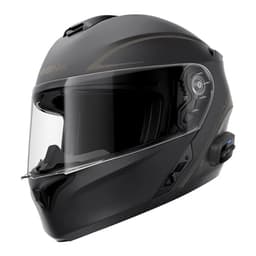
A modular helmet with the Bluetooth intercom built in and hidden — no bolt-on module, no wind snag. The US version is DOT-certified and Sena publishes Bluetooth 5.1, four-rider intercom and 18 hours of talk time. The cleanest way to get comms without a separate purchase.
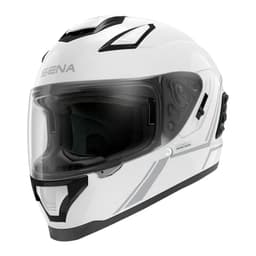
A composite-fiberglass full-face with a Mesh intercom and Sound by Harman Kardon built in. DOT-certified in the US, and the audio is a real step up from bolt-on speakers.
The trade with an integrated helmet is that the electronics and the helmet share a replacement cycle. Any helmet is finished after a significant impact — our guide on when to replace a motorcycle helmet covers why — and with a built-in unit the intercom goes with it. Buy a separate module and you keep the electronics when the helmet retires.
The Sena units we did not rank, and why
5R. Sena publishes the same two-rider Bluetooth 5.1 intercom and the same 700 m working distance as the 5S, with a longer 36-hour talk time and a smaller 76 x 41 x 27 mm module. It is plausibly the button sibling of the 5S, but Sena’s product page does not describe its control interface and we do not rank a unit on an inference. If the specification sheet is what you are buying, it is a legitimate choice.
SMH5. Sena publishes a two-rider intercom, up to 400 m in open terrain and 7 hours of talk time. It is the cheapest entry into the brand and every one of those three numbers is the weakest here. It exists for a rider who wants music, navigation prompts and an occasional word with a pillion, and nothing more.
Camera units. Sena’s camera-equipped intercoms are a different product with a different set of failure modes (storage, heat, battery drain) and we have not researched them to the standard we hold the rest of this page to. We would rather say that than rank them.
Sena or Cardo
The two brands split the category and the answer usually is not about hardware. Cardo’s mesh benchmark uses JBL speakers and a magnetic mount; Sena’s uses Harman Kardon — or, on the 60S EVO, Bose — and the Jog Dial. Both mesh networks are proprietary and neither talks to the other in mesh mode. Which means the practical question is not which is better, it is what the people you ride with already own. We lay out the full comparison on Cardo vs Sena, and put the two mid-tier units head-to-head on Cardo Freecom 4X vs Sena Spider ST1. If your group turns out to run Cardo, our guide to the Cardo rangedecodes the Packtalk, Freecom and Spirit families the same way this page decodes Sena’s.
Before you buy
Three things decide whether the unit actually gets used. First, check the speaker pocket in your helmet before you order — a 40 mm driver at 7 to 9 mm thick needs somewhere to sit, and the answer is never to carve the liner. Second, buy the pair if you already know there are two of you; dual packs exist for exactly this and two singles are the expensive route. Third, update the firmware the day it arrives, and make sure everyone in your group has done the same — that is what the Mesh 3.0 note above is really about.
And if you are still deciding whether you want an intercom at all, our guide to choosing a motorcycle intercom works through network type, speaker fit, mounting and glove-friendly controls without assuming a brand.
Frequently asked questions
Which Sena intercom should I buy?+
Work down three questions. Do you need mesh? If you ride in a group of four or more that spreads out, yes — the Spider RT1 is the cheapest way in and the 50S is the best-balanced. If you ride two-up or with one regular partner, no: the 5S does everything you need and keeps the Jog Dial. Do you want the dial or the slim module? S models get the Jog Dial, R models the low-profile buttons. And does your group already run Sena? Mesh does not cross brands, so that usually settles it.
Is the Sena 60S worth it over the 50S?+
Only for three specific things, because the network is the same. Sena publishes Mesh Intercom 3.0, Group Mesh for up to 24 riders and a 2 km (1.2 mile) working distance for both, so a 60S and a 50S sit in the same group. What the 60 Series adds is battery (24 h Bluetooth and 17 h mesh on the 60S against 16 and 13 on the 50S), an IPX7 waterproof rating Sena does not publish for the 50-series at all, and Wave — a cellular-based intercom Sena says supports a virtually unlimited number of participants. If you ride in the wet or ride long days between charges, that is a real upgrade. If you want the mesh network, it is not.
What is the difference between the Sena 50S and the 50R?+
The controls and the battery, not the network. Both publish Mesh Intercom 3.0, Group Mesh for up to 24 riders and a working distance of up to 2 km (1.2 miles) in open terrain, and both use 40 mm Harman Kardon speakers. The 50S has the Jog Dial; the 50R is the low-profile three-button module measuring 97 x 48 x 27 mm. Sena publishes 13 hours of mesh talk time for the 50S against 11 for the 50R.
Does the Sena 5S support four riders?+
No. Sena's own 5S product page publishes an intercom that supports up to 2 riders, over a working distance of up to 700 m (0.4 miles) in open terrain, and Sena's retail listing describes it as a two-way intercom. If you need four-way Bluetooth intercom without paying for mesh, Sena's SMH10 publishes up to 4 riders at up to 900 m — an older unit that does a thing the newer cheap one does not.
Did my Sena 50S get Mesh 3.0?+
It can. Sena's release notice for 50S and 50R firmware v1.5, dated 27 March 2025, records 'Added Mesh 3.0', and Sena's current product pages for both models publish Mesh Intercom 3.0. It is a firmware generation rather than new hardware, so an older unit gets there by updating. Check the firmware on every unit in your group — mixed mesh generations are a common cause of a group that paired fine last month and will not now.
Is Sena's 5-mile mesh range real?+
It is real and it is not what most riders think it means. Sena's Spider pages quote up to 5 miles / 8 km for Open and Group Mesh while listing a working distance of up to 1.2 miles in open terrain on the same page; the 50-series and 60-series pages quote up to 2 km (1.2 miles). Our reading is that the large figure describes a chain of riders relaying through each other end to end, and the small one describes the link between any two units. For two riders, 1.2 miles in open terrain is the number that applies — less with terrain in the way.
Do Sena and Cardo units work together?+
Not on mesh. Sena's mesh and Cardo's Dynamic Mesh are proprietary and only network with units of the same brand. The two can still connect over a standard universal Bluetooth intercom link, so a mixed pair can talk, but you lose the self-healing behavior that is the entire reason to buy mesh. If your group already runs one brand, buy that brand.
Which Sena has the longest battery life?+
The 60S EVO, which Sena publishes at 27 hours of Bluetooth and 19 hours of mesh talk time. Below the top tier the order is not what price would suggest: the cheapest mesh unit here, the Spider RT1, publishes up to 20 hours — longer than the Spider ST1 and the 5S at 18, and well clear of the 50S's 13 hours on mesh.
How much do Sena intercoms cost?+
They span a wide band, from the entry Bluetooth units up to the 60 Series, and pricing moves constantly with dual packs and promotions. We do not print a number into this answer — the price on each card above is pulled live from the retailer and time-stamped, which is the only figure worth trusting on a page you might be reading months after it was written.
Sources
Sena — 60S EVO Motorcycle Communication Headset — Sena's published 60S EVO specs: Mesh Intercom 3.0 and 2.0 plus Wave, Group Mesh up to 24 participants, 2 km (1.2 mi) range in open terrain, Bluetooth intercom up to 4 participants, 40 mm speakers with Sound by Bose, 27 h Bluetooth / 19 h mesh talk time, 1.5 h charge, IPX7 waterproof (accessed August 31, 2026)
Sena — 60S Motorcycle Mesh Communication System — Sena's published 60S specs: Mesh Intercom 3.0 and 2.0 plus Wave, Group Mesh up to 24, 2 km (1.2 mi) range in open terrain, 40 mm second-generation Harman Kardon speakers, 24 h Bluetooth / 17 h mesh talk time, 1.5 h charge, IPX7 waterproof, jog dial (accessed August 31, 2026)
Sena — 50S Motorcycle Mesh Communication System — Sena's published 50S specs: Mesh Intercom 3.0, Group Mesh up to 24 riders, up to 2 km (1.2 miles) working distance in open terrain, 13 h mesh / 16 h Bluetooth talk time, 2.5 h charge, Harman Kardon 40 mm speakers (accessed August 31, 2026)
Sena — 50R Motorcycle Mesh Communication System — Sena's published 50R specs: Mesh Intercom 3.0, up to 24 riders, 40 mm Harman Kardon speakers, 11 h mesh / 13 h Bluetooth talk time, 2.5 h charge, 97 x 48 x 27 mm module (accessed August 31, 2026)
Sena — SPIDER ST1 Motorcycle Mesh Communication System — Sena's published Spider ST1 specs: Mesh Intercom 3.0, Open Mesh across six channels, Group Mesh up to 24 riders, jog-dial control, 40 mm drivers, up to 18 h talk time, Bluetooth 5.2 (accessed August 31, 2026)
Sena — SPIDER RT1 Motorcycle Mesh Communication System — Sena's published Spider RT1 specs: Mesh Intercom 3.0, three-button control against the ST1's jog dial, 40 mm drivers, up to 20 h talk time, Bluetooth 5.2 (accessed August 31, 2026)
Sena — 5S Motorcycle Bluetooth Communication System — Sena's published 5S specs: Bluetooth 5.1, intercom supports up to 2 riders, up to 700 m (0.4 miles) in open terrain, 40 mm speakers, 18 h talk time, 1.5 h charge, Jog Dial (accessed August 31, 2026)
Sena — 5R Motorcycle Bluetooth Communication System — Sena's published 5R specs: 2-way Bluetooth 5.1 intercom, up to 700 m in open terrain, 40 mm speakers, 36 h talk time, 76 x 41 x 27 mm module. The page does not describe the control interface (accessed August 31, 2026)
Sena — SMH10 Bluetooth Motorcycle Communication System — Sena's published SMH10 specs: Universal Intercom for up to 4 riders, up to 900 m (980 yds) in open terrain, 12 h talk time, Jog Dial control (accessed August 31, 2026)
Sena — Firmware updates for the 50S & 50R v1.5 — Sena's own release notice for 50S (SP75) and 50R (SP76) firmware v1.5, dated 27 March 2025: "Added Mesh 3.0" — the primary record that the 50-series moved mesh generation by firmware rather than by new hardware (accessed August 31, 2026)