The two numbers, and what each one is really telling you
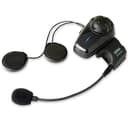
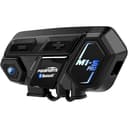
Rider count is the number of people who can be on one conversation at once. Cardo states that second-generation DMC supports up to 31 riders in a true DMC group, a figure it raised from 15 by firmware in its Mesh Boost update and delivers over the air to the Packtalk Pro, Edge and Neo. Sena states 24-rider Group Mesh across its mesh range. Below that, a Bluetooth intercom publishes a small number and means it: the Sena SMH10 publishes four riders, the Cardo Freecom 4X four, and the Fodsports M1-S Pro an eight-rider chain.
Working distanceis the one to read twice, because makers publish two different figures and they are not interchangeable. The big number — Cardo’s 8 km / 5 mi, Sena’s equivalent group figure — is the span of the whole network, relayed hop by hop through riders in between. The small number — Cardo’s 1.6 km / 1 mi unit-to-unit, Sena’s 2 km — is what two units do with nothing between them. On a real group ride strung out over a mountain road, the number that governs whether the tail bike hears the lead bike is the small one, multiplied by however many riders are strung out in between to relay it. A group of six covers a lot of ground. A pair does not.
One consequence worth stating plainly, because it saves money: paying more does not buy you more riders or more range. Cardo publishes the same 31-rider, 1.6 km unit-to-unit, 8 km group specification for the Packtalk Neo, the Edge and the Pro. What the money buys further up that range is speaker size, mount type, charge-while-riding and crash detection — not network capability. We laid the whole ladder out on our Cardo range page, and did the same for Sena.
What the ranking is actually saying
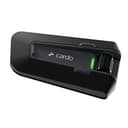
- The Packtalk Neo is first because it is the cheapest unit on Cardo’s current mesh network and arrives with nothing important missing for a group. Same DMC generation, same rider count, same range as the units above it. The honest trade Cardo publishes is that it does not support charging while you ride and it uses the clickable mount rather than the magnetic Air Mount.
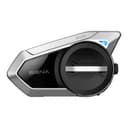
- The Sena 50S is first among Sena units for a group because of the thing that decides most group buys and has nothing to do with specs: everybody on the ride has to be on the same network. If your regular group runs Sena, buy Sena. A mixed group works — both brands fall back to standard Bluetooth to bridge — but you lose the mesh behaviour that is the entire reason to buy either.
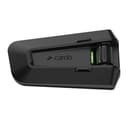
- The Packtalk Pro is the ride-leader’s unit. Same network, but Cardo publishes crash detection and 45 mm JBL speakers on it against 40 mm elsewhere. If you are the person who rides at the back sweeping and wants to be heard over wind at the front of the group, this is where the extra money goes.
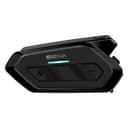
- The Spider RT1 is the honest budget answer. Sena publishes Mesh Intercom 3.0 and up to 20 hours of talk time on it at a price well under the flagship. If your group is assembling kit from scratch and cost decides how many riders end up connected at all, more riders on a Spider beats two riders on a 50S.
- The SMH10 is here because four riders is a real group and Sena publishes a four-rider Universal Intercom at up to 900 m for it. It is an old unit and it is Bluetooth, so the chain caveat applies in full — but if your group is a fixed four who always ride together and rarely split, it does the job for a fraction of mesh money.
- The Fodsports M1-S Pro is the try-before-you-commit pick. An eight-rider Bluetooth chain with FM at the lowest price here. Use it to find out whether your group actually wants to talk for six hours — a surprising number discover they do not.
Three things that ruin a group intercom, and none of them are specs
- Mixed brands. Two riders on Cardo and three on Sena is not one group, it is two groups with a Bluetooth bridge. Decide as a group before anyone buys. Our Cardo vs Sena comparison exists to settle exactly that argument.
- Mixed generations.Cardo’s own release notes state that legacy DMC units — Packtalk Bold, Slim and Black — can join a Mesh Boost group “with some limitations”. The rider on the five-year-old unit is the one who will be dropping out, and they will assume the network is at fault.
- Bad speaker placement.The best intercom in the world is useless if the speakers sit behind your jawbone instead of over your ear canal. This is the single most common reason a rider concludes their unit “is not loud enough”. Our installation guide covers where they actually go — and the one shortcut that permanently ruins a helmet.
What we did not rank, and why
The Cardo Freecom 4Xpublishes a four-rider Bluetooth intercom with JBL audio and would otherwise sit alongside the SMH10 here. On 18 September 2026 the retailer we link to listed it as “Only 1 left in stock”, so it is named rather than given a buy row. It is ranked on our main intercom page and compared head-to-head on Freecom 4X vs Spider ST1.
The LEXIN B4FM leads our budget intercom pageand our registry entry records it as a four-rider Bluetooth unit with FM, read from the retailer listing. On 18 September 2026 that listing’s own title read “10 Riders”. We have not found a LEXIN-published specification that resolves the two figures, so we are not ranking it on a rider count we cannot pin down — and if you are buying for a big group on a budget, read the current listing rather than trusting either number.
And the Sena 60S and 60S EVOsit above the 50S in Sena’s range but publish the same 24-rider Group Mesh and the same 2 km working distance. What they add is battery, an IPX7 rating Sena does not publish for the 50-series, and Wave. For a group ride specifically, they buy you nothing the 50S does not already do — which is why the 50S is the pick here and the 60S EVO leads the Sena range page instead.