KLIM Adventure GTX Short vs Alpinestars SMX-Z Drystar
Two waterproof gloves with the identical published certification — CE EN 13594:2015, KP Level 1 — and roughly a 2x price gap. This is what the extra money buys when the test result is a tie.
Buy the Alpinestars SMX-Z Drystar. It publishes exactly the same certification as the KLIM Adventure GTX Short — CE EN 13594:2015, Level 1, with the KP knuckle-impact marking — for a lot less money. The KLIM is the better glove in two specific, nameable ways, and if either of them is your situation it is worth the premium. For most riders neither one is, and paying twice for an identical test result is the most common expensive mistake in this category.
Here is why this pairing is worth a page of its own. Of the 24 gloves in our registry, four publish an EN 13594 rating at all, and every one of those four is Level 1 with the KP marking. We do not track a single glove that publishes Level 2. These two are two of the four, they are both short-cuff waterproof gloves, they both name a real membrane rather than claiming “waterproof” in the abstract, and neither one publishes any insulation. On the single line of a glove description that is a laboratory result rather than a marketing word, they are tied.
So this comparison cannot be settled by the certificate, which is how almost every glove comparison on the internet settles itself. It has to be settled on what each maker publishes underneath the certificate — and on which of the two makers publishes it at all. Every figure below was read from the source named at the bottom of this page on a dated visit. Nothing here was worn, ridden or crash-tested by us; our methodology page sets out exactly what we do and do not do.
If the letters and numbers do not mean anything to you yet, read what CE Level 1 KP actually means on a glove first. It explains the one distinction this whole page turns on: a “hard knuckle” is a shape, and KP is a test.
How this is funded: we earn a commission if you buy through our links, at no extra cost to you. It never changes which gear we recommend, and we’ll tell you plainly when to skip a pick. Full disclosure.
GORE-TEX, premium
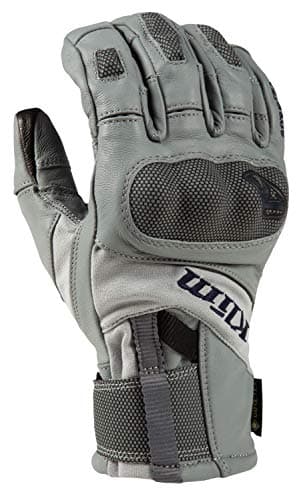
KLIM Adventure GTX Short Glove
The same GORE-TEX and the same published certification as the Badlands gauntlet, in a glove KLIM describes as a short design for under-cuff use, and with no insulation. If your adventure jacket has a tight storm cuff, or you ride wet-but-not-cold, this is the more useful of the two KLIM waterproof gloves here and it costs less.
Price as of November 12, 2026. #ad How we’re funded
Drystar, mid-price
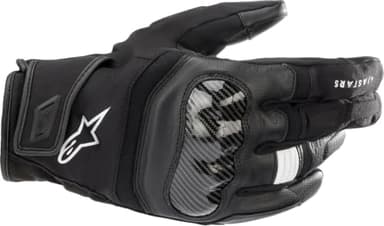
Alpinestars SMX-Z Drystar
The cheapest glove we found that publishes both halves of the job: a CE EN 13594 2015 Level 1 KP certification and a named waterproof membrane. Full-grain goat leather at the palm and impact zones, a nylon hard knuckle, a hook-and-loop wrist closure and touchscreen index and thumb. For all-day mixed-weather touring this is the sane default, and Alpinestars' own more expensive adventure glove cannot match it on paper.
Price as of November 12, 2026. #ad How we’re funded
| Spec | KLIM Adventure GTX Short Glove | Alpinestars SMX-Z Drystar |
|---|---|---|
| Published certification | CE certified to EN13594:2015, KP Level 1 — on KLIM's own product page | CE EN 13594 2015, Level 1 KP — on Alpinestars' published spec sheet |
| Where that spec was readable | klim.com, the maker's own page | An authoritative retailer's spec sheet — the alpinestars.com page for this model returned 404 |
| Waterproofing | GORE-TEX + GORE GRIP, carrying Gore's own “guaranteed to keep you dry” promise | Drystar membrane, named but with no hydrostatic figure published for this model |
| Shell | Goat leather and stretch woven construction | Full-grain goat leather palm and impact zones, suede side-hand reinforcement |
| Knuckle | Carbon fiber knuckle protector | Nylon hard knuckle |
| Palm protection | PORON XRD palm pad under the knuckle protector, plus 3D silicone finger pads | No palm armor published — leather and suede reinforcement only |
| Cuff | Short design, which KLIM states is for under-cuff use | Short hook-and-loop wrist closure |
| Insulation | None listed | None listed |
| Touchscreen | MULT-E-TOUCH functionality | Touchscreen-compatible index finger and thumb |
| Published size range | SM–3X | SM–3XL |
| Published weight | Neither maker publishes one | Neither maker publishes one |
| Price tier | Premium | Mid |
The certification is a tie, and that is the finding
Read the two certification lines next to each other and you are looking at the same sentence written by two marketing departments. KLIM publishes “CE CERTIFIED TO EN13594:2015, KP LEVEL 1”. Alpinestars’ spec sheet publishes “CE EN 13594 2015, Level 1 KP safety certification”. Same standard, same 2015 revision, same performance level, same optional knuckle-impact test passed.
That matters more than it sounds, because the certificate is the only part of a glove description that is a test result. EN 13594 puts a glove through abrasion, cut, tear and seam-strength testing in a lab, with a separate optional impact test at the knuckle that earns the KP marking. Everything else on a glove listing — the leather grade, the knuckle material, the palm slider, the stitching pattern — is a description of what the glove is made of, written by the company selling it. When two gloves publish the same EN 13594 result, the independently checkable part of the comparison is over.
So the honest version of this page is not “which glove is safer”. It is “what does roughly double the money buy you on top of an identical test result”. There are two real answers and one that we think is mostly noise.
What the KLIM premium actually buys
1. GORE-TEX, and a promise attached to it
KLIM does not publish its own waterproofing numbers for this glove — it publishes a membrane brand, GORE-TEX with GORE GRIP technology, which comes with Gore’s own “guaranteed to keep you dry” language. GORE GRIP is the construction where the membrane is laminated out towards the shell rather than floating inside a liner, which is why a Gore-Grip glove can be thin and still waterproof, and why it does not get that slack, shifting feeling a loose membrane liner gives you when your hand is wet.
Alpinestars names Drystar, which is its own in-house membrane, and publishes no hydrostatic head or breathability figure for this particular glove. This is the one place where Alpinestars could have won the argument on paper and chose not to: for the more expensive Andes V3 Drystar glove, Alpinestars publishes “5000mm waterproof protection” and “5000g/m2” breathability. So the company clearly can put a number on a Drystar membrane. For the SMX-Z it simply does not, and we are not going to borrow the Andes V3’s figure and attach it to a different glove. If you want a published waterproofing spec rather than a published brand, neither of these two gloves gives you one — and the brand with the external guarantee is KLIM’s. Our waterproofing explainer goes through why that trade keeps recurring across the category, and why rain performance is the one gear spec with no standard behind it at all.
2. A palm pad, which the Alpinestars does not publish
The KLIM lists a PORON XRD impact-absorbing pad in the palm, sitting under the carbon fiber knuckle protector, plus 3D silicone finger pads. The Alpinestars spec sheet publishes a full-grain goat leather palm with suede side-hand reinforcement and no palm armor at all.
This is a bigger deal than the knuckle, and it is the part of a glove most riders think about least. In a low-side you do not land on your knuckles, you land on your palms and then slide on them, and the heel of the hand takes both the impact and the abrasion. Leather handles the abrasion. A foam pad handles the impact. EN 13594 Level 1 certification tests the glove for abrasion, cut, tear and seam strength and the KP marking tests the knuckle — none of those four tests is an impact test at the palm. So the palm pad is a real difference the certificate does not capture, which is exactly why it is worth naming.
3. The carbon fiber knuckle, which is mostly noise
KLIM’s knuckle protector is carbon fiber and Alpinestars’ is nylon, and we think this difference is worth close to nothing to you. Both gloves passed the same optional knuckle-impact test to earn the same KP marking at the same level. That is the comparison. Carbon fiber is lighter and looks better through a visor; it is not a published improvement in the result of the only knuckle test either glove has been through. If a glove listing leads with its knuckle material rather than its KP marking, it is telling you about the part of the glove it can photograph.
The asymmetry nobody mentions: who publishes it
One difference between these two gloves has nothing to do with the gloves. KLIM publishes its certification, its membrane, its knuckle and palm construction and its size range on klim.com, on its own product page for this exact model, where we read them. The alpinestars.com product URL for the SMX-Z Drystar returned a 404 when we went looking, so the Alpinestars specification on this page comes from the maker’s published spec sheet as carried by an authoritative retailer.
We are telling you that because it is the honest description of our own sourcing, and because it has a practical consequence: if you want to check a claim about the SMX-Z Drystar yourself before you spend money, you are going to be reading a retailer rather than Alpinestars. That is a real, if minor, cost of buying the cheaper glove, and it is the kind of thing a comparison that only reads listings never notices. It does not change the certification, which is Alpinestars’ own published claim either way.
What neither glove does
Both of these are waterproof gloves. Neither of them is a warm glove, and the two are not the same thing.
- No insulation, in either.KLIM lists none for the Adventure GTX Short, and Alpinestars lists none for the SMX-Z. For comparison, KLIM’s gauntlet-length Badlands GTX publishes “60 Grams 3M Thinsulate insulation on backhand” — so when KLIM insulates a glove it says so, and for this one it does not. Below roughly 50 °F these are both going to need help. Our winter glove ranking and heated glove ranking are the pages for that problem, and the cold-weather gear guide covers the layering order.
- Neither is a gauntlet.Both are short-cuff gloves designed to sit under a jacket cuff. In sustained heavy rain, water runs down your sleeve and finds the gap at the wrist regardless of how good the membrane is — the membrane keeps water out of the leather, not off your forearm. If your riding is genuinely wet for hours at a time, a gauntlet that seals over the jacket is the right shape, and gauntlet vs short cuff is the page that argues it out.
- Neither publishes a weight. No glove in our registry does, which is worth stating because helmet makers publish weights and glove makers almost never do. If you read a gram figure for either of these, somebody weighed one themselves or made it up.
- Neither publishes Level 2.Both are Level 1. If you are looking at track use rather than road and touring, Level 1 is the street tier and you want to be reading EN 13594 Level 2 gauntlets — a category we do not currently track a single example of, which tells you how thin it is in the US market.
Fit and sizing, which decides more than either spec
KLIM publishes SM–3X for the Adventure GTX Short; Alpinestars publishes SM–3XL for the SMX-Z. Those ranges are effectively the same, and neither maker publishes a measurement-to-size table we could read for this glove, so we are not going to print one.
What we will tell you is the rule that matters more than any spec on this page. A glove that is loose in the palm is a glove that will rotate on your hand in a slide, and a seam is the first thing that fails when it does. EN 13594 tests seam strength precisely because seams are the weak point. Buy a glove that is snug across the palm with no slack fabric, with the fingertips just short of the ends, and accept that leather will give you a little room after a few rides rather than buying a size up to get there immediately. If you cannot try them on, buy from a retailer whose return policy lets you send the wrong size back — which, with a glove, is most of the purchase decision. Our gear fit guide goes through this joint by joint.
The verdict
Most riders should buy the Alpinestars SMX-Z Drystar. It is the cheapest glove we track that publishes both halves of the job — a real EN 13594 Level 1 KP certification and a named waterproof membrane — and it publishes the identical certification to a glove that costs roughly twice as much. For commuting, touring and mixed-weather road riding, that is the sane default, and the money you do not spend here buys a serious amount of the gear you are probably still missing.
Buy the KLIM Adventure GTX Short in two situations. The first is sustained wet riding where you want GORE-TEX and the external guarantee that comes with it rather than an in-house membrane with no published figure. The second is if the published palm pad matters to you — it is a genuine protective feature the Alpinestars does not list, in the place hands actually land. Adventure riders doing multi-day trips in weather they cannot choose are the clearest case for both of those at once.
What should not decide it: the carbon fiber knuckle, the brand on the cuff, or a belief that the pricier glove is better certified. It is not. They publish the same result. If you want to see where both of these sit against the rest of the category, including the gauntlet version of the KLIM and the certified glove we could not stock-verify, start with the adventure and touring glove ranking.
One stock note, because it changed what this page could compare. We checked availability live on 5 November 2026 before writing a word. The KLIM Badlands GTX Long — the gauntlet version, and the fourth certified glove in our registry — returned “Only 3 left in stock”, which is below the depth we will feature a product at on a new page. That is why this comparison is the short-cuff KLIM rather than the gauntlet, and it is the better pairing anyway: two short-cuff gloves at different prices isolate the money question instead of confusing it with cuff length.
Frequently asked questions
Is the KLIM Adventure GTX Short worth twice the price of the Alpinestars SMX-Z Drystar?
For most riders, no. Both gloves publish the identical certification — CE EN 13594:2015, Level 1, with the KP knuckle marking — so the only independently tested part of the comparison is a tie. The KLIM premium buys you GORE-TEX with GORE GRIP and Gore's own guarantee rather than an in-house membrane with no published figure, plus a PORON XRD palm pad the Alpinestars does not list. If you ride in sustained rain or you want published palm protection, those are real and the KLIM is worth it. If you are commuting and touring in mixed weather, the Alpinestars does the same certified job for a lot less.
Do both of these gloves have the same CE rating?
Yes, and that is the point of the page. KLIM publishes 'CE CERTIFIED TO EN13594:2015, KP LEVEL 1' for the Adventure GTX Short. Alpinestars' published spec sheet for the SMX-Z Drystar says 'CE EN 13594 2015, Level 1 KP safety certification'. Same standard, same revision year, same performance level, same optional knuckle-impact test. For context on how unusual that is: of the 24 gloves in our registry only four publish an EN 13594 rating at all, and all four are Level 1 KP. We do not track a single glove that publishes Level 2.
Which glove is more waterproof?
Neither maker publishes a number we can compare, so we cannot rank them and we are not going to pretend otherwise. KLIM publishes a membrane brand — GORE-TEX with GORE GRIP, which carries Gore's own 'guaranteed to keep you dry' promise. Alpinestars publishes a membrane name, Drystar, with no hydrostatic or breathability figure for this model, even though it does publish '5000mm waterproof protection' and '5000g/m2' breathability for its more expensive Andes V3 Drystar glove. If a published waterproofing spec is what you want, neither of these two gives you one; the external brand guarantee is the KLIM's.
Does the carbon fiber knuckle make the KLIM safer?
Not in any way either maker publishes. Both gloves carry the KP marking at Level 1, which means both passed the same optional knuckle-impact test within EN 13594 at the same performance threshold. Carbon fiber is lighter than nylon and it looks better, and that is what you are buying. Treat a knuckle material claim the way you would treat a shell material claim on a helmet: it describes the construction, not the test result. The letters KP are the test result.
Are these gloves warm enough for winter?
No. Neither glove lists any insulation, and waterproof is not the same as warm — a thin waterproof membrane with no thermal layer will keep rain out of the leather and do almost nothing for your fingers below roughly 50 °F. KLIM makes the distinction itself: its gauntlet-length Badlands GTX publishes '60 Grams 3M Thinsulate insulation on backhand' and the Adventure GTX Short publishes none. For cold riding you want an insulated winter glove or a heated one, and heated gloves are the only honest answer once you are riding in real cold for hours.
Will a short-cuff glove keep my wrists dry in heavy rain?
Only partly, and this applies to both of these gloves equally. A short cuff is designed to sit under your jacket cuff, which works until water runs down the outside of your sleeve and reaches the gap at the wrist. The membrane's job is keeping water out of the glove's leather, not keeping your forearm dry. In genuinely wet riding for hours at a time, a gauntlet that seals over the jacket cuff is the right shape — our gauntlet vs short-cuff page sets out the trade, which is mainly that gauntlets are hot, bulky and awkward to get on with a tight jacket sleeve.
How should a motorcycle glove fit?
Snug across the palm with no slack fabric, fingertips just short of the ends, and no bunching when you close your hand around a grip. The reason is structural rather than comfort: a loose glove rotates on your hand in a slide and loads the seams, and seam strength is one of the four things EN 13594 actually tests. Leather gives a little after a few rides, so buy the size that is snug now rather than the size that is comfortable now. Neither of these makers publishes a measurement-to-size table for these gloves, so if you cannot try them on, buy somewhere you can return them.
Why is the KLIM Badlands GTX Long not in this comparison?
Availability. We check stock live before featuring any product on a new page, and on 5 November 2026 the Badlands GTX Long returned 'Only 3 left in stock', which is below the depth we will build a recommendation on. It is the gauntlet-length version of the same KLIM glove, it publishes the same EN 13594 Level 1 KP certification, and it adds 60 g of 3M Thinsulate on the backhand — so it is the warmer, more weatherproof KLIM if you find it in your size. It stays ranked on our adventure and touring glove page, where it already was; the stock rule applies to featuring a product on a new page, not to removing it from an old one.
Sources
- KLIM — Adventure GTX Short Glove — KLIM's published Adventure GTX Short specs: "CE CERTIFIED TO EN13594:2015, KP LEVEL 1", "GORE-TEX + GORE GRIP", "GOAT LEATHER/STRETCH WOVEN CONSTRUCTION", "SHORT DESIGN FOR UNDER-CUFF USE", "CARBON FIBER KNUCKLE PROTECTOR", "PORON XRD PALM UNDER CARBON FIBER KNUCKLE PROTECTOR", "3D SILICONE FINGER PADS", "CERAMIC PRINT IN SLIDE AREAS", MULT-E-TOUCH functionality, sizes SM-3X. No insulation is listed (accessed September 10, 2026)
- Alpinestars — SMX-Z Drystar Glove (published spec sheet via RevZilla) — Alpinestars' published SMX-Z Drystar spec sheet: "CE EN 13594 2015, Level 1 KP safety certification", "Waterproof Drystar performance technology membrane for breathable all-weather protection", "Full grain goat leather palm and impact zones", "Suede side hand reinforcements", "Nylon hard knuckle", "Hook and loop wrist closure", "Touchscreen compatible index finger and thumb", sizes SM-3XL. Read from an authoritative retailer because the alpinestars.com product URL for this model returned 404 on this date (accessed September 10, 2026)
- KLIM — Badlands GTX Long Glove (CE Certified) — KLIM's published Badlands GTX Long specs: "CE Level 1 KP rating certified to EN 13594", "GORE-TEX + GORE Grip Technology" with the "GUARANTEED TO KEEP YOU DRY" promise, "Goat leather construction", "60 Grams 3M Thinsulate insulation on backhand", "Polycarbonate knuckle guard with XRD Impact Protection Foam", ceramic print in the knuckle, palm pad and gauntlet cuff pad, MULT-E-TOUCH screen functionality, sizes SM-3X. KLIM carries the certification in the product name itself (accessed September 10, 2026)
- Alpinestars — Andes V3 Drystar Glove — Alpinestars' published Andes V3 Drystar glove specs: "Goat leather and textile construction", "Drystar waterproofing: 5000mm waterproof protection", "Breathability: 5000g/m2", "Viscoelastic protective armor on the knuckles", "Reflective panels for improved visibility", "Touchscreen-compatible fingertips", sizes S, M, L, XL, 2XL, 3XL. No CE EN 13594 certification is published anywhere on the page (accessed September 10, 2026)
- KLIM — Induction Glove — KLIM's published Induction specs: "CE CERTIFIED TO EN13594:2015, KP LEVEL 1", "PREMIUM GOAT LEATHER CONSTRUCTION", "CARBON FIBER HARD KNUCKLE PROTECTOR", "5MM XRD IMPACT PROTECTION FOAM IN PALM AND KNUCKLE PADS", "MAPPED PERFORATIONS FOR AIRFLOW AND ABRASION PROTECTION", "MESH BACKHAND", "VELCRO + ZIPPER DUAL-ENTRY CUFF SYSTEM", MULT-E-TOUCH with precision pads, sizes XS-3X. Cited here as the vented KLIM glove that does hold the certification the Baja S4 lists as pending (accessed September 10, 2026)
Keep reading
Best adventure & touring gloves
Where both of these sit against the rest of the category, including the gauntlet KLIM and the certified glove we could not stock-verify.
See the rankingGlove CE ratings explained
What EN 13594, Level 1 and the KP marking actually test — and why 'hard knuckle' is a shape rather than a result.
Read the guideGauntlet vs short-cuff gloves
Both gloves here are short-cuff. This is the page that argues out whether that is the shape you want.
Compare the cuffsMotorcycle waterproofing explained
Why GORE-TEX publishes a guarantee and Drystar publishes millimeters, and why neither has a standard behind it.
Read the explainerBest motorcycle gloves
The main ranking across every riding style, from sub-$30 summer gloves to certified waterproof touring pairs.
See the main rankingBest winter motorcycle gloves
Neither glove on this page lists any insulation. This is the page for riding when it is actually cold.
See the winter picksHow motorcycle gear should fit
Fit decides more than either spec table on this page. Joint by joint, including why a loose glove loads its seams.
Read the fit guide