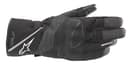
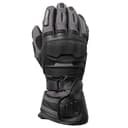
The certification is your shortlist, and it is a short one
EN 13594 is the European standard for motorcycle gloves. It measures abrasion resistance, cut resistance, tear and seam strength, and it rates a glove Level 1 or the tougher Level 2. Separately, a glove can carry a KPmarking, which means the knuckle protector was assessed against the standard’s impact requirement rather than simply being present. Our guide to choosing motorcycle gloves works through the whole standard properly.
Two things about it matter for adventure gloves specifically. The first is that EN 13594 is not a US requirement, so a glove sold here can be excellent and publish nothing at all. A missing rating means the maker has not published one — not that the glove failed. The second is that the makers who do publish are not evenly distributed: they cluster hard at the premium end of this category, and the gloves below are ranked partly on that because a published number is the only thing on a spec sheet that somebody outside the marketing department measured.
Here is what each glove on this page actually publishes, quoted rather than summarized.
| Glove | Published EN 13594 rating | Waterproofing | Insulated | Knuckle | Cuff |
|---|
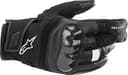
| Alpinestars SMX-Z Drystar | “CE EN 13594 2015, Level 1 KP” | Drystar membrane | No | Nylon hard knuckle | Short, hook-and-loop |
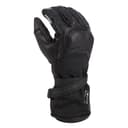
| KLIM Badlands GTX Long | “CE Level 1 KP rating certified to EN 13594” | GORE-TEX + GORE Grip | Yes — 60 g Thinsulate, backhand only | Polycarbonate over XRD foam | Long gauntlet |
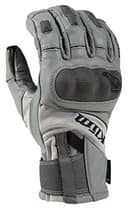
| KLIM Adventure GTX Short | “CE CERTIFIED TO EN13594:2015, KP LEVEL 1” | GORE-TEX + GORE GRIP | No | Carbon fiber over PORON XRD palm | Short, under-cuff |
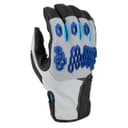
| KLIM Baja S4 | “Pending CE Level 1 KP rating” — pending | None | No | TPU vented knuckle | Short, hook-and-loop |
| Alpinestars Andes V3 Drystar | None published | Drystar, 5000 mm / 5000 g | No | Viscoelastic armor | Short |
| Tourmaster Super-Tour WP | None published | Aqua-barrier membrane | No | 3D molded protector | Short + zippered gusset |
Two findings you will not see on a retailer’s comparison page
First: on Alpinestars’ own shelf, the certification runs backwards against the price. The SMX-Z Drystar publishes “CE EN 13594 2015, Level 1 KP”. The Andes V3 Drystar, which is the better-known adventure glove and costs substantially more, publishes no EN 13594 rating anywhere on its product page — what it publishes instead is membrane performance, at 5000 mm of waterproofing and 5000 g/m² of breathability. Both are real data. They are just not the same kind of data, and paying more here buys you the membrane figure and loses you the safety certificate. That is a genuinely odd result and it is the reason the cheaper glove is ranked first.
Second: KLIM will tell you when a certification has not arrived yet. The Badlands GTX Long carries “CE Certified” in the product name itself. The Adventure GTX Short reads “CE CERTIFIED TO EN13594:2015, KP LEVEL 1”. And the Baja S4, in the same field on the same site, reads “Pending CE Level 1 KP rating certified to EN 13594”. One word apart, entirely different claim. Almost nobody in this market publishes the pending state at all — they simply say nothing until the certificate lands, or they say “CE” and let you assume. We have taken KLIM at its word and recorded the Baja S4 as uncertified until that word disappears, which is why it sits fourth rather than higher.
Waterproof or vented: you are picking the trip, not the glove
This is the fork that decides your purchase, and no amount of marketing copy resolves it, because a membrane and real airflow are physically opposed. A waterproof glove works by putting a continuous film between your hand and the weather. Perforated leather works by putting holes in exactly the same place. You cannot have both in one glove, and any glove claiming both is doing one of them badly.
If most of your riding is wet, cold or unpredictable — Pacific Northwest, spring in the mountains, anything involving a schedule you have to keep — buy the membrane. The SMX-Z Drystar is the value answer, the Adventure GTX Short is the premium uninsulated one, and the Badlands GTX Long is the one for genuine cold as well as wet.
If most of your riding is hot and dry— desert, summer touring, dual-sport days where you are working the bike — buy the vented glove and carry a cheap waterproof overglove for the two hours a month it rains. The Baja S4 is built for exactly this, with perforated goat leather at the palm and a mesh backhand. So is the KLIM Induction, which is not ranked here only because it is a street-focused glove rather than an adventure one, but which does hold the very certification the Baja S4 lists as pending.
The riders who get this wrong are usually the ones who buy one expensive waterproof glove and then sweat in it for nine months. Two mid-price gloves beat one flagship on almost any touring calendar, and our rain gear guide covers the overglove-versus-membrane trade in more detail.
Cuff length is decided by your jacket, not by you
Every glove on this page is short-cuff except the Badlands GTX Long, and that is not an accident — adventure jackets tend to have adjustable storm cuffs designed to seal over a glove. If yours does, a gauntlet fights it: you end up with the gauntlet inside the sleeve (pointless) or the sleeve rucked up over the gauntlet (cold, and a water channel straight down your forearm). KLIM is explicit about which is which, describing the Adventure GTX Short as a “short design for under-cuff use”.
The gauntlet still wins in two cases. One is genuine rain, where a long cuff over the sleeve is the only arrangement that does not funnel water into the glove. The other is cold, where the wrist is a major heat-loss path and covering it is worth real degrees. If your riding includes both, that is the argument for the Badlands and against everything else here. Our gauntlet versus short-cuff comparison works through the protection side of the same decision.
What the touchscreen finger is actually for
Every glove on this page is touchscreen-compatible, and on an adventure or touring bike this is closer to a safety feature than a convenience one. You are running a phone or a GPS, you are re-routing at junctions, and the alternative to a working fingertip is taking a glove off at the roadside — which in the rain means putting a wet glove back on, and in the cold means losing ten minutes of hand warmth you will not get back.
The implementations differ more than the spec line suggests. KLIM’s MULT-E-TOUCH covers multiple digits and, on the Induction and Adventure GTX Short, adds what KLIM calls precision pads. Alpinestars specifies the index finger and thumb on the SMX-Z and full fingertips on the Andes V3. Tourmaster specifies the index finger and thumb. If you navigate a lot, that is a real difference between these gloves and worth reading before you buy.
Sizing an adventure glove
Gloves are sized on hand circumference measured around the knuckles, excluding the thumb, and every maker here publishes a chart. Two things go wrong specifically in this category. The first is buying a waterproof glove in your summer glove size: a membrane and a liner take up volume, so a glove that fits perfectly in leather can be tight enough in GORE-TEX to cut circulation, which makes your hands colder rather than warmer. The second is sizing up so a liner will fit underneath, which leaves the knuckle protector floating somewhere other than over your knuckles.
Measure, buy the size the maker’s own chart gives you, and if you need more warmth add it with a heated grip or a heated gloverather than with a liner inside a glove that was not designed for one. All six gloves here run at least S/SM through 3X, so there is no size-availability excuse in this category — unlike the strap-on armor we ranked on the elbow guard page, where two-size ranges are common.
Where these fit in the rest of your adventure kit
Gloves are the piece riders most often leave until last, and on a touring bike that is backwards — your hands are on the controls for every minute of the trip, and cold or soaked hands degrade your inputs long before they become a comfort problem. If you are assembling adventure kit from scratch, the jacket comes first, and our adventure and touring jacket roundup is the direct sibling of this page. Boots come next, because they are the piece that has to work both on the pegs and off the bike — see the best adventure and touring boots. The helmet decision is its own thing entirely, and dual-sport and adventure helmets covers the peak-and-visor trade properly.
For a longer trip, our touring gear checklist is the page to work through before you leave, and it is the place the two-glove strategy above actually pays off: a vented pair on your hands and a waterproof pair in the top box weighs almost nothing and removes the single most common reason riders cut a day short.
What we did not rank, and why
- REV’IT! Sand 4.A genuinely certified adventure glove — REV’IT! publishes “CE certified to EN 13594:2015 Level 1 Knuckle Protection” — and it would otherwise have made this list. On the day we checked, the retailer we link to listed it only in 3XL and 4XL. Under our availability rule we do not rank a product most readers cannot buy in their size, so it is named here instead.
- Heated gloves. A different product solving a different problem, with their own page at best heated motorcycle gloves. Worth knowing before you compare: not one heated glove we have found publishes an EN 13594 rating, so the trade against a certified waterproof glove is real and not just about price.
- Winter and summer gloves generally.If your riding is genuinely seasonal rather than all-day-variable, the season-specific pages are the better fit — winter gloves add insulation this page mostly does not, and summer gloves go further on airflow than any adventure glove will.
- Gloves claiming “CE” with no standard named. The budget end of this category is full of listings that say CE without naming EN 13594, a level, or a year. Because two gloves here publish the full string and two others honestly publish nothing, there was no reason to include a claim we could not trace to a specification.
Before you buy
Four checks, in order. First, decide waterproof or vented before you compare anything, because the two are not competing for the same rider and the price order will otherwise choose for you. Second, look at your jacket cuff and buy the cuff length that works with it rather than against it. Third, read the certification line literally— “CE certified to EN13594:2015, KP Level 1” and “pending CE Level 1 KP rating” are different sentences and you should treat them differently. Fourth, measure your hand and use the maker’s own chart, allowing for the fact that a membrane takes up room a summer glove does not.
And if these are the first proper gloves you are buying rather than a second pair, start with our best motorcycle gloves roundup, which covers the all-round picks that handle most of the year without asking you to own two pairs.