Shoei GT-Air 3 vs Neotec 3
Two Shoei touring helmets, one chin bar apart. The flip-front costs more, weighs about 136 g more, and is the only one of the two whose US listing publishes ECE 22.06.
Buy the Neotec 3 if you want the certification, and the GT-Air 3 if you want the weight. That is the whole comparison in one line, and it is the opposite of how this decision is usually framed. The Neotec 3 is the flip-front and the more expensive helmet, so people assume the GT-Air 3 is the compromise. On what each maker publishes, the Neotec 3 is the better certified helmet — DOT plus ECE 22.06 with P/J dual homologation— while the GT-Air 3’s US listing publishes DOT and nothing else.
What you pay for that is about 136 g. Shoei publishes roughly 1,850 g for the Neotec 3 and 1,714 g for the GT-Air 3, and that gap is the hinge, the chin-bar mechanism and the structure around them. Both helmets are built on a Shoei AIM composite shell, both are designed around Shoei’s own comms rather than a module clamped to the side, and both are premium-priced. So this is not a good-versus-better comparison. It is a genuine trade: a certification the other one does not publish, against weight and simplicity.
Every figure in the table below is what Shoei publishes for that model as recorded in our registry on a dated visit — the source and the date sit under each spec table. We own neither helmet and run no lab; our methodology page says exactly what our recommendations are built from. Prices are live and carry the date they were read.
How this is funded: we earn a commission if you buy through our links, at no extra cost to you. It never changes which gear we recommend, and we’ll tell you plainly when to skip a pick. Full disclosure.
The full-face
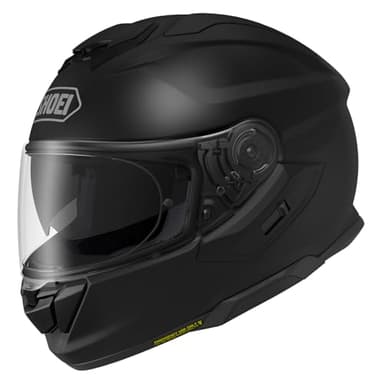
Shoei GT-Air 3
Shoei's dedicated touring full-face: AIM shell, an internal sun visor, a deep neck roll and comms integration designed in rather than bolted on. If you ride 400-mile days with a shield down, this is the reference.
Price as of October 4, 2026. #ad How we’re funded
The flip-front
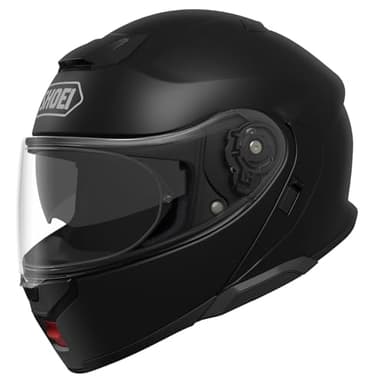
Shoei Neotec 3
The benchmark touring modular. Shoei's AIM shell, DOT plus ECE 22.06 with P/J dual homologation (legal to ride with the chin bar up), and the quietest flip-front we know of. Expensive, and worth it for high-mileage touring.
Price as of October 4, 2026. #ad How we’re funded
| Spec | Shoei GT-Air 3 | Shoei Neotec 3 |
|---|---|---|
| Helmet type | Full-face, dedicated touring | Modular (flip-front), touring |
| Certification published | DOT | DOT + ECE 22.06 (P/J dual homologation) |
| Rated with the chin bar up? | No chin bar to raise | Yes — the P/J rating covers open and closed |
| Shell | AIM multi-fiber composite | AIM multi-composite |
| Claimed weight | 1,714 g | 1,850 g |
| Key published feature | Drop-down internal sun visor | ECE 22.06 P/J — legal to ride with the chin bar up |
| Comms | Designed around Shoei's SRL system | Sena SRL3 integrates without breaking the shell lines |
| Fit | Intermediate oval; touring-plush interior | Intermediate oval; long-oval friendly |
| Price tier | Premium | Premium — the more expensive of the two |
The certification gap is the real story
Two helmets from the same maker, in the same touring family, on the same shell technology — and one of them publishes a second certification that the other does not. The Neotec 3 publishes DOT plus ECE 22.06. The GT-Air 3’s US listing publishes DOT only, with no SNELL and no ECE version.
That matters more than it sounds, because ECE 22.06 is not simply a European equivalent of DOT. It is the current UN regulation and it added oblique-impact testing for rotational forces — the twisting injury mechanism that straight linear drop tests never measured. A DOT-certified helmet is a legal, tested helmet; it has not been through that rotational test. Our ECE 22.06 page lists every helmet in our registry that publishes 22.06 by name, and the certification guide explains what each mark covers.
The second half of the Neotec 3’s certification is the part most flip-front buyers do not realise they are missing elsewhere. P/J dual homologation means the helmet is rated with the chin bar raised as well as lowered. Most modular helmets on the market are certified closed only, so riding with the chin bar up sits outside the certification. The Neotec 3 is one of the few that is tested both ways, and if the reason you want a flip-front is to ride short stretches open, that is the single most important line in the table above. We work through that distinction properly in modular versus full-face.
What the 136 grams actually costs you
Shoei publishes 1,850 g for the Neotec 3 and 1,714 g for the GT-Air 3. In isolation that reads like nothing. On a 400-mile day it is the difference you feel in your neck at hour six, and in stop-start traffic it is the weight your head carries at every light with no airflow holding the helmet up.
It is worth putting those numbers in context rather than in isolation. Both helmets are heavy by the standards of our weight ranking, where the lightest full-face we rank is a carbon-aramid shell well under 1,500 g, and both are heavy because they are touring helmets: the sealing, the neck roll, the sun-visor mechanism and the comms provision all weigh something. A modular is always heavier than the equivalent full-face, and the Neotec 3 is the lighter end of that penalty rather than the worse end.
Where the two helmets are genuinely the same
- The shell family.Both are Shoei AIM composites — the multi-fiber layup the company has built its road helmets around for years. Neither is a polycarbonate shell, and that is where a large part of both prices goes.
- The fit philosophy. Both are intermediate oval, which is the most common head shape and also the reason neither helmet suits a genuinely round or genuinely long head without trying it. Shoei records the Neotec 3 as long-oval friendly and the GT-Air 3 as having a touring-plush interior. Our guide to helmet head shapes covers why this decides comfort more than the size label does.
- Comms designed in, not bolted on.The GT-Air 3 is built around Shoei’s SRL system and the Neotec 3 around the SRL3, so on both helmets the intercom sits inside the shell line instead of clamping to the outside. If you tour with an intercom this is a bigger quality-of-life difference than any spec in the table — see how to choose an intercom.
- Quiet, by touring-helmet standards. Both are sealed, neck-rolled touring designs rather than vented race shells. We rank the Neotec 3 at the top of our quietest-helmets page, which is unusual for a flip-front and is the main reason it justifies its price.
Which one should you buy?
Buy the Neotec 3 ifyou want the ECE 22.06 certification and the rotational test behind it; if you want to ride with the chin bar up legally and within the helmet’s rating; if you wear glasses and are tired of threading the arms past cheek pads; or if your riding involves the stops a flip-front makes painless — tolls, fuel, border queues, talking to people. It is also the one to buy if you are moving from an open-face and want to be able to open the helmet when the road slows down.
Buy the GT-Air 3 if weight is what you notice at the end of a long day; if you want a continuous shell with no hinge through it; if you ride with the shield down for hours at a time and value the internal sun visor over the chin bar lifting; or if you simply do not want to pay the flip-front premium. It is the quieter buy in budget terms and the lighter one on your neck.
Buy neither ifyour riding is a commute. Both are touring flagships, and the deciding factor on a commute is that you have to leave the helmet somewhere — our commuting helmet ranking argues that case and names cheaper helmets that do the daily job better. Likewise, if you want the strongest energy-management certification rather than the rotational one, neither of these publishes SNELL, and our safest-helmets ranking sorts the registry by exactly that.
Frequently asked questions
Should I buy the Shoei GT-Air 3 or the Neotec 3?
The Neotec 3 if you want certification, the GT-Air 3 if you want weight. The Neotec 3 publishes DOT plus ECE 22.06 with P/J dual homologation, meaning it is rated with the chin bar up as well as down, and ECE 22.06 is the only one of the common marks that added oblique-impact testing for rotational forces. The GT-Air 3's US listing publishes DOT and nothing else. In exchange the GT-Air 3 is a published 1,714 g against the Neotec 3's 1,850 g, has no hinge through the shell, and costs less.
Is the Shoei Neotec 3 safer than the GT-Air 3?
On published certification it carries more: DOT plus ECE 22.06 against DOT alone on the GT-Air 3's US listing. That is a factual difference in what each helmet has been tested against, and ECE 22.06 includes rotational oblique-impact testing that DOT does not. It is not a claim that the Neotec 3 performs better in any specific crash — we run no tests and no US body publishes a comparative helmet safety score. What is also true is that a full-face has one continuous shell where a modular has a hinge, which is the structural argument that usually runs the other way.
How much heavier is the Neotec 3 than the GT-Air 3?
About 136 grams, on the figures Shoei publishes: roughly 1,850 g for the Neotec 3 against 1,714 g for the GT-Air 3. That is the hinge, the chin-bar mechanism and the structure around them. Both are heavy for a composite-shell helmet — the lightest full-face in our registry is a carbon-aramid shell well under 1,500 g — because both are sealed touring designs with a sun visor mechanism and comms provision. If weight on your neck at hour six is what decides helmets for you, the GT-Air 3 is the pick.
Can you ride the Neotec 3 with the chin bar up?
Yes, and this is one of the few modular helmets where that is covered by the certification rather than just physically possible. The Neotec 3 publishes ECE 22.06 with P/J dual homologation, which means it was tested and rated in both the open and closed positions. Most flip-fronts on the market are homologated closed only, so riding them open sits outside what the certificate covers. If opening the helmet on the move is why you want a modular, check for a P/J marking specifically rather than assuming.
Do both helmets have a drop-down sun visor?
Our registry records the internal sun visor as the GT-Air 3's headline published feature, and records the Neotec 3's as its ECE 22.06 P/J dual homologation. Both are touring helmets in the same Shoei family and both are designed for long days with the shield down. Rather than infer a feature we have not read on the listing for a specific model, check the current product page for the exact configuration and colourway you are buying — that is the same rule we apply to every spec on this site.
Which Shoei is better for touring?
Both are built for it, and they split on how you tour. The Neotec 3 suits a tour with stops in it — fuel, tolls, food, conversation — because the chin bar lifts and, unusually, it is rated that way. It is also the quietest flip-front we rank, which on a long day matters more than almost any other spec. The GT-Air 3 suits a tour that is hours of shield-down highway, where 136 g less on your neck and a shell with no hinge through it are the things you notice. Neither is the wrong answer.
Are these helmets SNELL certified?
No. Neither the GT-Air 3 nor the Neotec 3 publishes a SNELL rating — the GT-Air 3's listing is explicit that it carries DOT only. SNELL is a voluntary standard and its protocol is the toughest energy-management and penetration test in common use, but a SNELL-certified helmet is usually a race-shaped one with the noise and airflow to match. If a SNELL rating is your priority, our SNELL-certified ranking lists every helmet in the registry that publishes one, checked against Snell's own certified-product list.
Will my intercom fit either helmet?
Both are designed around Shoei's own systems — the GT-Air 3 around the SRL and the Neotec 3 around the SRL3 — which is why neither needs a module clamped to the outside of the shell. A universal intercom will generally physically fit, but you lose the reason you paid for these helmets: the designed-in unit sits inside the shell line and keeps the aerodynamics and the sealing intact. If you already own a universal unit, factor the cost of switching into the comparison, because on these two helmets it is a real part of the decision.
Sources
- 49 CFR 571.218 — FMVSS No. 218, Motorcycle helmets — The US federal helmet standard: peak-acceleration, penetration and retention requirements; applies to all on-road motorcycle helmets (accessed July 21, 2026)
- UNECE — Vehicle Regulations (UN Regulation No. 22 / ECE 22.06) — The UN regulation behind ECE 22.06, which added rotational/oblique-impact testing over 22.05 (accessed July 21, 2026)
- NHTSA — How to Choose the Right Motorcycle Helmet — NHTSA consumer guidance on DOT certification and spotting novelty helmets (accessed July 21, 2026)
- Snell Memorial Foundation — Standards — Snell's motorcycle helmet standards: M2025D/M2025R are the current generation and M2020D/M2020R the previous one (D = DOT markets, R = ECE markets) (accessed July 21, 2026)
Keep reading
Best touring helmets
Quiet, well-sealed helmets built for 400-mile days, and the certification each one actually carries.
See the touring picksBest modular helmets
Flip-fronts compared on certification, weight and wind noise, from touring flagships to budget flip-ups.
See the modular picksShoei Neotec 3 vs HJC i90
The same flip-front against a mid-priced rival, so you can see exactly what the flagship premium buys.
See that comparisonECE 22.06 motorcycle helmets
Every helmet in our registry that publishes 22.06 by name, separated from the unversioned “ECE” claims.
See the 22.06 helmetsQuietest motorcycle helmets
What actually makes a helmet quiet — shell sealing, neck roll, aero shape — and where the Neotec 3 sits.
See the quiet picksSafest motorcycle helmets
The whole registry sorted by published certification, including which helmets add rotational management.
See the safest picks