Sena Stryker vs Sena Outrush R
Sena's two comms-built-in helmets, compared on what Sena publishes: a full-face with Mesh and Harman Kardon audio against a modular with Bluetooth 5.1 and a sun visor. One of them cannot talk to a mesh group at all.
Buy the Stryker if the people you ride with run mesh intercoms, and the Outrush R if they do not. That single question settles this comparison faster than any other spec, because it is the one difference you cannot fix later: Sena publishes Mesh for the Stryker, and for the Outrush R it publishes Bluetooth 5.1 with a four-rider intercom and no mesh capability of any kind. Everything else — chin bar or flip-front, fiberglass or polycarbonate, audio brand, price — is a preference. Mesh versus Bluetooth is a network.
Both are DOT FMVSS 218 helmets with the electronics built in rather than clamped on, which is the entire point of buying either one: no module to snag, no battery pack hanging off the shell, no double-sided tape. Both also share the same structural trade-off, and it is worth saying before the table rather than after it: you cannot upgrade the comms without replacing the helmet. If that bothers you, the honest answer is a plain helmet plus a separate unit — the built-in versus separate intercom question has its own page, and our intercom ranking is where that road leads.
The Outrush R figures below were read from Sena’s own US product page, including the four specs Sena does not publish for it; the Stryker figures come from its live listing as recorded in our registry on a dated visit. We have worn neither helmet and this page makes no claim about how either one sounds or fits in practice — see our methodology.
How this is funded: we earn a commission if you buy through our links, at no extra cost to you. It never changes which gear we recommend, and we’ll tell you plainly when to skip a pick. Full disclosure.
The full-face with Mesh
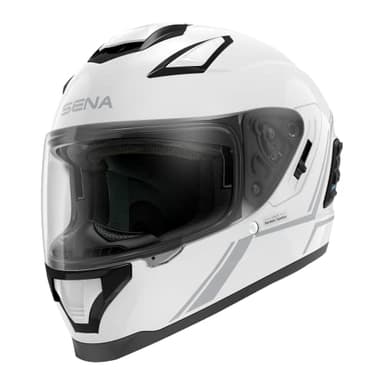
Sena Stryker
A composite-fiberglass full-face with a Mesh intercom and Sound by Harman Kardon built in. DOT-certified in the US, and the audio is a real step up from bolt-on speakers.
Price as of October 17, 2026. #ad How we’re funded
The modular with Bluetooth
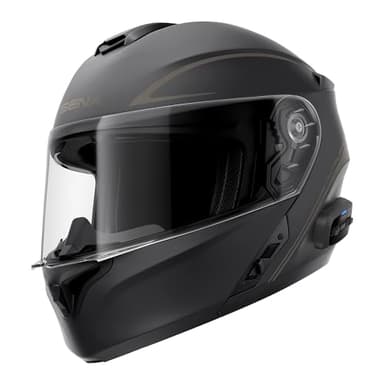
Sena Outrush R
A modular helmet with the Bluetooth intercom built in and hidden — no bolt-on module, no wind snag. The US version is DOT-certified and Sena publishes Bluetooth 5.1, four-rider intercom and 18 hours of talk time. The cleanest way to get comms without a separate purchase.
Price as of October 17, 2026. #ad How we’re funded
| Spec | Sena Stryker | Sena Outrush R |
|---|---|---|
| Helmet type | Full-face | Modular (flip-front) |
| Certification published | DOT FMVSS 218 | DOT FMVSS 218 (no ECE homologation listed) |
| Shell | Composite fiberglass | Single-shell polycarbonate ABS, multi-density EPS |
| Published weight | 1,750 g | 1,730 g at size M |
| Intercom type | Mesh intercom built in | Bluetooth 5.1 — no mesh capability published |
| Intercom group / range | Mesh network (Sena publishes no rider count on the listing) | Up to four riders, up to 900 m (0.6 mi) in open terrain |
| Audio | Sound by Harman Kardon speakers and mics | Sena speakers; no diameter published |
| Talk time | Not published on the listing | Up to 18 hours; 2.5 h charge |
| Sun visor | Not published on the listing | Inner drop-down sun visor |
| Extras | Integrated LED taillight | Quick-release clear face shield, voice controls |
| Price tier | Premium | Mid |
| Who it is for | Full-face riders in a mesh group who want the best built-in audio | Modular riders who want glasses-friendly entry, a sun visor and two-way or small-group talk |
The mesh difference, in plain terms
A Bluetooth intercom builds a chain: units pair to each other in a fixed order, and when one rider drops out of range the chain behind them can break until someone re-pairs. A mesh network behaves like a group rather than a chain — riders drop in and out and the network re-forms around them without anyone pressing anything. On a two-up commute the difference is invisible. On a six-bike day through canyons it is the whole experience, and it is why mesh versus Bluetooth is the first thing we tell group riders to settle.
Two caveats keep this honest. First, mesh networks are brand-specific: Sena’s mesh and Cardo’s DMC do not join each other, so a mesh helmet is only an advantage if your group runs the same brand — Cardo versus Senais the page for that decision. Second, for the Outrush R this is not a “worse mesh” situation, it is the absence of the feature: Sena publishes Bluetooth 5.1 and a four-rider intercom for it and no mesh at all. The word “mesh” does appear on Sena’s Outrush R page, but it refers to breathable ventilation fabric. Our full Outrush R review covers that and the four other specs Sena leaves out.
Full-face or modular is the second question
The Stryker is a full-face: one piece, chin bar fixed, the shape with the most structural coverage and the quietest aerodynamics. The Outrush R is a modular, which means a chin bar on a hinge, a drop-down sun visor, and the ability to flip the front up at a fuel stop or to put glasses on without taking the helmet off. That convenience costs weight and adds a mechanism, which is the trade-off modular versus full-face works through properly.
The published weights here are unusually close — 1,750 g for the fiberglass full-face against 1,730 g for the polycarbonate modular at size M — so weight is not the deciding factor between these two the way it usually is between a full-face and a flip. If low mass is what you are shopping for, the lightest helmets page is the right list and neither of these is on it.
What neither of these helmets is
- Neither is ECE 22.06 homologated.Both publish DOT FMVSS 218, which every street helmet sold in the US must meet. Neither lists the newer European standard with its rotational-impact criteria. If that matters to you, our ECE 22.06 pagelists the helmets in our registry that publish it — and none of them has comms built in.
- Neither is upgradeable.When the electronics date, the helmet dates with them. A five-year-old helmet should be looked at anyway — when to replace a helmet covers that — but a separate intercom moves to your next lid and these do not.
- Neither publishes an IP rating. Sena publishes IP figures for its standalone units and not for these helmets, so we will not imply a waterproofing level for either.
If you want built-in comms for less
There is a third option that neither of these addresses: the cheapest route into an all-in-one helmet. It is a real step down in both shell material and intercom, and it is also a fifth of the Stryker’s price, which is the correct comparison for a rider who is deciding between built-in comms and no comms at all.
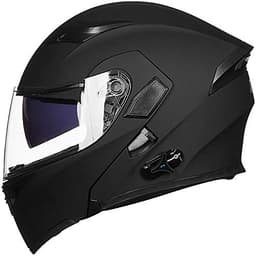
The budget alternative
ILM 902BT Pro Bluetooth Modular
DOT FMVSS 218The budget way into a helmet with Bluetooth built in: a DOT-certified flip-up with intercom, drop-down sun visor and dual-visor design for the price of a mid-tier helmet alone.
See all Bluetooth helmets we rankPrice as of October 17, 2026. #ad How we’re funded
It meets DOT FMVSS 218 with an intercom, a flip front and a drop-down sun visor, in an ABS shell — and ILM publishes no helmet-only weight, which is the kind of gap worth noticing at this price.
Our verdict
The Stryker is the better helmet of the two and the Outrush R is the better buy for more riders. Fiberglass shell, Harman Kardon audio and a mesh network are genuine advantages, and if you ride in a Sena-mesh group the Stryker is the answer and the price is the price. For everyone else — two-up, solo with music and navigation, a small group that pairs over Bluetooth, or anyone who wants a sun visor and a flip front — the Outrush R does the job for substantially less, and Sena publishes more about it than it does about the Stryker.
Frequently asked questions
Does the Sena Outrush R have mesh intercom?
No. Sena's own US product page publishes Bluetooth 5.1 and an intercom for up to four riders at up to 900 metres in open terrain, and no mesh capability of any kind. The word 'mesh' does appear on that page, describing breathable ventilation fabric rather than a network. If you need mesh, the Stryker is the Sena helmet that has it — or you fit a separate mesh unit to a plain helmet.
Is the Sena Stryker worth the extra money over the Outrush R?
If you ride in a group that runs Sena mesh, yes — you are buying a network the Outrush R cannot join, plus a composite fiberglass shell and Harman Kardon audio. If you ride solo, two-up, or in a small Bluetooth group, the extra buys you things you will not use, and the Outrush R adds a drop-down sun visor and a flip-up chin bar the Stryker does not have.
Which is heavier, the Stryker or the Outrush R?
They are within 20 grams of each other on published figures: 1,750 g for the Stryker and 1,730 g at size M for the Outrush R. That is unusual — a modular is normally the heavier shape because of the hinge hardware — and it means weight should not decide this purchase. Note that helmet weights are quoted at a specific size, so a large of either will weigh more than these numbers.
Are these helmets ECE 22.06 certified?
Neither publishes an ECE 22.06 homologation. Both publish DOT FMVSS 218, the US federal standard every street helmet must meet to be sold. ECE 22.06 is the newer European standard that added rotational-impact criteria; in our registry the helmets that publish it do not have comms built in, so a rider who wants both is currently choosing a plain ECE 22.06 helmet plus a separate intercom.
Can I use a Sena helmet intercom with a Cardo unit?
For a mesh group, no — Sena Mesh and Cardo DMC are separate networks and do not join. Most current units from both brands can still talk to each other over standard Bluetooth as a fallback, which works for two riders and gets fragile in a group. In practice the group decides: pick the brand the people you ride with already run.
Is a helmet with built-in comms better than a separate intercom?
It is tidier and less flexible. Built-in means no module on the shell, no tape, no wind snag and nothing to lose, and it is usually cheaper than buying a helmet and a good intercom separately. Separate means you can upgrade the electronics without replacing the helmet, move your unit to a new lid, and choose a current mesh system — which is why our intercom ranking exists alongside these helmets rather than instead of them.
Sources
- Sena — Outrush R (maker's product page, US) — Every figure on the Outrush R review, read from Sena's own US product page. Helmet certification: "DOT" (no ECE homologation is listed). Electronics approvals: "CE, FCC, IC". Shell: "Single shell polycarbonate ABS and multi-density EPS". Weight: "DOT: 1,730 g (61 oz) (M size)". Comms: "Bluetooth 5.1", intercom "up to 900 meters (0.6 miles) in open terrain" for up to four riders, talk time "up to 18 hours", charge time "2.5 hours", "Lithium Polymer Battery". Helmet features: an "Inner sun visor", and a clear, scratch- and UV-resistant face shield with a quick-release system. Sizes S to XXL. Warranty: "Electronics: 2 years" and "Helmet Integrity: 2 years". What Sena does NOT publish on this page, and the review says so: no speaker diameter, no microphone type, no IP rating, no mesh-intercom capability of any kind (the "breathable mesh" wording on the page is ventilation fabric), and no box contents (accessed October 15, 2026)
- 49 CFR 571.218 — FMVSS No. 218, Motorcycle helmets — The US federal helmet standard: peak-acceleration, penetration and retention requirements; applies to all on-road motorcycle helmets (accessed July 21, 2026)
- NHTSA — How to Choose the Right Motorcycle Helmet — NHTSA consumer guidance on DOT certification and spotting novelty helmets (accessed July 21, 2026)
Keep reading
Sena Outrush R review
Every figure Sena publishes for the Outrush R, plus the five specs it does not — including the mesh claim we corrected.
Read the reviewBest Bluetooth motorcycle helmets
The full ranking of helmets with comms built in, from the cheapest ABS flip-up to the Stryker.
See the rankingBuilt-in or separate intercom?
The structural trade-off behind both helmets on this page, and when a plain helmet plus a unit wins.
Read the guideMesh vs Bluetooth intercoms
Why a chain breaks and a mesh heals, and how big a group has to be before it matters.
Read the comparison