AGV K6 S Review: Four Shells, Five EPS Densities, and a Weight Nobody Agrees On
AGV's own page publishes 1,290 g in the first shell size. Every US retail listing says about 1,255 g. Here is every figure AGV does publish for the K6 S, read on a dated visit — including the five it does not.
How this is funded: we earn a commission if you buy through our links, at no extra cost to you. It never changes which gear we recommend, and we’ll tell you plainly when to skip a pick. Full disclosure.
The AGV K6 S is a carbon-aramid full-face built on four shell sizes and a five-density EPS liner, certified to ECE 22.06, and it is one of the lightest certified helmets you can buy. That much is not in dispute. What is in dispute — quietly, in a way nobody seems to have noticed — is what it weighs.
AGV’s own US product pages publish “1.290 g in first shell size”. We read two colorways on 29 October 2026, Black and Nardo Grey, and both carry the identical figure, which is how we know it is the model’s number and not one finish’s. Almost every retail listing in the US — including the one our own registry entry was built from at launch — says about 1,255 g. That is a 35 g gap between the manufacturer and its own retail channel, on the single spec this helmet is bought for.
We are not going to resolve it for you, because we cannot. What we can do is tell you which number came from where, which is more than most reviews of this helmet do. Everything below was read from AGV’s own pages on a dated visit and is cited at the foot of this page. We have not worn this helmet, ridden in it, or tested it in any way — our methodology page sets out exactly what we do and do not do.
What AGV publishes
Read in the order a buyer cares about it. Every row is AGV’s own wording or AGV’s own number.
| Specification | What AGV publishes |
|---|---|
| Certification | ECE22.06, named in the product description, which states the helmet “passes all the tests required by the strict ECE22.06 standard”. DOT appears only in the product title, as “DOT (E2206)” |
| Shell | “Carbon-Aramid fiber” |
| Shell sizes | “4 shell sizes” |
| Liner | “5-density EPS developed in 4 sizes” |
| Weight | “1.290 g in first shell size” |
| Ventilation | “5 front vents” and “1 wide rear extractor”, described as “Adjustable air vents” |
| Shield | “Anti-scratch”, “Optic class 1”, “Patented visor lock system” and “Patented Extra Quick Release System”. No model name |
| Field of view | 85° vertical, 190° horizontal |
| Anti-fog | “Pinlock® 120XLT™ MaxVision™ Included” |
| Retention | “Double D” |
| Interior | “Removable and washable”, with a Shalimar crown pad and Ritmo cheek pads |
| Included accessory | “Wind protector” |
| Sizes | XS, S, M, L, XL, XXL |
Prices on this helmet move, so we do not print one in prose. The buy button below carries the live figure with the date it was read, and AGV’s own page carries a number it does not label as MSRP.
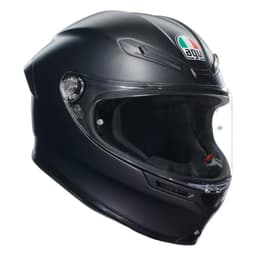
The helmet this review is about
AGV K6 S
DOT + ECE 22.06One of the lightest full-carbon-aramid lids you can buy at ~1,255 g, and it's certified to the newer ECE 22.06 standard on top of DOT. The sport-touring helmet for riders who notice weight on a long day.
See where it ranks against the SNELL helmetsFour shells and five EPS densities: the spec most makers skip
“4 shell sizes” is the line on this page that most deserves your attention, and it is the one almost nobody quotes. Here is why it matters.
A helmet is a hard shell with a crushable EPS liner inside it, and the letter on the box is a liner size, not a shell size. A maker building one shell for every head fits the small heads by putting thicker foam and thicker cheek pads inside the same outer shell — which gives a small rider a helmet that is physically bigger than it needs to be, heavier than it needs to be, and sitting further from their head than the design intended. Our shell-sizes guide goes into the mechanics.
Four shells across six letters means at most two letters share a shell, and AGV reinforces it by developing the EPS itself in four sizes with five densities. That is a genuinely premium construction decision, and it is rarer in disclosure than in practice: Shoei publishes no shell count at all for the RF-1400 on its own product page, as we recorded when we reviewed that helmet. So when AGV publishes a shell count, take it as a data point about AGV’s transparency as much as about the helmet.
The honest limit of the spec is that AGV does not say which letters map to which shell. If you are an XS or an XXL — the ends of the range, where shell-sharing bites hardest — that is the question you want answered and this page cannot answer it. Ask the dealer to tell you which shell your size is on.
The weight question, in full
We have put this in its own section because it is the one place where reading the manufacturer rather than the retailer changed what we know.
- AGV publishes 1,290 g in the first shell size. Read on two colorway pages on the same day, identical on both.
- The US retail listing says about 1,255 g.That is where our registry entry’s figure came from, and where the 1,255 you see on this site and most others came from.
- “First shell size” is doing work in that sentence. It means the smallest of the four shells — so the published figure is the lightest configuration of the helmet, not the one a Large head wears. AGV publishes no weight for any other shell, which means nobody can tell you what a size L K6 S weighs, including AGV.
So what do you do with that? Three things. First, treat any K6 S weight you read — ours included — as the lightest shell, and add an unknown amount if you wear a Large or above. Second, note that 35 g is genuinely small: our own helmet weight guide argues that 50 g is below the threshold of perception on a helmet, and we have therefore deliberately notgone round the site restating 1,255 as 1,290 — churning twenty pages for a figure nobody can feel is how a site becomes less accurate, not more. Third, whichever number you use, the conclusion does not move: against a published 1,640 g for the Shoei RF-1400, the K6 S is around 350 to 385 g lighter, and that gap is far bigger than the disagreement inside it.
What ECE 22.06 gets you, and what it does not
AGV publishes ECE 22.06 and no SNELL certification. Both halves of that sentence matter.
ECE 22.06 is the newest of the three standards relevant to a US buyer. It added rotational-acceleration criteria and tests at more impact points and more speeds than the version it replaced, and it is a type approval: the model is tested and homologated rather than self-declared. Our ECE 22.06 page has the detail, and our standards explainer covers how it compares to the other two.
What it is not is a SNELL certification, and that is a real limitation for one specific buyer: if your track organizer’s tech inspection names SNELL, this helmet does not satisfy it. We will not tell you whether yours does, because requirements differ by club, circuit and year and the only source that binds is the organization taking your entry. If the answer comes back SNELL, our sport and track rankingwalks through how short that list is — six helmets out of the 37 we track, and two of them were not purchasable in any depth on the day we checked.
One more thing worth saying plainly, because the category invites the opposite assumption: there is no comparative safety rating published for the US market at all. SHARP in the UK and MotoCAP in Australia both publish star ratings, and both rate the helmets sold in their own markets. A carbon-aramid shell at 1,290 g is a lighter helmet than a polycarbonate one; it is not, on any published evidence, a safer one. The crushable EPS liner does the energy absorption in both.
Who this helmet is for — and who it is not
Buy it if you ride fast road or sport-touring miles, your neck notices a heavy helmet by hour four, you want a current-generation European homologation, and your head is an intermediate oval. The combination of four shells, a five-density EPS and genuinely low mass is a coherent engineering argument rather than a feature list, and the Pinlock in the box removes the most common premium-helmet surprise purchase.
Do not buy it if any of four things are true. If your track day wants SNELL, it is the wrong helmet and no amount of carbon fixes that. If quiet is your top priority, five front vents and a wide rear extractor is the wrong architecture and our quietest rankingis built on sealed touring lids instead. If your head measures above 64 cm, AGV publishes no size for you on these models and our big-heads pageis the right starting point. And if you need a drop-down sun visor, AGV does not publish one for this helmet — the sun-visor page ranks the helmets that do.
If you are weighing this helmet against the other obvious premium full-face, we have already done that comparison in detail: Shoei RF-1400 vs AGV K6 S is SNELL M2025D against ECE 22.06 and about 1,640 g against the figure this page has just spent four paragraphs on. And before you commit to a letter on a box, read our per-brand size chart: AGV’s chart is the tidiest of the four we have read, and it is tidy in a different place from HJC’s.
How to read our safety notes. We have not crash-tested any of this gear — nobody honestly can on a review budget. Every helmet and armor pick names the certification the maker publishes (DOT, ECE 22.06, SNELL, or a CE level), which we read from the listing on a dated visit. Certification is the floor, not a guarantee; fit and condition matter as much as the sticker. What the standards actually mean.
Frequently asked questions
How much does the AGV K6 S weigh?
AGV publishes 1,290 g 'in first shell size' on its own US product pages — we read the Black and Nardo Grey colorways on 29 October 2026 and both carry the identical figure. Almost every retail listing, including the one our own registry entry was built from, says about 1,255 g. We cannot reconcile the two and we are not going to pretend we can: the maker's number is the one with a named source, the retail number is the one that got repeated. The gap is 35 g, which is inside the 50 g our own helmet weight guide calls noise, so we have deliberately not restated 1,255 g across the site. Either way this is one of the lightest certified full-face helmets you can buy, and AGV publishes no weight at all for any size other than the first shell.
Is the AGV K6 S ECE 22.06 certified?
Yes, and AGV says so in its own words. The product description states the helmet 'passes all the tests required by the strict ECE22.06 standard' and names ECE22.06 directly. DOT appears on the same page only inside the product title, written as 'DOT (E2206)' — the E2206 code is the ECE 22.06 approval marking. What AGV does not publish anywhere on the page is a SNELL certification of any kind, so if your track organizer asks for SNELL this is not the helmet, and our sport and track ranking explains how short that list actually is.
How many shell sizes does the AGV K6 S have?
Four, which AGV publishes as '4 shell sizes' alongside a '5-density EPS developed in 4 sizes'. That is a more useful spec than it sounds and most makers do not publish it — Shoei, for instance, publishes no shell count for the RF-1400 on its own product page, which we noted when we reviewed it. Four shells across six letter sizes (XS to XXL) means at most two letters share a shell, so a small head is getting a smaller shell rather than just thicker cheek pads. Thicker padding on an oversized shell is how a cheap helmet fits a small head, and it is worse for both comfort and the way the helmet sits in a crash.
Does the K6 S come with a Pinlock insert?
Yes. AGV lists 'Pinlock 120XLT MaxVision Included' as part of the helmet, and that is worth real money on a premium lid — a Pinlock insert is the single most effective anti-fog fix there is, and the MaxVision size is the wider one. The page also lists a 'Wind protector' under accessories included. AGV does not publish a full box-contents list, so we cannot tell you whether a spare or tinted shield is in there; assume it is not and budget for one if you want a tint.
What does AGV not publish for the K6 S?
Five things we went looking for and could not find on AGV's own pages. No weight for any size except the first shell, so the figure does not tell you what your helmet weighs. No model name for the standard visor — AGV publishes visor features (anti-scratch, Optic class 1, a patented lock and a patented Extra Quick Release System) but not what the part is called, which matters when you go to buy a replacement. No warranty term; there is a warranty link in the page footer and no coverage period stated on the product page. No liner fabric composition, only the pad names (a Shalimar crown pad, Ritmo cheek pads) and that the interiors are 'Removable and washable'. And no SNELL certification. Any review quoting a warranty length or a visor part number for this helmet got it from somewhere other than AGV.
What size AGV K6 S should I buy?
AGV publishes one size chart covering several models at once — the table is headed for the Pista GP RR, K7, K6 S, K5, K3, K1 S and AX9 — in even two-centimeter ranges: XS 53-54, S 55-56, M 57-58, L 59-60, XL 61-62, XXL 63-64 cm. It is the tidiest of the four manufacturer charts we have read, with no overlapping rows and no gaps. The catch is that it is tidy in a different place from everyone else's: a 60 cm head is a Large in AGV's chart and an XL in HJC's, and Scorpion publishes two charts of its own that disagree with each other from Large upward. Our per-brand size chart lays all four side by side. Note also that AGV publishes nothing above 64 cm for these models, so a genuinely large head has to shop elsewhere.
Is the AGV K6 S good for touring?
It is a credible sport-touring helmet and a poor pure-touring one, and the reason is in the specification. Five front vents and a wide rear extractor is a lot of open path through a shell, and open paths are how a helmet gets loud; AGV publishes no noise figure and there is no standardized helmet noise test, so nobody can give you a number. What it does have going for it on a long day is the weight, because neck fatigue compounds over hours in a way that nothing else on a spec sheet does. If quiet matters more to you than grams, our touring and quietest rankings are built around sealing instead.
Is the K6 S safer than a cheaper helmet?
It is certified to a newer standard than most, and that is not the same claim. ECE 22.06 added rotational-acceleration criteria and tests at more impact points and speeds than the version before it, so a 22.06 helmet has been assessed against more scenarios than a DOT-only helmet. But there is no comparative safety rating published for the US market at all — SHARP in the UK and MotoCAP in Australia publish star ratings for helmets sold in their own markets — so nobody, including us, can rank this helmet against a cheaper one on measured outcomes. We have not worn or crash-tested anything. What we can say is that the carbon-aramid shell buys weight, not a higher safety ceiling: the energy absorption is done by the EPS liner underneath, in this helmet and in a $140 one.
Sources
- AGV — K6 S (maker's own product page, US) — Every figure on the AGV K6 S review, read from AGV's own US product page for the Black colorway and cross-checked the same day against AGV's Nardo Grey page, which publishes identical technical figures. Published: shell "Carbon-Aramid fiber"; "4 shell sizes"; "5-density EPS developed in 4 sizes"; weight "1.290 g in first shell size"; ventilation "5 front vents" plus "1 wide rear extractor", described as "Adjustable air vents"; "Pinlock® 120XLT™ MaxVision™ Included"; retention system "Double D"; visor features "Anti-scratch", "Optic class 1", "Patented visor lock system" and "Patented Extra Quick Release System"; a field of view of 85° vertical and 190° horizontal; "Removable and washable" interiors with a Shalimar crown pad and Ritmo cheek pads; accessories included "Wind protector"; sizes XS through XXL; and a listed price of $639 which the page does not label as MSRP. Certification: the product description names "ECE22.06" and states the helmet "passes all the tests required by the strict ECE22.06 standard", while DOT appears only in the product title, as "DOT (E2206)". THE WEIGHT IS THE REASON THIS SOURCE EXISTS: AGV publishes 1,290 g in the first shell size where the US retail listing our registry was built from quotes about 1,255 g — a 35 g gap, which is inside the 50 g this site's own weight guide calls noise, so the registry figure was deliberately NOT restated across the site. What AGV does NOT publish on this page, and the review says so: no weight for any size other than the first shell, no visor model name, no warranty term, no liner fabric composition, no full box contents, and no SNELL certification of any kind. The page also carries a California Prop 65 chemical-exposure warning (accessed October 29, 2026)
- AGV — Size guide (published on the K6 S product page) — AGV publishes ONE chart covering several models at once — the table is headed for the PISTA GP RR, K7, K6 S, K5, K3, K1 S and AX9 E2206 — in even two-centimeter ranges with no overlaps and no gaps: XS 53-54, S 55-56, M 57-58, L 59-60, XL 61-62, XXL 63-64. The chart stops at XXL; AGV publishes no adult size above 64 cm for these models, where HJC's chart runs to 69 cm. The same page republishes the K6 S technical figures read for the review — "4 shell sizes", "5-density EPS developed in 4 sizes", "1.290 g in first shell size", "5 front vents", "1 wide rear extractor", "Pinlock® 120XLT™ MaxVision™ Included" and "Double D" retention — identically to the Black colorway page, which is why the review treats them as the model's figures rather than one finish's (accessed October 29, 2026)
- UNECE — Vehicle Regulations (UN Regulation No. 22 / ECE 22.06) — The UN regulation behind ECE 22.06, which added rotational/oblique-impact testing over 22.05 (accessed July 21, 2026)
- 49 CFR 571.218 — FMVSS No. 218, Motorcycle helmets — The US federal helmet standard: peak-acceleration, penetration and retention requirements; applies to all on-road motorcycle helmets (accessed July 21, 2026)
- NHTSA — How to Choose the Right Motorcycle Helmet — NHTSA consumer guidance on DOT certification and spotting novelty helmets (accessed July 21, 2026)
- Snell Memorial Foundation — Standards — Snell's motorcycle helmet standards: M2025D/M2025R are the current generation and M2020D/M2020R the previous one (D = DOT markets, R = ECE markets) (accessed July 21, 2026)
- SHARP — UK Government Helmet Safety Ratings — UK Department for Transport independent helmet safety star ratings (accessed July 21, 2026)
- MotoCAP — Independent Motorcycle Clothing & Helmet Assessment — Independent Australian lab rating protective clothing and helmets for protection and comfort (accessed July 21, 2026)
Keep reading
Shoei RF-1400 vs AGV K6 S
SNELL M2025D against ECE 22.06, and the weight gap — the head-to-head most buyers of this helmet actually run.
Read the comparisonBest sport & track helmets
Where the K6 S ranks against the six helmets in our registry that publish a SNELL certification.
See the sport rankingHelmet size chart by brand
AGV's chart read next to Shoei, HJC and ScorpionEXO — and the 60 cm head that four makers cannot agree on.
Compare the chartsECE 22.06 helmets
What the newer European standard added, and every helmet in the registry that publishes it.
See the ECE 22.06 picksHelmet shell sizes explained
Why four shells across six letters matters, and how thicker padding on one shell fakes a fit.
Read the shell guideLightest motorcycle helmets
Every helmet we track that publishes a weight, sorted by grams — and the 19 that publish nothing.
See the lightest picks