Motorcycle Helmet Size Chart by Brand
We read SHOEI, AGV, HJC and ScorpionEXO's own charts on the same day. A 60 cm head is a Large in two of them and an XL in the other two, ScorpionEXO publishes two charts that disagree with each other, and SHOEI's chart returns no answer at all for half the measurements you could take.
How this is funded: we earn a commission if you buy through our links, at no extra cost to you. It never changes which gear we recommend, and we’ll tell you plainly when to skip a pick. Full disclosure.
Measure your head, then read the chart belonging to the brand you are buying — not a generic one, and not the one you used last time. We read four manufacturers’ own size charts on the same day, 29 October 2026, and laid them against each other. They do not agree, and the disagreement is large enough to put you in the wrong size.
The headline: a 60 cm head is a Large in AGV’s chart and an XL in HJC’s. ScorpionEXO publishes twoadult charts for its own range and they disagree with each other from Large upward. HJC’s chart has two rows that overlap, so for a 55 cm or 58 cm head it returns two sizes. And SHOEI publishes single centimeter points rather than ranges, which means every even measurement between them — 54, 56, 58, 60, 62 — lands exactly halfway between two SHOEI sizes and the chart answers nothing.
Every figure below was read from the manufacturer’s own page and is cited at the foot of this page. One brand is missing and we would rather say why than fill the gap: Bell’s size chart renders in the browser rather than in the page source, and returned no table text on this date, so there is no Bell row here. We are not going to transcribe a Bell chart from a retailer and call it Bell’s.
The four charts, as each maker publishes them
AGV
One chart covering seven models at once — the table is headed for the Pista GP RR, K7, K6 S, K5, K3, K1 S and AX9 E2206. Even two-centimeter ranges, no overlaps, no gaps. It is the tidiest of the four, and it stops at XXL.
| Size | Head circumference |
|---|---|
| XS | 53–54 cm |
| S | 55–56 cm |
| M | 57–58 cm |
| L | 59–60 cm |
| XL | 61–62 cm |
| XXL | 63–64 cm |
SHOEI
The shortest chart of the four, and the only one published as single points rather than ranges. SHOEI heads it “Guidelines for Setting”, which is a fair description of what it is.
| Size | Head circumference |
|---|---|
| XS | 53 cm |
| S | 55 cm |
| M | 57 cm |
| L | 59 cm |
| XL | 61 cm |
| XXL | 63 cm |
SHOEI then says the most useful thing any of these four manufacturers says about its own chart, and we are quoting it in full because it is the whole point of this page: “different from hat, a size of helmet cannot be identified by circumference alone.” Its measuring instruction is “Please measure your circumference in your longest portions and select your size roughly”, and its advice is “Please wear your required model in your dealer before purchase.” Note that SHOEI’s individual model pages publish per-model ranges which are not identical to these points — the RF-1400, for example, is sold from X-Small through 3X-Large, well past where this general chart stops.
HJC
The widest published span of the four: eleven adult sizes from 3XS to 5XL, in centimeters with hat-size and inch columns alongside. HJC notes that the C10 is the model offered in 3XS. It is also the chart with the internal contradictions.
| Size | Centimeters | Hat size | Inches |
|---|---|---|---|
| 3XS | 50–51 | 6 1/4 – 6 3/8 | 19 3/4 – 20 1/8 |
| 2XS | 52–53 | 6 1/2 – 6 5/8 | 20 1/2 – 20 7/8 |
| XS | 54–55 | 6 3/4 – 6 7/8 | 21 1/4 – 21 5/8 |
| S | 55–56 | 6 7/8 – 7 | 21 5/8 – 22 |
| M | 57–58 | 7 1/8 – 7 1/4 | 22 3/8 – 22 7/8 |
| L | 58–59 | 7 1/4 – 7 3/8 | 22 7/8 – 23 1/4 |
| XL | 60–61 | 7 1/2 – 7 5/8 | 23 5/8 – 24 |
| 2XL | 62–63 | 7 3/4 – 7 7/8 | 24 3/8 – 24 3/4 |
| 3XL | 64–65 | 8 – 8 1/8 | 25 1/8 – 25 1/2 |
| 4XL | 66–67 | 8 1/4 – 8 3/8 | 26 – 26 3/8 |
| 5XL | 68–69 | 8 1/2 – 8 5/8 | 26 3/4 – 27 1/8 |
Two rows overlap in HJC’s own chart.55 cm appears in both XS (54–55) and S (55–56). 58 cm appears in both M (57–58) and L (58–59). If your measurement is one of those two numbers, HJC’s chart gives you two sizes and no tiebreak — which is presumably why the page carries the disclaimer “The size chart is only for reference. Always try the helmet on and follow this manual’s instructions for a proper fit.” HJC also publishes youth sizes for the Y10 and Y50 only: YS 48–49, YM 50–51, YL 52–53 and YXL 54–55 cm.
ScorpionEXO
The only brand of the four that publishes two adult charts, each with its own named list of models. If you are buying a Scorpion, the first question is which chart your helmet is on.
Type A— listed for the EXO-RACE AIR, EXO-ECLIPSE, EXO-R1 AIR, EXO-R1 AIR / CARBON, EXO-ST1400 EVO CARBON, EXO-R420, EXO-R330, EXO-R320, COVERT X, COVERT, EXO-HX1, EXO-AT950 and VX-16.
| Size | Inches | Centimeters | Hat size |
|---|---|---|---|
| XS | 20 7/8 – 21 1/4 | 53–54 | 6 5/8 – 6 3/4 |
| S | 21 5/8 – 22 | 55–56 | 6 7/8 – 7 |
| M | 22 1/2 – 22 7/8 | 57–58 | 7 1/8 – 7 1/4 |
| L | 23 1/4 – 23 5/8 | 59–60 | 7 3/8 – 7 1/2 |
| XL | 24 – 24 3/8 | 61–62 | 7 5/8 – 7 3/4 |
| 2XL | 24 3/4 – 25 1/4 | 63–64 | 7 7/8 – 8 |
| 3XL | 25 5/8 – 26 | 65–66 | 8 1/8 – 8 1/4 |
| 4XL | 26 3/8 – 26 3/4 | 67–68 | 8 3/8 – 8 1/2 |
Type B— listed for the EXO-GT930, EXO-T520, COVERT FX, COVERT II, EXO-R430, EXO-XT9000 CARBON, EXO-AT960, EXO-TECH EVO Carbon, EXO-TECH EVO PRO and EXO-TECH EVO.
| Size | Inches | Centimeters | Hat size |
|---|---|---|---|
| XS | 21 1/4 | 54 | 6 3/4 |
| S | 21 5/8 – 22 | 55–56 | 6 7/8 – 7 |
| M | 22 1/2 – 22 7/8 | 57–58 | 7 1/8 – 7 1/4 |
| L | 22 7/8 – 23 1/4 | 58–59 | 7 1/4 – 7 3/8 |
| XL | 23 5/8 – 24 | 60–61 | 7 1/2 – 7 5/8 |
| 2XL | 24 3/8 – 24 3/4 | 62–63 | 7 3/4 – 7 7/8 |
| 3XL | 25 1/4 – 25 5/8 | 64–65 | 8 – 8 1/8 |
| 4XL | 26 – 26 3/8 | 66–67 | 8 1/4 – 8 3/8 |
The two charts are identical through Medium and diverge from Large upward: Type A’s Large is 59–60 cm, Type B’s is 58–59. Type B then runs one centimeter low all the way to the top, so a 60 cm head is a Large on a Scorpion EXO-R1 Air and an XL on a Scorpion EXO-T520 — same brand, same measurement, different letter. Scorpion’s own caveats are worth reading too: “The sizing chart is simply a starting guide, as head shapes vary” and “For the best fit visit an authorized ScorpionEXO dealer.”
Your measurement, read across all four charts
This is the table the rest of the internet does not print. Each row is one head measurement; each column is what that brand’s own chart calls it. “No answer” means the chart genuinely does not resolve the measurement — it is not us hedging.
| Your head | AGV | SHOEI | HJC | Scorpion A | Scorpion B |
|---|---|---|---|---|---|
| 54 cm | XS | No answer (between XS 53 and S 55) | XS | XS | XS |
| 55 cm | S | S | XS or S | S | S |
| 56 cm | S | No answer (between S 55 and M 57) | S | S | S |
| 58 cm | M | No answer (between M 57 and L 59) | M or L | M | M or L |
| 59 cm | L | L | L | L | L |
| 60 cm | L | No answer (between L 59 and XL 61) | XL | L | XL |
| 62 cm | XL | No answer (between XL 61 and XXL 63) | 2XL | XL | 2XL |
| 66 cm | Not published | Not published | 4XL | 3XL | 4XL |
Three things fall out of that table. At 59 cm all four charts agree, and at 60 cm two say Large and two say XL. One centimeter is the difference between a settled question and a coin flip. Second, SHOEI’s point chart resolves exactly half the measurements you could plausibly take and shrugs at the other half — which, read charitably, is SHOEI telling you to go to a dealer, and that is in fact what it says. Third, past about 64 cm the field thins to two brands, and the one with the widest published range is the cheapest of the four.
Three helmets whose makers publish the charts above
The point of reading charts is buying a helmet. These three come from the brands whose charts are reproduced on this page, they span the price range, and every one of them was stock-checked on the day this page went up. Our affiliate disclosure explains how we are funded.
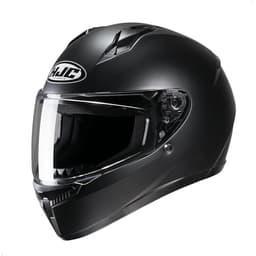
Widest published size range, cheapest way in
HJC C10
DOTHJC's entry full-face, and one of the cheapest DOT-approved lids from a major maker. An advanced polycarbonate composite shell and a proper removable liner — the honest floor for a first helmet.
See the budget helmet rankingPrice as of November 12, 2026. #ad How we’re funded
HJC is the brand whose chart runs from 3XS at 50–51 cm to 5XL at 68–69 cm, and HJC names the C10 as the model it offers in 3XS. If your measurement sits outside what AGV and SHOEI publish — at either end — this is the brand to start with, and this is its cheapest full-face. Read the cons in the card: it is a DOT-only helmet, which is a real limitation and the reason it is not on our sport and track ranking.
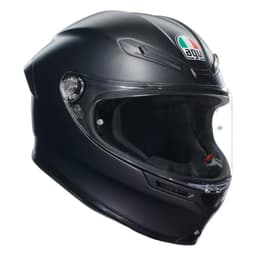
The tidiest chart, and the lightest helmet
AGV K6 S
DOT + ECE 22.06One of the lightest full-carbon-aramid lids you can buy at ~1,255 g, and it's certified to the newer ECE 22.06 standard on top of DOT. The sport-touring helmet for riders who notice weight on a long day.
Read our full AGV K6 S reviewAGV publishes one chart for seven models with no overlaps and no gaps, which makes it the easiest of the four to use — and the K6 S is the helmet that chart was read from. AGV also publishes four shell sizes for it, which is the spec that decides whether a small head gets a smaller shell or just thicker padding. The ceiling is the catch: nothing above 64 cm.
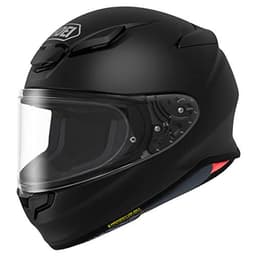
Published XS to 3XL, past where SHOEI's general chart stops
Shoei RF-1400
DOT + SNELL M2025DThe full-face most experienced riders land on: Shoei's hand-laid AIM+ shell, DOT plus a SNELL M2025D rating on Shoei's own spec table, and a quiet, refined fit. You're paying for finish and certification, and it shows.
Read our full Shoei RF-1400 reviewPrice as of November 12, 2026. #ad How we’re funded
SHOEI’s general size FAQ stops at XXL / 63 cm, but its RF-1400 product page publishes a size range of X-Small through 3X-Large — which is the clearest possible demonstration of why you read the chart on the page of the helmet you are buying. SHOEI does warn that not every color comes in every size, and on the page we read 3X-Large was listed in two finishes only.
What a size chart cannot tell you
All four manufacturers say some version of “this is a starting point”, and they are not covering themselves. There are three things a circumference genuinely cannot describe.
Head shape.Two heads measuring 58 cm can be shaped completely differently — long front-to-back and narrow side-to-side, or round. A long oval head in an intermediate-oval shell gets a pressure point on the forehead inside twenty minutes, and the chart was right the whole time. Our head-shape guide covers how to work out which you are and which brands run which way.
Shell size. The letter on the box is a liner size. How many physical shells the maker builds decides whether your size is a purpose-built shell or a bigger one padded down, and it changes both the weight and how the helmet sits. Our shell guide explains why, and most makers do not publish the number at all.
Cheek pads.Most mid and premium helmets ship with cheek pads in interchangeable thicknesses, which means the correct shell with the wrong pads feels wrong and is fixable for the price of a pad set. A helmet that is right everywhere except the jaw is usually a pad problem, not a size problem — ask before you return it.
Which is the short version of the whole page: use the chart for the brand you are buying to work out which helmet to put on, then let your head decide. If you want the full fit routine — how it should feel new, the roll-forward test, how long to leave it on before judging — our sizing guide walks through it, and our where-to-buy guide covers getting fitted in one place and buying in another without being a jerk about it.
How to read our safety notes. We have not crash-tested any of this gear — nobody honestly can on a review budget. Every helmet and armor pick names the certification the maker publishes (DOT, ECE 22.06, SNELL, or a CE level), which we read from the listing on a dated visit. Certification is the floor, not a guarantee; fit and condition matter as much as the sticker. What the standards actually mean.
Frequently asked questions
Is there a universal motorcycle helmet size chart?
No, and the differences are big enough to cost you a size. We read four manufacturers' own charts on 29 October 2026. A 60 cm head is a Large in AGV's chart (L = 59-60 cm) and an XL in HJC's (XL = 60-61 cm). A 62 cm head is an XL in AGV's chart and a 2XL in HJC's. ScorpionEXO publishes two charts for its own range with a named model list for each, and they disagree from Large upward: Type A's Large is 59-60 cm, Type B's is 58-59 cm. Always read the chart for the exact brand and, where the brand publishes more than one, the exact model.
How do I measure my head for a motorcycle helmet?
Wrap a soft cloth tape measure around your head starting at the forehead about an inch above the eyebrow line, and run it across the largest part of the back of your head — that is ScorpionEXO's own published instruction. Keep it level, snug but not tight. SHOEI's instruction is to measure 'in your longest portions', so take the largest reading you can find rather than the first one, and measure twice to confirm. Write the number down in centimeters, because three of the four charts we read are published in centimeters first and converted to inches second.
What size helmet is a 58 cm head?
It depends which brand you are buying, and two of the four charts cannot settle it inside their own brand. AGV says Medium (M = 57-58 cm). HJC's chart puts 58 cm in both Medium (57-58) and Large (58-59) — the rows overlap, so HJC's own chart returns two answers. ScorpionEXO's Type A chart says Medium (57-58) while its Type B chart, covering a different list of its own models, again puts 58 in both Medium and Large. SHOEI publishes single points rather than ranges — M at 57 cm and L at 59 cm — so 58 cm falls exactly between two SHOEI sizes and the chart gives you nothing. This is the measurement where you have to try the helmet on.
What is the biggest motorcycle helmet size available?
Of the four brands whose charts we read, HJC publishes the widest span: 5XL at 68-69 cm, with 3XL at 64-65 and 4XL at 66-67. ScorpionEXO goes to 4XL (67-68 cm on its Type A chart). AGV stops at XXL, 63-64 cm, and publishes nothing above that for the models on its chart. SHOEI's English size FAQ also stops at XXL, at 63 cm. So a head measuring 66 cm has a published size at two of these four brands and nothing at the other two — which is why our big-heads page exists and why shopping by brand matters more at the ends of the range than in the middle.
Should I size up or down if I am between helmet sizes?
Try both, and expect the smaller one to be right more often than you want it to be. A helmet that can be rolled forward until the eye port drops past your brow is too loose — that is ScorpionEXO's own test and it is a good one. A new helmet should feel firm, with the cheek pads pressing noticeably, because the liner will pack down with use and a helmet that is comfortable in the shop is frequently loose in six months. The real answer, though, is that 'between sizes' is often a head-shape problem rather than a circumference problem: a long narrow head in an intermediate-oval shell measures correctly and still hurts. Our head-shape guide covers how to tell.
Why does my helmet size differ from my hat size?
Because a hat sits on your head and a helmet has to hold a specific position on it. SHOEI puts this better than we can, and says it directly on its own size page: 'different from hat, a size of helmet cannot be identified by circumference alone.' A hat only needs the circumference to match. A helmet needs the liner to make contact evenly all the way round, the eye port to sit at the right height, and the cheek pads to hold your jaw — three things circumference alone cannot describe. HJC publishes hat sizes alongside centimeters on its chart, which is useful as a cross-reference and not as a decision.
Can I buy a motorcycle helmet online without trying it on?
You can, and all four of these manufacturers would rather you did not. SHOEI's advice is to 'wear your required model in your dealer before purchase'. ScorpionEXO says 'for the best fit visit an authorized ScorpionEXO dealer'. HJC says 'always try the helmet on'. If you buy online anyway — which is often the only option for a large size or an unusual color — buy from a retailer with a genuine returns policy on a worn-indoors helmet, and check the policy before you add to cart rather than after. Our where-to-buy guide covers the fit-local, buy-anywhere approach in full.
Do helmet size charts vary between models of the same brand?
Yes, and ScorpionEXO is the proof — it publishes two complete adult charts on its own size page, each with its own named list of models, and they disagree from Large upward. AGV takes the opposite approach and publishes one chart headed for seven of its models at once. SHOEI's model pages carry per-model ranges that are not identical to the single-point figures on its general size FAQ. The practical rule: look for the chart on the page of the exact helmet you are buying, and treat a brand-level chart as a rough filter for which shop to walk into.
Sources
- SHOEI — About Size (maker's own product FAQ) — SHOEI's own English-language size guidance, and the shortest of the four charts read for the per-brand sizing guide. Under the heading "Guidelines for Setting" SHOEI publishes a SINGLE centimeter figure per size rather than a range: XS 53cm, S 55cm, M 57cm, L 59cm, XL 61cm, XXL 63cm. Measuring instruction, verbatim: "Please measure your circumference in your longest portions and select your size roughly." The page then states the limit of its own chart, verbatim: "different from hat, a size of helmet cannot be identified by circumference alone", and advises "Please wear your required model in your dealer before purchase." Because the chart is points and not ranges, every even centimeter between them — 54, 56, 58, 60, 62 — falls exactly halfway between two SHOEI sizes and the chart returns no answer for it, which is the clearest illustration on any of these four pages of why a size chart is a starting point rather than a decision (accessed October 29, 2026)
- AGV — Size guide (published on the K6 S product page) — AGV publishes ONE chart covering several models at once — the table is headed for the PISTA GP RR, K7, K6 S, K5, K3, K1 S and AX9 E2206 — in even two-centimeter ranges with no overlaps and no gaps: XS 53-54, S 55-56, M 57-58, L 59-60, XL 61-62, XXL 63-64. The chart stops at XXL; AGV publishes no adult size above 64 cm for these models, where HJC's chart runs to 69 cm. The same page republishes the K6 S technical figures read for the review — "4 shell sizes", "5-density EPS developed in 4 sizes", "1.290 g in first shell size", "5 front vents", "1 wide rear extractor", "Pinlock® 120XLT™ MaxVision™ Included" and "Double D" retention — identically to the Black colorway page, which is why the review treats them as the model's figures rather than one finish's (accessed October 29, 2026)
- HJC — Size Chart (maker's own site) — HJC's own published adult chart, in centimeters with hat-size and inch columns, and the widest published size span of the four brands read: 3XS 50-51, 2XS 52-53, XS 54-55, S 55-56, M 57-58, L 58-59, XL 60-61, 2XL 62-63, 3XL 64-65, 4XL 66-67, 5XL 68-69. HJC notes that the C10 is the model offered in 3XS. Youth sizes, offered on the Y10 and Y50 only: YS 48-49, YM 50-51, YL 52-53, YXL 54-55. TWO ROWS OVERLAP IN HJC'S OWN CHART: 55 cm appears in both XS (54-55) and S (55-56), and 58 cm appears in both M (57-58) and L (58-59) — so for those two measurements the chart returns two sizes. HJC's own disclaimer, verbatim: "The size chart is only for reference. Always try the helmet on and follow this manual's instructions for a proper fit." No measuring instruction appears on this page (accessed October 29, 2026)
- ScorpionEXO — Helmet Size Guide (maker's own site) — ScorpionEXO publishes TWO different adult size charts for its own range, with a named model list for each — the only brand of the four read on this date to do so. TYPE A (listed for EXO-RACE AIR, EXO-ECLIPSE, EXO-R1 AIR, EXO-R1 AIR / CARBON, EXO-ST1400 EVO CARBON, EXO-R420, EXO-R330, EXO-R320, COVERT X, COVERT, EXO-HX1, EXO-AT950, VX-16): XS 53-54, S 55-56, M 57-58, L 59-60, XL 61-62, 2XL 63-64, 3XL 65-66, 4XL 67-68. TYPE B (listed for EXO-GT930, EXO-T520, COVERT FX, COVERT II, EXO-R430, EXO-XT9000 CARBON, EXO-AT960, EXO-TECH EVO Carbon, EXO-TECH EVO PRO, EXO-TECH EVO): XS 54, S 55-56, M 57-58, L 58-59, XL 60-61, 2XL 62-63, 3XL 64-65, 4XL 66-67. The two charts disagree from Large upward — Type A's Large is 59-60 and Type B's is 58-59 — so the same measured head takes a different letter depending on which Scorpion model it is buying. Measuring instruction, verbatim: "Start by measuring the circumference around your head using a soft tape measure", "Starting at your forehead just above the eyebrow line (approximately one inch above)", "and across the largest portion of the back of your head", "Repeat the process to confirm the measurement", "Select the helmet size from the chart below that is closest to your measurement." Scorpion's own caveats, verbatim: "The sizing chart is simply a starting guide, as head shapes vary" and "For the best fit visit an authorized ScorpionEXO dealer." (accessed October 29, 2026)
- NHTSA — How to Choose the Right Motorcycle Helmet — NHTSA consumer guidance on DOT certification and spotting novelty helmets (accessed July 21, 2026)
- 49 CFR 571.218 — FMVSS No. 218, Motorcycle helmets — The US federal helmet standard: peak-acceleration, penetration and retention requirements; applies to all on-road motorcycle helmets (accessed July 21, 2026)
Keep reading
Motorcycle helmet sizing
How to measure, how a correct fit should feel, and the checks to run before you keep a helmet.
Read the sizing guideHelmet head shapes explained
Long oval, intermediate oval, round oval — the thing a size chart cannot tell you and the usual reason a correctly sized helmet hurts.
Find your head shapeHelmet shell sizes explained
Why four shells across six letters matters, and how a single-shell helmet fakes a small fit with thicker foam.
Read the shell guideBest helmets for big heads
Where to look when your measurement is past the end of a brand's published chart — and which brands publish past 64 cm.
See the big-head picksWhere to buy a motorcycle helmet
Get fitted where you can put helmets on, then buy where your size is in stock and returnable.
Read the buying guideHow to choose a motorcycle helmet
The whole decision in order — type, certification, fit, then features — for a first or a replacement lid.
Read the full guide