Cardo Packtalk Pro vs Sena 60S EVO
The two brands' current top units, on the figures each maker publishes — and they split cleanly: Cardo reaches more riders and detects a crash, Sena talks for twice as long and reaches riders who are nowhere near you.
These are the two units at the top of the two ranges that matter, and both brands have moved on since the comparison most buyers find first. Packtalk Edge versus Sena 50S is still a useful page, but it is a tier below this one on both sides. The Packtalk Pro sits above the Edge in Cardo’s own range, and the 60S EVO sits above the 60S in Sena’s — which leaves the 50-series two tiers down.
The honest summary is that these two units are not better and worse than each other, they are different shapes. Cardo publishes a larger group (31 riders against 24) and the only crash detection here. Sena publishes more than double the talk time (27 hours of Bluetooth against 13) and a cellular intercom that works when there is no radio path at all. Every figure below is the one its own maker publishes, read from their product pages on a dated visit and recorded in our registry. We own neither unit and we have not measured either, so nothing here is a listening test.
One thing to settle before the spec table, because it decides the purchase for a lot of riders: these two will not mesh with each other. Cardo’s DMC and Sena’s Mesh Intercom only network with units of the same brand. They can talk over a universal Bluetooth intercom connection, but you lose the self-healing behavior that is the entire reason to buy either. If your group already runs one brand, that is your answer and you can stop reading — Cardo versus Sena covers the brand-level version of this decision.
How this is funded: we earn a commission if you buy through our links, at no extra cost to you. It never changes which gear we recommend, and we’ll tell you plainly when to skip a pick. Full disclosure.
Cardo's current top unit
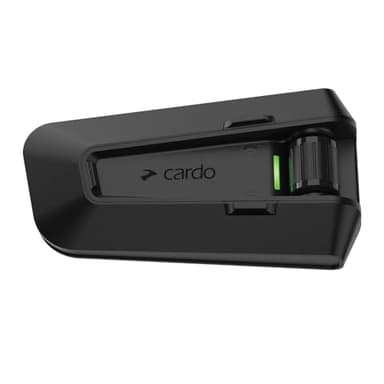
Cardo Packtalk Pro
The top of Cardo's range, and the only unit here with crash detection. Cardo publishes 45 mm JBL speakers against the Edge's 40 mm, plus auto on/off — on the same 2nd Generation DMC network, the same 1.6 km unit-to-unit range, the same 13 hours and the same IP67 rating as the Edge. Buy it for the sensor and the bigger drivers, not for a better network.
Sena's current top unit
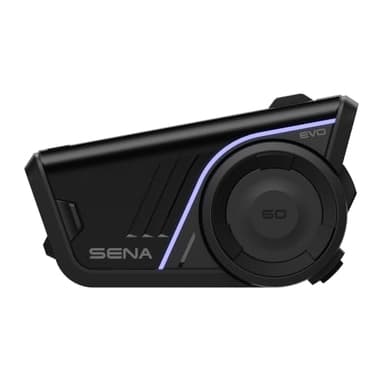
Sena 60S EVO
Sena's current top tier, and the first of its units tuned by Bose rather than Harman Kardon. Mesh Intercom 3.0 plus the cellular Wave intercom, IPX7 waterproofing and the longest talk time Sena publishes anywhere in the range. It is also the most expensive way to join the same mesh network a 50S joins.
Price as of October 7, 2026. #ad How we’re funded
| Spec | Cardo Packtalk Pro | Sena 60S EVO |
|---|---|---|
| Network | 2nd Generation DMC (Dynamic Mesh) | Mesh Intercom 3.0 and 2.0, plus Wave |
| Published group size | Up to 31 riders | Group Mesh up to 24 participants |
| Published range | Up to 1.6 km / 1 mi unit-to-unit; 8 km / 5 mi across the group | 2 km / 1.2 mi in open terrain |
| Bluetooth intercom | Yes — a universal Bluetooth link; Cardo publishes no participant count for it | Yes, up to 4 participants |
| Cellular intercom | Not published | Wave — works with no radio path between riders |
| Published talk time | 13 hours | 27 h Bluetooth / 19 h mesh, 1.5 h charge |
| Speakers | 45 mm, Sound by JBL | 40 mm, Sound by Bose |
| Crash detection | Yes — on-road/tarmac, selected regions, needs a paired phone and cloud data | Not published |
| Water rating published | IP67 | IPX7 |
| Mount and controls | Magnetic Air Mount, auto on/off | Magnetic mount, glove-friendly jog dial, dual clamp kits included |
| Warranty | 3 years | Check current listing |
| Price tier | Premium | Premium |
Group size versus reach: the two makers optimized differently
Read the range rows carefully, because they are not measuring the same thing and the headline numbers invert depending on which you care about. Cardo publishes 1.6 km unit-to-unit and 8 km across a full group; Sena publishes 2 km in open terrain. Per hop, Sena’s published figure is the longer one. Across a strung-out group, Cardo’s relayed 8 km figure is the larger one, because a mesh group chains its hops. Both numbers are open-terrain best cases that a canyon, a line of trucks or a hill will cut, and neither maker publishes a figure for anything else.
Group size is the cleaner difference: 31 against 24. In practice almost nobody rides in a 24-rider group, let alone a 31-rider one, so this row matters less than its margin suggests — and if you do run rides that large, the limiting factor is usually that someone is out of range of everyone, not that the network is full. One honest wrinkle worth recording: the 31-rider figure comes from Cardo’s own Packtalk Pro product page, while Cardo’s own Edge-versus-Pro comparison table still shows a “max riders” row of 15 — the pre-Mesh-Boost number. Cardo’s pages disagree with each other, so we quote the higher figure as published and tell you the lower one exists. Our group-riding picks go through the practical side of that, and mesh versus Bluetooth explains why a mesh network degrades gracefully where a Bluetooth chain simply breaks.
Battery is the biggest published gap, and it is not close
Sena publishes 27 hours of Bluetooth talk time and 19 hours on mesh, from a 1.5-hour charge. Cardo publishes 13 hours. That is more than double on the Bluetooth figure and roughly half again on mesh, and it is the single most consequential row in the table for anyone touring. Thirteen hours covers any realistic day in the saddle; twenty-seven covers two of them, which is the difference between carrying a charger to a motel every night and not thinking about it.
Cardo’s counter is charge-while-riding, which the Packtalk tier supports — Cardo’s own Neo-versus-Edge article makes the point by noting that the Neo is the one that does not. A USB lead from the bike turns the battery question into a non-question, and that is a real answer rather than a dodge. It only helps if your bike has a powered socket and you are willing to run the cable to your helmet; without it, Sena wins this row outright. For the honest version of how much power a bike has to spare, our heated-jacket ranking works through the same alternator arithmetic from the other end.
Audio: a bigger driver against a different tuning partner
Cardo publishes 45 mm Sound by JBL speakers, the largest in its range and a step up from the 40 mm drivers in the Packtalk Edge. Sena publishes 40 mm speakers with Sound by Bose, and the 60S EVO is the first Sena unit tuned by Bose rather than Harman Kardon.
We are not going to rank these, and you should be suspicious of anyone who does from a spec sheet. A larger driver moves more air, which generally helps at the bottom end and at speed, and that is about as far as the published numbers take you. Everything else — whether Bose’s tuning suits your ears, how either behaves at 80 mph inside your particular helmet, how the microphone handles wind — needs a test we have not run. What we can say is that the helmet matters more than the driver diameter: a sealed touring lid from our quietest ranking makes either unit sound better than a vented sport helmet does, and earplugs change the answer again.
Crash detection is the Pro’s one unique feature. Read the caveats.
The Packtalk Pro is the only unit here that publishes crash detection, and it is the reason a lot of solo riders pick it. It is also the feature with the most conditions attached, and Cardo publishes all of them: it needs the unit, a paired phone and cloud data coverage to work at all, it is built for on-road and tarmac scenarios, and Cardo offers it in selected regions only.
That is not a reason to dismiss it — a system that calls for help when you cannot is a genuinely different class of feature from a bigger speaker. It is a reason to check the region list and to understand that a crash in a valley with no signal is exactly the crash it cannot report. If automated help in a crash is the thing you are buying, weigh it against an airbag vest, which protects you rather than reporting on you and needs no network: our airbag-vest ranking covers what those actually publish.
Waterproofing: the same immersion test, declared differently
Cardo publishes IP67 and Sena publishes IPX7. The second digit is the same in both, so both makers are declaring the same water-immersion level. The difference is the first digit: Cardo declares a dust rating and Sena’s Xmeans no dust rating has been declared. On a motorcycle, dust is not a theoretical concern — it is a dirt-road concern — so if your riding includes gravel this row is worth something. If it is all pavement, both ratings describe a unit that will survive the rain you ride in.
Mount and controls
Both units mount magnetically, which used to be Cardo’s clearest advantage over Sena and is no longer. Cardo publishes the patented Air Mount plus auto on/off, so the unit wakes when you clip it on. Sena publishes a magnetic mount, a glove-friendly jog dial and dual clamp kits in the box, which is the detail worth noticing: a second clamp means a second helmet gets a cradle without a second purchase. If you own a touring helmet and an ADV helmet, that saves you real money.
On controls it is a jog dial against buttons and voice. The jog dial is the easier interface in winter gloves because it is one large thing you can find without looking; buttons are faster once you have learned them. Neither is a reason to choose a unit, and our intercom guide runs through the whole decision if you are starting from scratch.
Which one to buy
- Your group already runs Cardo, or already runs Sena. Buy that brand. This is not a close call and nothing else in this comparison outweighs it, because the mesh is the product and it does not cross brands.
- You ride long days and charging is a nuisance — buy the 60S EVO. Twenty-seven published hours of Bluetooth talk time against thirteen is the largest honest gap in the table, and it is the one you notice on day three of a tour.
- You ride alone and want something that can call for help — buy the Packtalk Pro. Check Cardo’s region list first, and accept that it needs your phone and a data signal.
- You ride with people who are not on the ride — buy the 60S EVO. Wave is a cellular intercom, so it works between riders with no radio path at all. Nothing in Cardo’s published spec does that.
- You run the biggest group rides — buy the Packtalk Pro. Thirty-one published rider slots against twenty-four, and the longer published group-relay figure.
- You just want music, calls and navigation on your own — buy neither. Both of these are group-riding tools at a group-riding price, and a unit from our budget picks covers solo use for a fraction of it. That is the buyer-first answer even though it is the one that pays us least.
What we did not compare
Sound quality, microphone performance and real-world range. We own neither unit, we have no anechoic chamber and we have not ridden with either, so every claim on this page is a published figure or a structural consequence of one. Where a maker publishes nothing — Sena’s warranty term, Cardo’s cellular capability — the table says so instead of filling the gap.
The dual packs. Both units sell as singles and as pairs, and the per-unit maths usually favors the pair if two of you are buying. We link the single-unit listings because that is what the spec sheets describe; check the pair price before you buy two singles. For the two-up case specifically, our rider-and-passenger picks make the case that you may not need two full flagships at all.
Frequently asked questions
Is the Cardo Packtalk Pro better than the Sena 60S EVO?
Neither is better across the board — they publish different strengths. Cardo publishes a larger mesh group (31 riders against 24), a 45 mm JBL speaker against Sena's 40 mm, crash detection and a declared dust rating. Sena publishes more than double the Bluetooth talk time (27 hours against 13), a longer unit-to-unit range in open terrain (2 km against 1.6 km), the Wave cellular intercom and two clamp kits in the box. If your riding group already runs one of the two brands, that decides it, because the two mesh networks do not talk to each other.
Can a Cardo Packtalk Pro connect to a Sena 60S EVO?
Not on mesh. Cardo's Dynamic Mesh and Sena's Mesh Intercom only network with units of the same brand, so a mixed group cannot run one mesh. The two units can connect over a standard universal Bluetooth intercom link, which gets you talking but gives up the self-healing behavior that is the reason to buy a mesh unit in the first place. In a group that matters: everyone should be on the same system.
Which has better battery life?
Sena, by a wide published margin. Sena states 27 hours of Bluetooth talk time and 19 hours on mesh from a 1.5-hour charge for the 60S EVO; Cardo states 13 hours for the Packtalk Pro. Cardo's answer is charge-while-riding, which genuinely removes the problem if your bike has a powered socket and you are happy to run a cable to your helmet. Without that, the 60S EVO covers roughly two full touring days to the Pro's one.
How well does Cardo's crash detection actually work?
We cannot tell you, because we have not crashed either unit and no independent lab publishes a result for it. What we can tell you is what Cardo publishes about the conditions: it needs the unit, a paired phone and cloud data coverage to function at all, it is designed for on-road and tarmac scenarios, and it is offered in selected regions only. Read that as a system that works on a road with signal, which is where most riding happens — and not as a substitute for telling someone your route.
What is Sena Wave, and does Cardo have anything like it?
Wave is a cellular intercom: instead of a radio link between helmets, the conversation goes over mobile data, so two riders can talk with no radio path between them at all — different roads, different states. Sena publishes it alongside Mesh 3.0 and 2.0 on the 60S EVO. Cardo's published specification for the Packtalk Pro does not include a cellular equivalent. If you regularly ride separately from the person you want to talk to, this is the one row in the table with no Cardo answer.
Is IP67 better than IPX7?
For water, they declare the same thing — the 7 in both means the same immersion test. The difference is the first digit. Cardo's IP67 declares a dust rating as well; the X in Sena's IPX7 means no dust rating has been declared, which is not the same as failing one. If you ride gravel and dirt roads, the declared dust rating is worth something. If you ride pavement, both describe a unit built for rain.
Do I need a flagship intercom at all?
Only if you ride in groups. Mesh networking is the thing you are paying for at this price, and it does nothing for a rider alone — music, phone calls and turn-by-turn navigation all work on a unit costing a fraction of either of these. Buy a flagship if you ride with others often enough that a dropped rider is a regular annoyance; buy from our budget picks if you mostly ride solo or with one fixed passenger.
Will these work with my helmet?
Both mount universally with a clamp or an adhesive plate, and both expect a helmet with speaker pockets — most mid-range and premium helmets have them, cut into the EPS beside your ears. A helmet with no speaker pockets will work but will press the drivers against your ears, which is uncomfortable within an hour. If you are buying the helmet at the same time, our Bluetooth helmet ranking covers both the lids with the electronics built in and the ones designed to take a bolt-on unit.
Sources
- Cardo — PACKTALK PRO — Cardo's published PACKTALK PRO specs: 2nd Generation DMC, "Connects Up to 31 Riders", range of up to 1.6 km / 1 mi, 45 mm JBL speakers, IP67 waterproof, patented magnetic Air Mount, 3-year warranty, and crash detection that Cardo states requires the unit, a phone and cloud data coverage and covers on-road/tarmac scenarios in selected regions only (accessed August 31, 2026)
- Cardo — PACKTALK EDGE vs PACKTALK PRO: Which to Buy? — Cardo's own Edge-versus-Pro comparison table: identical 2nd Generation DMC, unit-to-unit range 1.6 km (1 mile), group range 8 km (5 miles), Air Mount, 13-hour battery, IP67, Bluetooth 5.2 and 3-year warranty; the PRO adds 45 mm JBL speakers (against 40 mm), crash detection and auto on/off, while the EDGE is Edgephones compatible. The table's "Max riders" row still reads 15 — the pre-Mesh-Boost figure (accessed August 31, 2026)
- Cardo — Packtalk Neo vs. Edge: What's the Difference? — Cardo's own Neo-versus-Edge article: identical 2nd Generation DMC, "Unit-to-unit range reaches up to 1.6km, and the group range extends to 8km", 40 mm JBL speakers "tuned identically", "13 hours of talk time per charge" and "up to 10 days on standby" for both; the differences are the Air Mount versus the clickable mount, that "The Neo does not support charge-while-riding", and a 3-year versus 2-year warranty (accessed August 31, 2026)
- Cardo — PACKTALK EDGE — Cardo's published PACKTALK EDGE specs: 2nd Generation Dynamic Mesh, "Connect up to 31 riders", range of up to 1.6 km / 1 mi, 40 mm Sound by JBL speakers, IP67, Bluetooth 5.2, patented magnetic Air Mount, 2 hours of talk time after 20 minutes of charge, 3-year warranty (accessed August 31, 2026)
- Sena — 60S EVO Motorcycle Communication Headset — Sena's published 60S EVO specs: Mesh Intercom 3.0 and 2.0 plus Wave, Group Mesh up to 24 participants, 2 km (1.2 mi) range in open terrain, Bluetooth intercom up to 4 participants, 40 mm speakers with Sound by Bose, 27 h Bluetooth / 19 h mesh talk time, 1.5 h charge, IPX7 waterproof (accessed August 31, 2026)
- Sena — 60S Motorcycle Mesh Communication System — Sena's published 60S specs: Mesh Intercom 3.0 and 2.0 plus Wave, Group Mesh up to 24, 2 km (1.2 mi) range in open terrain, 40 mm second-generation Harman Kardon speakers, 24 h Bluetooth / 17 h mesh talk time, 1.5 h charge, IPX7 waterproof, jog dial (accessed August 31, 2026)
Keep reading
Best motorcycle intercoms
The full ranking from flagship mesh down to a simple one-rider headset, with the network types explained.
See the intercom picksCardo vs Sena
The brand-level version of this decision, on the tier below — network, audio and who each brand suits.
Read the brand comparisonPacktalk Edge vs Sena 50S
The previous-generation head-to-head. Still the better page if you are buying the cheaper tier on either side.
See the Edge vs 50SMesh vs Bluetooth intercoms
Why a mesh group survives a rider dropping out and a Bluetooth chain does not — and when the chain is enough.
Read the explainerBest intercoms for group riding
What actually matters when there are more than three of you, including the published group sizes nobody reaches.
See the group picksHow to choose a motorcycle intercom
The whole decision in order — network, helmet fit, controls, battery — if you are starting from nothing.
Read the guide