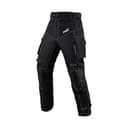
The two numbers, and why pants are where you actually get them
A riding garment carries two separate certifications, and they are tested by different methods for different things. EN 17092 rates the garment— the fabric, the seams, the way the whole pant holds together when it is dragged across a surface — and grades it in classes from AAA at the top down through AA and A, with B and C below those for garments that carry little or no armor. EN 1621-1 rates the armor in the pocket: shoulders, elbows, hips and knees, at Level 1 or the tougher Level 2. Our CE armor guide walks through the whole family. What matters for shopping is that a pant can hold a Level 2 knee protector inside a shell with no garment rating at all, or an AA-rated shell with Level 1 armor, and the label on the thigh will not tell you which.
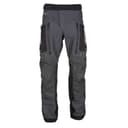
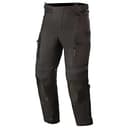
Across this site the usual finding is that US-market gear does not publish the garment class at all. Pants are the exception, and it is worth stating plainly: five of the nine pants here publish an EN 17092 class on the maker’s own page, and four of those name the part number of the standard as well. KLIM publishes “CE AA rating certified to EN 17092-3” for the Carlsbad and the Baja S4. Tourmaster publishes “CE-certified A EN 17092-4” for both Adventure Lite pants. Alpinestars publishes “CE-Certified Garment” and “A Class” for the Andes V3 and does not name the standard. The other four — the Ridgecrest, the Terra Trek, the Overpant Evo and the HWK — publish an armor claim and no garment class, and they are ranked accordingly.
| Pant | Garment class (as published) | Knee armor | Hip armor | Weather |
|---|
| KLIM Carlsbad | AA, EN 17092-3 | Rogue CE Level 2 | Rogue CE Level 2 | GORE-TEX Performance Shell laminate |
| Alpinestars Andes V3 Drystar | “A Class”, standard not named | Not published | Not published | Fixed Drystar membrane, 5000mm |
| Tourmaster Adventure Lite | A, EN 17092-4 | Armanox CE Level 1 | Armanox CE Level 1 | Laminated 420D waterproof shell |
| KLIM Baja S4 | AA, EN 17092-3 | D3O CE Level 1 LP1 | D3O CE Level 1 LP1 | Mesh, no membrane |
| Tourmaster Adventure Lite Mesh | A, EN 17092-4 | Armanox CE Level 1 | Armanox CE Level 1 | Mesh, no membrane |
| Tourmaster Ridgecrest | Not published | EN 1621-1 Level 1 | EVA foam, not certified | Mesh + zip-out waterproof liner |
| FLY Terra Trek | Not published | CE Level 1, EN 1621-1 | Pocket only, armor sold separately | Taped-seam Hydraguard shell + thermal liner |
| Tourmaster Overpant Evo | Not published | Armanox CE Level 1 | None listed | None listed |
| HWK | Not published | “CE”, no standard named | “CE”, no standard named | Water-resistant Reissa membrane |
Laminate, fixed membrane, zip-out liner, or mesh
The weather system is the decision that decides whether you keep wearing the pant, so it is worth understanding what the four approaches actually do before you look at a price.
- A laminated shellbonds the waterproof membrane to the outer fabric, so the outside of the pant does not soak up water and get heavy. The Carlsbad (GORE-TEX Performance Shell) and the Adventure Lite (a laminated 420D polyester) work this way, and Alpinestars describes the Bogotá Pro’s Drystar liner as laminated too. It is the most expensive construction and the most comfortable in a full day of rain.
- A fixed membranesits inside the shell permanently, which is the Andes V3’s approach: Alpinestars publishes “Fixed membrane” and a 5000mm figure. The outer fabric can wet out, but you never have to stop and reconfigure anything. The cost is that the membrane is always there in summer.
- A zip-out liner is the budget answer and the most versatile one. The Ridgecrest carries an Aqua-Barrier waterproof liner behind an open mesh shell, so the same pant is a mesh pant in July and a rain pant in October. The trade is that the mesh shell soaks through and hangs wet while the liner keeps you dry.
- Mesh with nothing behind it is what the Baja S4 and the Adventure Lite Mesh are: full-time airflow, no weather protection of any kind. KLIM is explicit that the Baja S4 is designed to kit with its Enduro S4 overshell for cool or wet weather; Tourmaster simply lists no liner. Either is a second pant, not an only pant.
The Terra Trek sits between categories. FLY publishes a 600D shell “with fully taped seams” and its Hydraguard membrane, and separately a removable thermal liner — so the waterproofing is in the shell and only the insulation zips out. The Overpant Evo has no membrane at all, and Tourmaster does not claim one; it is an abrasion and knee-armor layer you pull on over trousers, which is a different product solving a different problem. If rain is the reason you are shopping, our rain gear guide covers the whole kit, including what to do about boots and gloves.
Hip armor is where the budget pants quietly cut
Every pant here has knee armor of some description. The hip is where the specifications diverge, and it is the joint that reaches the road in the most common kind of fall — a low-side where the bike goes out from under you and you land on your side.
Only four pants here ship with certified armor at the hip: the Carlsbad (Rogue CE Level 2), the Baja S4 (D3O CE Level 1 LP1), and both Adventure Lites (Armanox CE Level 1). The Ridgecrest ships with removable EVA foam hip pads, and Tourmaster is honest that they are foam — it notes they accept Safe-Tech hip pads if you upgrade. The Terra Trek ships with hip armor pocketsand no armor in them; FLY’s Barricade CE hip protectors are an extra purchase. The Overpant Evo lists no hip armor and no pocket. The Andes V3 lists no armor detail at all. And the HWK says “CE armor” at the knees and hips without naming a standard, a level or who certified it, which for our purposes is the same as no rating.
None of that makes the cheaper pants a bad buy. It makes the hip pocket the first thing to check and, on the Terra Trek and the HWK, the first thing to fill. Our armor inserts page covers drop-in EN 1621-1 protectors that go into standard pockets, and the price of one is small next to the difference between these pants.
Why the Alpinestars is ranked second with the thinnest spec sheet
This deserves an explanation, because on published data alone the Andes V3 Drystar should sit lower. Alpinestars publishes nine lines for it: “CE-Certified Garment”, “A Class”, “Direct vent openings”, “Drystar”, “5000mm”, “Waterproof”, “Fixed membrane”, “Thermal insulation” and “Detachable thermal layer”. The description adds “added protection in strategic areas”. Nowhere does it name the standard behind “A Class”, and nowhere does it say what armor is in the knee or hip pocket or what level it carries.
It is ranked where it is for two reasons. First, it is the one pant in the mid-price bracket that combines a fixed membrane, a detachable thermal layer, direct vents and three leg lengths across eight sizes— S to 5XL in Regular, Short and Long — which is a real advantage for a garment that has to sit right over a boot and under a jacket. Second, the class it does publish is a class, which puts it ahead of the four pants that publish none.
But note what Alpinestars publishes for its own Bogotá Pro Drystar 4 Seasons pants: “Level 2 CE Nucleon Flex Pro knee armor and Bio-Flex hip armor”, on the same website. The maker can name the armor and the level when it wants to. It does not for the Andes, and we found the identical pattern on our adventure glove page, where Alpinestars published an EN 13594 rating for its cheaper glove and none for its dearer one. So the advice is the same: open the pocket, read the label on the pad, and if it does not say EN 1621-1 and a level, treat it as unknown and budget for an insert.
Sizing: waist, length and where the knee armor ends up
Riding pants are sized on the waist, but the spec that actually decides whether they work is where the knee armor sits when you are on the bike. Sitting in the riding position pulls the knee up and the pant leg with it; a pant that fits standing up can have its knee protector halfway down your shin at the first corner. Every maker here has a different answer. KLIM uses knee adjustment straps on the Carlsbad and adjustable knee armor on the Baja S4. FLY publishes “adjustable knee armor pockets” for different heights on the Terra Trek. Tourmaster gives the Ridgecrest a 3-way adjustable knee pocket and the Overpant Evo an “adjustable fit” knee. Whatever you buy, sit on your bike in it before the first ride and move the armor until it is over the kneecap in the crouch, not standing.
Length options matter more here than on a jacket. The Andes V3 comes in Regular, Short and Long. The KLIM pants come in Short and Tall waist sizes at the retailer we link to, the Terra Trek in Tall, the Ridgecrest in Short. The two Adventure Lites and the Overpant Evo were listed in a single length on the date of writing. If you are outside the middle of the height range, start with the pants that publish a second length rather than hoping the armor straps will make up the difference.
The last fit question is the cuff. A pant that goes on over an adventure boot needs a cuff that opens: the Carlsbad has a zipper and snap cuff that KLIM says opens for boot and knee-guard adjustment, both Adventure Lites have wide zippered leg openings, and the Ridgecrest a zippered cuff with hook-and-loop straps. The Overpant Evo opens the entire leg, which is the point of it. Most pants here also list a jacket connection zipper — 8 inches on the Terra Trek and the Overpant Evo, a jacket-pant zip connection of unstated length on both KLIMs, and on the Ridgecrest a full-circumference zip plus an 8-inch one with the jacket-side half in the box. Neither Adventure Lite nor the HWK lists one, and the Andes V3 is described only as compatible with its matching jacket. Where it exists, use it: a pant zipped to a jacket cannot ride down in a slide.
Where riding pants fit in the rest of your kit
If you are building an adventure or touring kit around these, the matching pages are already live. The KLIM pants are cut to zip into KLIM’s jackets and our adventure and touring jacket roundup covers those; the waterproof jacket roundup is the match for the Andes V3 and the Adventure Lite. Below the pant, our adventure boot page covers the boots these cuffs are designed to go over, and the adventure glove page ranks on the same read-what-the-maker-publishes rule as this one.
Two smaller purchases change how these pants feel more than anything on the pant itself. A thermal riding bottom from our base layers page turns a mesh pant into a three-season one and stops a laminate pant feeling clammy in the cold. And if you have bought a pant whose hip pocket is empty or holds foam, an EN 1621-1 insert is the cheapest protection upgrade on this site. For the whole packing list, the touring gear checklist puts pants in order with everything else.
What we did not rank, and why
- KLIM Badlands Pro.The flagship above the Carlsbad, and on published data the best pant KLIM makes: a GORE-TEX 3-layer Pro shell, variable-density SuperFabric on the knees, CE AA to EN 17092-3 and KLIM’s Rogue EXP CE Level 2 hip and knee armor, with the useful note that sizes 30 and under get compact knee armor. It was in stock at the retailer we link to on the date of writing. It is not ranked because it is priced well above the Carlsbad for the same published class and level, and the Carlsbad is already the most expensive pant on the page. If money is no object it is the answer; the source is listed below.
- KLIM Latitude.The touring-cut twin of the Carlsbad — GORE-TEX Performance Shell, 600D Cordura overlays, the same AA rating — but KLIM ships it with Rogue CE Level 1 knee and hip armor and lists the Level 2 as an upgrade. That puts it behind the Carlsbad on the second criterion at a similar price, and on the date of writing the regular lengths were low-stock at the retailer.
- Alpinestars Bogotá Pro Drystar 4 Seasons. The pant that shows Alpinestars can publish armor levels: Level 2 Nucleon Flex Pro knees, Bio-Flex hips, a laminated Drystar liner that can be worn inside or outside the shell, and a 100-gram thermal liner. It would have ranked. It was not featured because on the date of writing the retailer we link to listed the men’s version as “Only 1 left in stock” in one size and on a shipping delay in the other, and featuring a listing in that state is how a site ends up recommending pants nobody can buy.
- A women’s-cut pick.The Stella Bogotá Pro Drystar was in stock at the retailer on the date of writing, but Alpinestars’ own US site listed no women’s-cut textile riding pant we could read a specification from, and we do not rank a garment on a retailer’s title alone. Our women’s jacket, glove and bootpages exist; a women’s pants page will follow when a maker publishes enough to build one.
- Armored jeans. A different garment for a different ride, with a page of its own at armored motorcycle jeans. This page opens by sending the town-speed commuter there, and means it.
- Leather pants and race suits. Track and sport riding is a separate category with a separate standard of its own, and nothing in the registry covers it yet. It is not on this page rather than half-covered by it.
Before you buy
Three checks, in order. First, decide the weather system before the price: laminate, fixed membrane, zip-out liner or mesh. It is the decision that decides whether the pant is worn or shelved, and the price order will make it for you otherwise. Second, find the hip armoron the maker’s page — not “CE armor”, but a standard and a level at the hip specifically. Four pants here have it; five do not, and three of those five have a pocket an insert can fix for a small sum. Third, sit on the bike in them and move the knee armor until it is over the kneecap in the riding crouch, then zip them to the jacket.
And if this is the first riding pant you have bought rather than the latest, our beginner gear guide works through the whole head-to-toe order by budget, so the pant is bought in the right sequence with the helmet, jacket, gloves and boots around it.