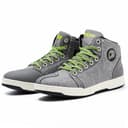
What a women’s last actually changes
Three things, and all of them affect whether the boot protects you rather than just whether it is comfortable.
- A narrower heel relative to the forefoot. A foot that slips inside the boot moves the ankle independently of the boot structure, which is precisely what the TPU ankle brace is there to prevent.
- A lower and differently-shaped instep. This is why a men’s boot in a small size often will not close properly over the top of the foot, or closes so tight it cuts off circulation.
- A narrower calf on tall boots. The most common complaint, and the reason many women end up in mid-height boots by default. A tall boot that gaps at the calf lets water in, catches on the tank, and does not brace the joint the way it was designed to.
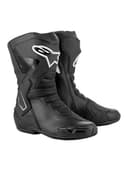
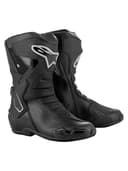
The Stella boots address all three. A unisex boot in a small size addresses none of them — it is simply smaller in every dimension at once.
Making unisex sizing work
Most riders on this page will end up in a unisex boot at some point, because the women’s options run out. Some practical guidance:
- Convert to EU sizing and buy against that. Motorcycle boots are almost universally sized in EU numbers, and women’s US-to-EU conversions differ from men’s. Work in EU, cross-check against the maker’s own chart, and do not assume a US women’s 8 maps cleanly.
- Size for the length, then fix the volume. A boot that is the right length but loose in volume can be improved with a thicker insole or a heavier riding sock. A boot that is too short cannot be fixed at all.
- Check the heel first. Walk in the boot. If your heel lifts out of the heel cup, the boot is too big in volume regardless of what the length says, and it will not hold your ankle.
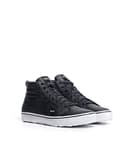
- Low-cut is a legitimate fallback. If no tall boot fits your calf, a certified casual riding shoe that actually fits beats a tall boot that gaps. We would rather you were in a well-fitted shoe.
What to prioritize
1. Fit, then certification
Unusually for this site, fit comes first here — because the certified options are so few that the failure mode is buying a certified boot that does not fit and riding in sneakers instead. A well-fitted uncertified riding shoe is worn; a certified boot that rubs is not.
2. EN 13634, where it exists
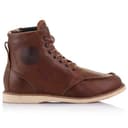
The standard covers abrasion, impact cut resistance, transverse rigidity and ankle height. Both Stella boots publish EN 13634:2017. The Alpinestars Oscar Monty V2 states CE-certified motorcycle footwear. Where a listing claims CE without naming the standard — as the budget unisex option does — our spec table records that exactly, because it is a different level of evidence.
3. Ankle protection you can see
A TPU brace or cup over the outside ankle bone. This is the single most visible protective feature on a boot and the one most often missing on fashion products sold in this category. Our boot buying guide explains why torsional restraint matters more than padding.
4. Waterproofing if you commute
The Stella Drystar version publishes 5,000 mm waterproofing and 5,000 g/m² breathability with the same protection hardware as the standard boot. If you ride year-round rather than seasonally, that is the version to buy — and waterproof boots covers the wider category.
The same pattern across the rest of the kit
Boots are the thinnest women’s category on this site, but the shape of the problem repeats. Helmets for women is largely about small shell sizes, because almost no maker builds a women-specific shell. Women’s jackets is the healthiest of the four, with several makers drafting real women’s patterns. Women’s gloves sits in between, with one certified option and a budget end that publishes nothing.
In every case the advice is the same and it is not satisfying: buy the thing that fits, verify the certification where a maker publishes one, and do not accept a bad fit because the alternative was marketed at you.