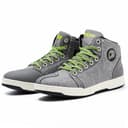
What a low-cut shoe actually gives up
The main job of a tall motorcycle boot is not impact absorption. It is torsional restraint — stopping your ankle rotating past the angles it can survive. A bike falling on your leg, a foot caught between the peg and the road, or a low-side that twists the joint are the events tall boots are built for, and they resist them with height, a stiff shank in the sole, and lateral bracing above the ankle bone.
A shoe that stops at or just above the ankle can only do a fraction of that. What it does provide is real and worth having:
- Abrasion resistance on a surface that would take a sneaker apart in a couple of meters.
- Some ankle coverage — usually padded, sometimes with a molded cup over the malleolus.
- A shift panel, which is a durability feature but also means the shoe does not come apart at the seam that wears first.
- A sole that stays on the peg and does not deform around it.
- Laces that cannot be swallowed by the chain, on the designs that cover or trap them.
The honest framing: a casual riding shoe is a large upgrade on sneakers and a real step down from a tall boot. If your riding includes highway speed and you are choosing between a riding shoe you will wear and a tall boot you will not, take the shoe. If you will genuinely wear the boot, our best motorcycle boots ranking is the page you want.
Certification in this category
EN 13634 is the motorcycle footwear standard. It covers abrasion, impact cut resistance, transverse rigidity and, importantly for this category, ankle-height requirements — which is why relatively few low-cut shoes carry it. The Alpinestars pick above states CE-certified motorcycle footwear; the IRON JIA’S listing claims CE certification without naming a standard, and our spec table records exactly that rather than upgrading the claim.
Read that distinction carefully when you shop. “CE” on a listing with no standard behind it is a claim, not a test result. It does not automatically mean the shoe is bad — but a shoe that names EN 13634 has been through something a shoe that does not has not.
What to look for
Ankle coverage above the bone
The lateral malleolus — the bump on the outside of your ankle — is what you are trying to cover. A shoe cut below it is a sneaker with a shift pad. Look for a collar that comes up over it and, ideally, a molded or padded cup on the outside.
A reinforced shift panel
Non-negotiable, and the easiest thing to check in a product photo. The top of the left foot is where every non-riding shoe fails first.
Lace management
A lace flap, a hidden lace channel, or a hook that holds the bow. Loose laces near a chain are a real hazard, not a theoretical one.
Waterproofing, if you commute
Two of the picks above have waterproof leather uppers, and it is worth more in a shoe than in a tall boot — a low shoe fills from the top in heavy rain far more readily. Our waterproof boots page covers membrane versus treated leather, and the rain gear guide covers why water usually arrives over the top rather than through the material.
A sole you can actually walk in
The whole point. Check the sole has real tread rather than a flat racing profile, because a slick sole on a wet garage floor is its own small hazard.
Riding shoes are a category with a real range
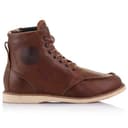
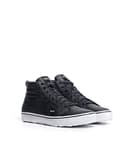
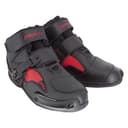
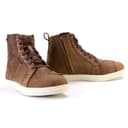
At the top, the Alpinestars Oscar Monty V2 is a full-grain leather shoe with CE-certified motorcycle footwear status and a genuinely all-day-walkable last — it is also our top pick on cruiser boots for the same reason. In the middle, the TCX Street 3 WP adds a waterproof membrane and TPU ankle protection at a mid-market price. At the bottom, the budget picks give you ankle coverage, a shift panel and a sole, which is a large step up from a canvas sneaker for very little money.
The mistake to avoid is buying a “motorcycle-style” sneaker with no shift panel, no ankle collar and no certification claim at all. Those exist in quantity, they are sold in the same search results, and they are sneakers with a logo.
And if you are here because you are not convinced you need riding footwear at all, that is a reasonable position and we have answered it directly: are motorcycle boots necessary? explains what a riding boot is actually built around, which turns out not to be your toes.