Are Motorcycle Boots Necessary?
The honest answer involves admitting what the marketing gets wrong. A riding boot is not mostly about your toes — it is built around an ankle that a sneaker leaves completely unsupported.
How this is funded: we earn a commission if you buy through our links, at no extra cost to you. It never changes which gear we recommend, and we’ll tell you plainly when to skip a pick. Full disclosure.
Let us get the honest part out of the way first. You can ride a motorcycle in sneakers, thousands of people do it every day, and most of them will never have a reason to regret it. Nothing on this page is going to pretend otherwise. What this page will do is explain what a riding boot is actually built to do — because the usual argument for boots gets the reason wrong, and the wrong reason is easy to dismiss.
The usual argument is about your toes. It is not really about your toes. It is about your ankle, and about a specific mechanism that no other kind of footwear is designed for.
What a riding boot is built around
A motorcycle exerts forces on your feet that walking never does. Your foot sits on a small metal peg with a gear lever an inch from your toes. A bike that goes down travels, and it can travel with a foot underneath it or trapped between the bike and the road. The failure mode is not a stubbed toe — it is the ankle being twisted or crushed sideways, in a direction the joint does not go.
That produces four design features you will not find elsewhere:
- Lateral ankle structure. Internal braces, torsion control and reinforcement over the ankle bones, specifically to resist sideways movement. A hiking boot supports your ankle for walking on a slope, which is a different job with a different geometry.
- A shift pad.A reinforced panel on the top of the left boot where the gear lever hits it. Without one, the lever wears a hole in an ordinary shoe surprisingly fast — which is itself a good indicator of how much force is going through that spot.
- A sole built for a peg. Flat enough to sit stably on a footpeg, firm enough not to flex around it, grippy enough to plant a foot at a stop. Deep hiking lugs can catch on a peg, and a soft trainer sole rolls off it.
- An upper that survives a slide.Abrasion-resistant leather or microfibre, and — the part people forget — a closure that keeps the boot on your foot. A boot that comes off has protected nothing.
What EN 13634 actually certifies
If you want to shop this on evidence rather than adjectives, the field to look for is EN 13634, the European standard for motorcyclists’ footwear. It assesses abrasion resistance, impact cut resistance, transverse rigidity — the crush-from-the-side property that this whole page is about — and whether the boot stays on the foot.
The honest finding from our own registry is that very few US-market boots publish it. Of fifteen boots we rank, the Alpinestars Stella SMX-6 V3 and its Drystar version publish “CE EN 13634:2017” on the maker’s page and the Oscar Monty V2 publishes CE-certified motorcycle footwear; a couple more claim “CE certified” on the listing without naming a standard, and the rest publish nothing at all. That is not evidence those boots are bad — it is evidence that the category documents itself poorly, and we record it as unverified rather than assuming.
The counter-argument, taken seriously
There is a real case against tall riding boots and it is not stupidity. They are hot. They are awkward to walk in. You cannot wear them into a meeting. If your commute is fifteen minutes and you then spend nine hours in a building, a pair of sport-touring boots is a thing you have to carry around all day, and the predictable outcome is that they stay at home.
A boot that lives in the garage protects nobody, and the honest answer to that problem is a riding shoe, not a lecture. The category has become genuinely good: reinforced ankle areas, shift pads, peg-appropriate soles, toe sliders on some, in a shape that passes as normal footwear. You give up height, and with it some of the lateral support — but you give up nothing at all compared with the trainers you would otherwise be wearing.
If you will not carry a second pair of shoes
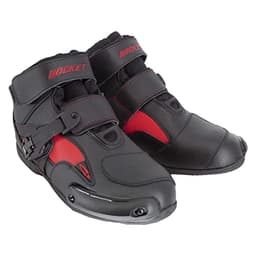
Joe Rocket Sector Casual Riding Boots
A leather riding shoe with a reinforced shifter panel and a toe slider that looks close enough to a normal boot to wear into an office. Joe Rocket publishes no CE rating for it, so this is ankle coverage and abrasion resistance rather than certified protection.
See the casual riding shoe rankingPrice as of September 22, 2026. #ad How we’re funded
The Joe Rocket Sector is the pick for the rider whose real constraint is walking around all day afterwards — a leather riding shoe with a reinforced shifter panel and a toe slider that does not announce itself.
The cheapest way to stop riding in trainers
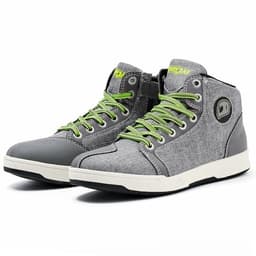
IRON JIA'S CE-Certified Riding Shoes
CE certified (listing; standard not named)The budget sneaker-style riding shoe, listed as CE certified and sized for both men and women. It is the cheapest thing here that makes any certification claim at all — but the listing does not name the standard, so weigh that claim accordingly.
See the budget boot rankingPrice as of September 22, 2026. #ad How we’re funded
The IRON JIA’S is a sneaker-profile riding shoe with a reinforced ankle and shift pad at roughly the price of a decent pair of trainers. Its listing claims CE certification without naming a standard, and we record that exactly as it is rather than rounding it up — but as a first step off ordinary shoes, it is a real one.
If you are going to do it properly
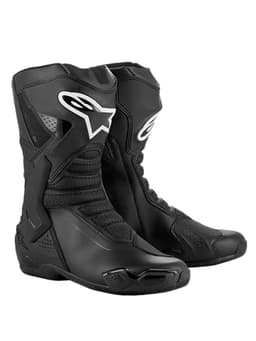
Alpinestars SMX-6 V3
The do-everything sport-touring boot: ankle and shin protection, a locking heel/toe structure and enough comfort to walk in. The default upgrade from sneakers for street riders.
See the full boot rankingPrice as of September 22, 2026. #ad How we’re funded
And if you are persuaded, the Alpinestars SMX-6 V3 is the one boot that covers street, sport and touring riding: a microfibre upper with TPU ankle protection, a shin plate and a toe slider. It is stiff out of the box, and that stiffness is the structure doing its job.
So: necessary?
Here is our position, stated plainly. Boots are not the first thing to buy — a certified helmet that fits comes first, and gloves come second, because hands hit the ground in almost every fall and gloves are the cheapest protective item there is. Our beginner gear guide works through that order by budget.
But boots are the item riders most reliably postpone and most reliably wish they had not, because the injury they prevent is the one that takes months rather than weeks to recover from. And the version of this decision that actually gets acted on is rarely “tall boots or nothing” — it is a riding shoe you will genuinely wear every day, which is a far better outcome than a perfect boot you have talked yourself into and will not put on.
How to read our safety notes. We have not crash-tested any of this gear — nobody honestly can on a review budget. Every helmet and armor pick names the certification the maker publishes (DOT, ECE 22.06, SNELL, or a CE level), which we read from the listing on a dated visit. Certification is the floor, not a guarantee; fit and condition matter as much as the sticker. What the standards actually mean.
Frequently asked questions
Do you really need motorcycle boots?
Need is doing a lot of work in that question. Nothing except a helmet is legally required in most places, and plenty of riders ride in sneakers for years without consequence. What a riding boot provides that no other footwear does is a structure that resists your ankle being twisted or crushed sideways, a sole that stays on the peg, and an upper built to survive a slide rather than a walk. If you are only ever going to buy one thing beyond a helmet, gloves come first. Boots are the item riders most often skip and most often regret skipping.
Can I ride a motorcycle in work boots?
They are a real improvement on sneakers and a real step down from riding boots. What a work boot gives you is height over the ankle, a tough leather upper and often oil-resistant soles — genuinely useful. What it does not give you is the lateral ankle structure that a riding boot is built around, a shift pad where the gear lever hits, or a sole designed to grip a peg rather than a floor. Work boots also tend to have hooks or speed lacing that can snag. If a work boot is what you own, ride in it rather than in trainers, and put a proper boot on the list.
Are motorcycle boots CE certified?
Some are and many are not, and the field on the box is worth reading. The European standard for motorcyclists' footwear is EN 13634, which covers abrasion, impact cut resistance, transverse rigidity and the boot staying on your foot. In our own registry only a minority of boots publish it: the Alpinestars Stella SMX-6 V3 and its Drystar version publish 'CE EN 13634:2017' and the Oscar Monty V2 publishes CE-certified motorcycle footwear, while most budget boots publish nothing, or claim 'CE certified' without naming a standard. A boot with no published standard is not automatically bad, but it is unverified.
Are riding sneakers or riding shoes good enough?
They are a genuine category rather than a marketing exercise, and for a commuter they are frequently the right answer — because the best boot is the one you actually wear. A proper riding shoe has a reinforced ankle area, a shift pad, a sole built for a peg and often a toe slider, in a shape you can walk into a building in. What it gives up against a tall boot is height, so the lateral support at the ankle is more limited. The honest trade is that a riding shoe worn every day beats a tall boot left in the garage.
What is the difference between a motorcycle boot and a hiking boot?
Direction of load. A hiking boot is built to flex forwards and backwards comfortably over thousands of steps and to grip uneven ground; its ankle support is about stability on a slope. A riding boot is built to resist the ankle rolling and twisting sideways under a load the wearer cannot control, which is a different structure entirely — internal braces, torsion control, reinforcement at the malleolus. Hiking boots also have deep lugged soles that can catch on a peg, and no shift pad, so the gear lever wears straight through the upper.
Do motorcycle boots need to be waterproof?
Only if you ride in the rain, and be aware of the trade. A waterproof membrane makes a boot warmer, so a rider in a hot climate may be better served by a vented boot and a pair of overboots for the occasional soaking. A rider who commutes year-round in changeable weather will value a waterproof boot every single wet morning, because wet feet are the fastest route to a miserable ride. Our waterproof boot ranking splits the options, and several casual riding shoes now publish waterproofing too.
How tight should motorcycle boots be?
Snug enough that your heel does not lift and your foot does not slide forward under braking, with room to wiggle your toes. A boot that is too loose lets your foot move inside it, which is both uncomfortable and the mechanism by which a boot comes off in a crash. Try them with the socks you will actually ride in, and expect a stiff sport-touring boot to need breaking in — that stiffness is the protective structure, not a fit problem. Our fit guide covers the same principle across the rest of your kit.
Sources
- NHTSA — Traffic Safety Facts 2023: Motorcycles (DOT HS 813 732) — 2023 motorcyclist fatality, injury and helmet-use statistics (accessed July 21, 2026)
- MotoCAP — Independent Motorcycle Clothing & Helmet Assessment — Independent Australian lab rating protective clothing and helmets for protection and comfort (accessed July 21, 2026)
- NHTSA — Motorcycle Helmet Effectiveness Revisited (DOT HS 809 715) — Helmets ~37% effective at preventing rider fatalities (accessed July 21, 2026)
Keep reading
How to choose motorcycle boots
Once you have decided you want a pair, this is the guide that works through height, closure, certification and sole type.
Read the buying guideBest motorcycle boots
The main ranking — sport-touring, adventure and commuter boots compared on published protection rather than looks.
See the boot rankingBest casual motorcycle shoes
Riding footwear you can walk into an office in — the answer for most riders who will not wear a tall boot.
See the casual picksBest budget motorcycle boots
If the objection to boots is the price rather than the look, start here — real protection at the bottom of the market.
See the budget picksBeginner motorcycle gear guide
Where boots sit in the head-to-toe buying order, by budget — and what to buy before them if money is finite.
Read the beginner guideHow should motorcycle gear fit?
The fit rules for every piece, checked on the bike rather than standing in a shop — including the heel-lift test for boots.
Read the fit guide