The four criteria this ranking is built on
In the order they decide the purchase. They are deliberately not the criteria behind the main boots ranking, where the best boot wins regardless of price, or the budget ranking, which is sorted purely on cost per boot.
| Criterion | Why it decides a first boot | What to look for |
|---|
| A published standard | There is no US motorcycle boot standard, so a maker naming EN 13634 is volunteering to be measured. Most do not | The string “EN 13634” with a year, on the maker’s own page. Five of our 17 boots have it. “CE certified” with no standard named is a weaker claim, and we label it that way |
|---|
| Ankle and shin coverage | The ankle is the joint that twists in a low-speed drop, which is the crash a new rider is most likely to have — a parking lot, a gravel driveway, a foot put down on paint | A shaft above the ankle bone, a stiffened heel counter and a lateral ankle guard. A low shoe gives up most of this and the page says so on every shoe here |
|---|
| Sole and shifter zone | A bike asks two things of a sole that a hiking boot never does: grip on a painted, oily surface while you hold up 400 lb, and resistance to twisting across the footpeg | An oil-resistant rubber compound, a reinforced shift pad on the left instep, and — the spec almost nobody publishes — a transverse stiffener in the sole. Alpinestars calls theirs TPF |
|---|
| Whether you will wear them | The best boot in the world protects nothing from inside a cupboard. New riders take short, frequent trips, and that is exactly when a tall race boot stays home | A short shaft, a zip rather than three ratchets, and a profile you can walk a mile in. This is why a certified SHOE outranks an uncertified tall boot on this page |
|---|
What the registry actually shows about boots
We keep every product on this site in one registry with the certification each maker publishes, so these are counts, not impressions. Across 17 boots:
- 5 name EN 13634 by number.Two of those are women’s boots (the Alpinestars Stella SMX-6 V3 and its Drystar version, both CE EN 13634:2017), the IRON JIA’S shoe is the third, and the two boots added for this page are the fourth and fifth. One more — the Alpinestars Oscar Monty V2 — publishes only “CE-certified motorcycle footwear” without naming a standard, so 6 of 17 publish any certification at all and 11 publish nothing.
- Exactly 1 publishes the four EN 13634 performance levels. The IRON JIA’S shoe’s listing states “EN 13634:2017 Rated 1-2-2-1”. Alpinestars, which certifies more of its range than anyone else here, publishes the standard and stops.
- Not one publishes a weight. Boots are the only category on this site where no maker gives a figure, which is why this page ranks on coverage and construction rather than grams. Our helmet weight guide shows what the opposite looks like.
Read together, those three counts say something uncomfortable and useful: price does not predict disclosure in this category. The gloves market has the same problem — 4 of our 24 gloves publish EN 13594 — and jackets are worse still, with 2 of 27 publishing an EN 17092 class. Helmets are the exception, not the rule.
How we ranked these six
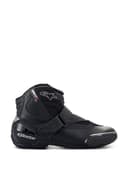
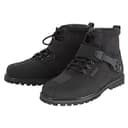
- The Alpinestars SMX-1 R V2 leads because it is the cheapest boot here a maker certifies by name. Alpinestars’ own product page carries the statement “The following standards apply: CE EN13634:2017”, plus an external high-modulus TPU heel counter, lateral ankle and shift pad, and a TPF transversal protection frame in the sole. The shaft is short — about 14 cm at size 44 — and it closes with a Velcro instep strap over a reverse zip. The honest costs: Alpinestars publishes the standard but NOT the four performance levels, a short boot protects less shin than a tall one by design, and the microfiber upper will never age like leather.
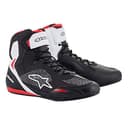
- The Alpinestars Faster-3 Rideknit is the certified shoe, and it outranks three tall boots on this page for one reason. It carries the same CE EN 13634:2017 statement on Alpinestars’ own page, in a profile you can wear to a shop or an office. Microfiber upper, TPR heel counter for lateral support, a breathable 3D mesh lining and a replaceable EVA footbed, with laces plus a hook-and-loop ankle strap so nothing can reach the chain. The trade-off is large and we are not going to soften it: Alpinestars lists no ankle protector and no shift pad for this model, and a shoe leaves your ankle bones and shin far more exposed than any boot below it. Buy it as the pair you will wear on short rides, not as your only pair.
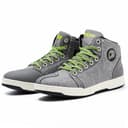
- The IRON JIA’S riding shoe is here because of what it puts in writing. Its listing names the standard and the levels — “EN 13634:2017 Rated 1-2-2-1” — which means a short upper, the higher level on impact abrasion, the higher level on impact cut and the LOWER level on transverse rigidity. In plain terms: better than most cheap shoes at not tearing open, softer than most at resisting a twist across the peg. Two honest notes. That claim comes from a marketplace listing rather than a maker’s technical page, which is a weaker provenance than Alpinestars’ own site. And the synthetic construction will not last like leather.
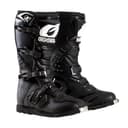
- The O’Neal Rider is the most coverage per dollar on the site and the least pleasant to live with. A tall MX-style boot with a shin plate, buckle closure and reinforced heel, toe and ankle, for roughly the price of the cheap shoes above it. If your riding is dirt, gravel driveways or a dual-sport commute, the coverage argument wins outright. The costs are real: O’Neal publishes no certification for it, it is stiff and MX-styled rather than walkable, and there is a genuine break-in period. It also leads our budget boots page, where cost is the only axis.
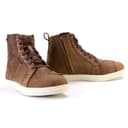
- The Joe Rocket Outbreak is the first-leather-boot answer. Real leather with ankle protection and an oil-resistant, walkable sole, at the lowest price any leather boot reaches here — and the natural choice if your first bike is a cruiser rather than a naked or a sport bike. No certification is published, the cut is low so there is little shin coverage, and the protection is basic next to a sport or ADV boot. What it does is get you out of sneakers into something that survives a slide, in a style you will not resent. Our cruiser boots page covers that lane properly.
- The Milwaukee Leather MBM9113 is the wet-weather answer under $100. Waterproof leather with reinforced ankle support in a riding-shoe profile, which matters more than it sounds: a new rider with wet feet on day three is a new rider who takes the car on day four. No CE certification is published, and the low cut gives the least ankle coverage of anything on this page. It is the honest budget compromise, and it is also ranked on our waterproof boots page.
Buy the boots third, not fifth
The usual order a new rider buys gear in is helmet, jacket, gloves, then — months later, if at all — boots. We would put boots third, ahead of a dedicated jacket, for one reason: feet and ankles are involved in almost every low-speed drop, and a sneaker offers nothing against a twist or a hot exhaust. A jacket with armor is better than a jacket without one, but a jeans- and-sneakers rider in a parking-lot tip-over hurts their ankle, not their chest. Our head-to-toe beginner guide sets out the whole kit by budget, and are motorcycle boots necessary is the longer answer to the question behind this page.
Fit: three things that are different from normal footwear
- Size them with riding socks on, late in the day. Feet swell, and a boot that is perfect in the morning is tight at hour three. You want your toes just short of the end with no heel lift when you flex forward.
- Check the boot against your bike, not just your foot. A thick sole raises you off the peg and can make a tall seat worse; a bulky toe box can foul the gear lever on sportbikes. If you are between sizes on a tall boot, the calf circumference usually decides it, not the length.
- A boot does not break in like a hiking boot.The stiff parts — heel counter, ankle guard, sole stiffener — are structural and are not supposed to soften. If it hurts in a specific spot in the shop, it will still hurt in month three. Our gear fit guide covers the whole kit.
What we did not rank, and why
Four boots that would have made this page, all excluded on availability. We hold a new pick to a stock bar — a listing reading “only 1” to “only 5 left” is below it — because sending a new rider to a page where their size is gone is worse than a shorter list. On the day this page was written the Alpinestars SMX-6 V3 read “only 2 left”, the Alpinestars Oscar Monty V2 “only 4 left”, the Fly Racing Maverik “only 2 left”, and the TCX Street 3 Waterproof “usually ships within 2 to 3 weeks”. All four remain ranked on the main boots page, the casual shoes page and the adventure-touring page, where those rankings predate this check.
Work boots and hiking boots, including steel-toe. A steel toe cap is designed for a dropped object, not for abrasion across asphalt or a twist across a footpeg, and a hiking sole is built to flex in exactly the direction a boot sole should not. Neither is tested against anything motorcycling cares about. If the budget genuinely will not stretch, the honest answer is the cheapest shoe on this page, not a work boot.
Tall race boots. A full race boot with a magnesium toe slider and three ratchets is more protective than everything here and is the wrong first purchase: it is expensive, it is awkward to walk in, and it discourages the short rides that are how you actually learn. Revisit it when you know what kind of riding you do. The main ranking is where to look when that day comes.
Anything whose only claim is the words “motorcycle boot”. There are hundreds of them and the category’s own numbers are the reason we will not rank them: with no US standard and no maker disclosure, there is nothing to compare. A boot that volunteers EN 13634 is telling you something; a boot that volunteers nothing is telling you something too.