EN 13634 Explained: What CE Certified Means on Motorcycle Boots
The four digits on a boot label read height, abrasion, impact cut and transverse rigidity — in that order. Of the 17 boots in our registry only five name the standard, and the one that publishes all four levels costs under $100.
How this is funded: we earn a commission if you buy through our links, at no extra cost to you. It never changes which gear we recommend, and we’ll tell you plainly when to skip a pick. Full disclosure.
There are four separate CE certificates that can appear on motorcycle gear, and they are routinely confused with each other. EN 1621 grades impact armor. EN 17092 grades a jacket or pant. EN 13594 grades gloves. EN 13634 grades boots. This page is about the fourth, which is simultaneously the most detailed of the four — it is the only one that prints four separate results on the label — and the one least often published on anything sold into the United States.
The headline number first, because it frames everything else. Of the 17 boots in our product registry, five name EN 13634, one more says only “CE certified” without naming a standard, and eleven publish nothing at all. Helmets are the opposite: all 37 helmets we track publish DOT FMVSS 218, because US law requires it for on-road sale. For boots there is no US standard, no legal floor, and consequently no commercial reason for a maker to pay for testing. A boot that volunteers EN 13634 is telling you something real.
How to read the label
A certified boot carries a label — Dainese, which certifies to this standard, says it sits “on the lower part of the tongue” — with a motorcycle pictogram, the standard’s number and year, and up to four numbers. The numbers are not a single score. They are four independent test results in a fixed order, and each test is evaluated individually, so a boot can hold the higher level on one and the lower level on the next.
| Digit | What it measures | What Level 1 vs Level 2 changes for you |
|---|---|---|
| 1st — Height | How far the upper extends up the leg. This digit is a category, not a performance level | A 1 is a short upper, a 2 is a tall one. This is the digit that tells you whether you are looking at a riding shoe or a touring boot, and it is also the one most likely to be a 1 on anything you would wear off the bike |
| 2nd — Impact abrasion | How long the boot survives being dragged across an abrasive surface. Dainese describes the rig as 60-grit sandpaper simulating asphalt | This is the slide. Dainese publishes the thresholds as “at least 5 seconds” for Level 1 and “12 seconds” for Level 2 — see the note below on why those figures vary between makers. More seconds means the upper is still between your foot and the road further into a slide |
| 3rd — Impact cut | Resistance to a blade dropped onto the boot — Dainese publishes 2.8 m/s — measured as how deep it penetrates | This is the footpeg, the brake lever, the kerb edge and the sheared bodywork. Dainese publishes “no more than 25 mm” for Level 1 and “no more than 15” for Level 2 — i.e. Level 2 lets a blade in roughly 10 mm less far |
| 4th — Transverse rigidity | How much the sole deforms when squeezed sideways in a press. The under-appreciated test | This is the bike falling on your foot while it is on the peg, and a crush load across the sole. A higher level means a stiffer, usually heavier sole and a boot that is less comfortable to walk in. It is the digit most often set to 1 on shoes and casual boots |
A note on the numbers above, because this site does not pass off a secondary figure as a primary one. The thresholds quoted are the ones Dainese publishes on its own explainer. Other manufacturer documents for the same 2017 edition quote shorter abrasion times — and both can be right, because the standard tests more than one zone of the boot and the less exposed zone has a lower requirement than the main one. We have not read the standard’s own text, which is a paid document, so we attribute the numbers to the maker that published them and tell you the structure — four tests, two levels, scored individually — is the part you can rely on. That is the same policy we apply to the exact ECE 22.06 thresholds.
The optional marks: IPA, IPS and WR
Beyond the four digits a maker can have extra features tested and marked. The three you will actually see are IPA (ankle impact protection), IPS (shin impact protection) and WR(water resistance). These matter more than they look, because they are the only way to tell a tested ankle protector from a plastic cup. A listing that advertises “ankle protection” with no IPA mark is describing a part, not a test result. That is not the same as useless — a stiff TPU ankle guard does real work — but it is an engineering choice rather than a certified performance level, and the honest way to read it.
What this looks like across a real registry
Here is every certification claim across the 17 boots we track, because the distribution is the useful part:
- Five boots name EN 13634:2017. None of the five publishes all four levels except one — and it is the cheapest. Four of them are Alpinestars, which publishes the standards statement verbatim on its own product pages (“The following standards apply: CE EN13634:2017”) and then stops: no height digit, no abrasion level, no cut level, no rigidity level.
- One boot publishes the full code, and it is the sub-$100 IRON JIA’S riding shoe: “EN 13634:2017 Rated 1-2-2-1”. Read through the table above, that is a short upper, Level 2 on abrasion, Level 2 on impact cut and Level 1 on transverse rigidity. The provenance is weaker than Alpinestars’ — it is a marketplace listing rather than a maker’s technical page — but it is more information than any premium boot here gives you.
- One boot says “CE-certified motorcycle footwear” and names nothing. We record that exactly as written rather than upgrading it to EN 13634, because CE is a conformity mark and not a standard. A CE mark with no standard behind it is a claim about paperwork.
- Eleven publish no certification of any kind.That includes boots we rank highly and recommend without reservation on construction grounds. The absence is a disclosure gap, not proof of a bad boot — but it does mean you are buying reputation and construction rather than a graded result.
For comparison, the same count across the rest of the site: 4 of 24 gloves publish EN 13594 and every one of them is Level 1; 2 of 27 jackets publish an EN 17092 class; and 37 of 37 helmets publish DOT. The only category with universal disclosure is the only category with a US legal requirement, which is the whole argument in one line.
Three boots that publish something
Not a ranking — the beginner boots page and the main ranking do that. These are simply the boots on this site whose labels you can actually read, with the exact claim each one makes.
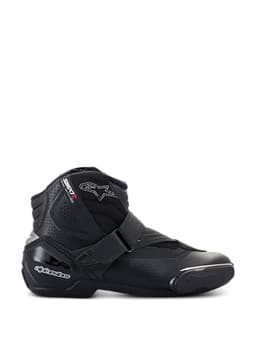
Standard named, levels not published
Alpinestars SMX-1 R V2
CE EN 13634:2017The cheapest boot in this registry that carries Alpinestars' own CE EN 13634:2017 statement, in a short shaft a new rider can actually walk in. TPU heel counter, lateral ankle and shift pad, a transverse protection frame in the sole, and a Velcro strap plus reverse zip rather than a ratchet to fight with at the kerb.
See it ranked against the restPrice as of October 17, 2026. #ad How we’re funded
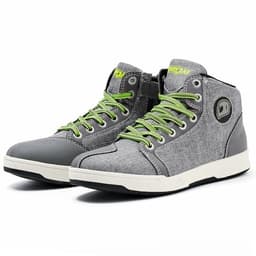
The only four-digit label here: 1-2-2-1
IRON JIA'S CE-Certified Riding Shoes
EN 13634:2017 rated 1-2-2-1 (per listing)The budget sneaker-style riding shoe, and — read the listing — the only boot in this registry that publishes the full four-digit EN 13634:2017 code rather than just the standard. It states 1-2-2-1: short shaft, the higher level on abrasion and impact cut, the lower level on transverse rigidity. Nobody premium here publishes that much.
See it ranked against the restPrice as of October 17, 2026. #ad How we’re funded
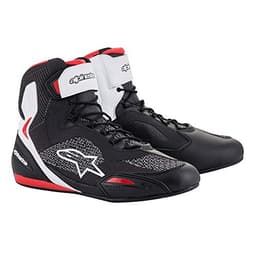
Certified in a shoe profile
Alpinestars Faster-3 Rideknit
CE EN 13634:2017A riding shoe that carries Alpinestars' own CE EN 13634:2017 statement — which almost nothing that looks like a trainer does. Microfiber upper, TPR heel counter, 3D mesh lining and a replaceable EVA footbed. The honest pitch: the certified shoe you will actually put on for a ten-minute ride.
See it ranked against the restPrice as of October 17, 2026. #ad How we’re funded
EN 13634:2017 vs EN 13634:2010
If a label reads 2010 rather than 2017 it is the older edition of the same standard, and the most visible change between them is the first digit: the 2017 edition made the upper’s height an explicit category on the label. Older stock is not unsafe for being marked 2010 — it is older stock, tested against the requirements in force when it was certified. What it does tell you is that the boot’s design is probably not current, which matters more for a membrane or a sole compound than for the leather.
What to do with all this at the checkout
- Look for “EN 13634” with a year.On the maker’s own product page, not just in the marketplace title. That single string separates five boots from eleven in our registry.
- If the four digits are published, read the fourth one. Abrasion and cut get the attention, and transverse rigidity is the test that corresponds to the most common real event — a bike landing on a foot that is still on the peg.
- Do not read the absence of a certificate as the absence of protection. Eleven boots we track publish nothing, and several are properly built. Judge construction: shaft height above the ankle bone, a stiffened heel counter, a lateral ankle guard, a reinforced shift pad, an oil-resistant sole.
- Never pay a certified-boot premium for an uncertified boot. In this category price does not predict disclosure, and the cheapest boot on this site publishes the most. Check the label before you accept the price.
If you are buying a first pair, our beginner boots page applies all of this to the six boots worth starting with. Are motorcycle boots necessary makes the case for having any at all, and how long gear lasts covers when a certified boot stops being one.
How to read our safety notes. We have not crash-tested any of this gear — nobody honestly can on a review budget. Every helmet and armor pick names the certification the maker publishes (DOT, ECE 22.06, SNELL, or a CE level), which we read from the listing on a dated visit. Certification is the floor, not a guarantee; fit and condition matter as much as the sticker. What the standards actually mean.
Frequently asked questions
What does EN 13634 mean on motorcycle boots?
EN 13634 is the European standard for motorcycle protective footwear. A certified boot has been tested on upper height, impact abrasion resistance, impact cut resistance and transverse rigidity, and the result is printed as a pictogram plus up to four numbers on a label inside the boot — usually on the lower part of the tongue. Each test is scored separately at Level 1 (the basic pass) or Level 2 (the higher pass), so one boot can hold different levels across the four. The current edition is marked EN 13634:2017; older product reads EN 13634:2010.
What do the four numbers on a motorcycle boot label mean?
They are four separate results in a fixed order: the first is the upper's height, the second is impact abrasion, the third is impact cut, the fourth is transverse rigidity. A 1 is the basic pass for that test and a 2 is the higher pass. So a boot marked 1-2-2-1 has a short upper, the higher level on abrasion, the higher level on cut and the lower level on sole rigidity. Because each test is evaluated individually, the four digits are much more informative than the phrase 'CE certified' on its own — and in our registry exactly one boot of 17 publishes all four.
Are motorcycle boots required to be CE certified in the US?
No. There is no US standard for motorcycle footwear — nothing equivalent to DOT FMVSS 218, which every street helmet sold here must meet. EN 13634 is a European standard, mandatory for sale as protective equipment in that market and entirely voluntary here. Some makers certify their US-market boots to it anyway and say so; most do not mention it. That is why a published EN 13634 mark is a genuine signal rather than a box everyone ticks.
Is a Level 2 boot better than a Level 1 boot?
On that one test, yes — and it is not a general quality score. Level 2 requires more from the boot on whichever test carries the 2: longer survival against the abrasion rig, less blade penetration on the cut test, more load before the sole deforms. The cost is almost always weight, stiffness and price, which is why plenty of good touring boots sit at Level 1 across the board. The honest framing is that Level 1 is the standard's minimum useful protection and Level 2 is the higher tier, and a Level 1 boot you wear every ride protects you more than a Level 2 boot you leave at home.
Why do so few motorcycle boots publish a CE rating?
Because nothing in the US market asks them to. Certification costs money and testing time, and a maker selling into a market with no footwear standard and no retailer requirement gets no commercial return for it. The result shows up clearly in our own numbers: of 17 boots we track, five name EN 13634, one more says only 'CE certified' without naming a standard, and eleven publish nothing at all. It is the same pattern as gloves, where 4 of 24 publish EN 13594, and jackets, where 2 of 27 publish an EN 17092 class.
What do the IPA, IPS and WR marks mean on a boot?
They are optional extras that sit alongside the four main digits when a maker chooses to have them tested. IPA is ankle impact protection, IPS is shin impact protection, and WR indicates water resistance. Treat them the way you treat the main levels: useful when published, and absent far more often than not. If a boot's marketing talks about an 'ankle protector' but the label carries no IPA mark, what you have is a hard plastic cup that has not been tested as impact protection — which is not the same thing as useless, just untested.
Does EN 13634 test whether a boot is waterproof?
Only as an optional extra, marked WR, and that is water resistance rather than a membrane guarantee. The four core tests are purely mechanical: height, abrasion, cut and rigidity. A boot can be fully certified and soak through in twenty minutes of rain, and a boot with a GORE-TEX or Drystar membrane can carry no certification at all. Read the two claims separately — our waterproof boots page covers the membrane side.
Should I buy an uncertified boot?
Often you will have to, because eleven of the seventeen boots we track publish nothing. When there is no certificate, judge the construction instead: a shaft above the ankle bone, a stiffened heel counter, a lateral ankle guard, a reinforced shift pad on the left instep, an oil-resistant sole, and — the spec almost nobody publishes — a transverse stiffener in the sole. What we would not do is pay a premium for an uncertified boot when a certified one sits at the same price, which happens more often in this category than you would expect.
Sources
- Dainese — How does certification for motorcycle shoes and boots work? — A manufacturer's own explainer of the standard it certifies to. Dainese publishes: "Motorcycle footwear is certified according to European standard EN13634, which provides two levels of certification"; the symbol sits "on the lower part of the tongue" and "indicates the reference standard and the final level"; the four numbers read, in order, upper HEIGHT, impact ABRASION level, impact CUT level and TRANSVERSE RIGIDITY level, and "Each test is evaluated individually" so one boot can hold different levels across the four. The numeric thresholds Dainese publishes: impact abrasion "To achieve level 1 certification, the sample has to last at least 5 seconds; for level 2, 12 seconds"; impact cut "No more than 25 mm for level 1 certification, no more than 15 for level 2". It describes the abrasion rig as 60-grit sandpaper simulating asphalt, the cut test as a blade dropped at 2.8 m/s, and transverse rigidity as sole deformation measured under a press. Other manufacturer documents quote lower abrasion seconds because EN 13634 tests two zones of the boot separately — which is why this page attributes the figures to Dainese rather than asserting them as the standard's own numbers (accessed October 15, 2026)
- Alpinestars — SMX-1 R V2 Boots (maker's product page) — Alpinestars' own certification statement, verbatim: "According to European statutory law the CE mark is a conformity requirement for the marketing of this product." and "The following standards apply: CE EN13634:2017." Published construction: "lightweight and abrasion-resistant microfiber upper" reinforced with strategically placed TPU protectors; "External, high modulus TPU heel counter, lateral ankle and shift pad"; microfiber instep and Achilles accordion flex zones; a rubber compound sole with an "integrated Alpinestars TPF (Transversal protection Frame)" against transverse loads; thermowelded flex grooves; a front Velcro closure over the instep with aramidic-fiber strap wires and a TPR puller; and a reverse zip entry. Sizes UK 4.5-13.5 / EU 38-50. Alpinestars publishes the STANDARD and not the four EN 13634 performance levels, and publishes no ventilation or perforation spec even though the US retail listing calls the boot "Vented" (accessed October 15, 2026)
- Alpinestars — Faster-3 Rideknit Shoes (maker's product page) — Alpinestars' own certification statement for the riding shoe, verbatim: "According to European statutory law the CE mark is a conformity requirement for the marketing of this product." with "The following standards apply:" listing "CE EN13634:2017". Published construction: "Upper constructed from a superbly lightweight, durable and abrasion-resistance microfiber"; a breathable 3D mesh lining with anti-slip micro-suede at the heel; a TPR heel counter "to add side support and stability"; and a replaceable, anatomically shaped EVA footbed with a Lycra top. Closure is laces plus a hook-and-loop ankle strap. Sizes 6 to 14 in whole and half sizes. What Alpinestars does NOT publish for this model, and the reason the page says so: no ankle protector, no shift pad, no sole material and none of the four EN 13634 performance levels (accessed October 15, 2026)
- MotoCAP — Independent Motorcycle Clothing & Helmet Assessment — Independent Australian lab rating protective clothing and helmets for protection and comfort (accessed July 21, 2026)
Keep reading
Best motorcycle boots for beginners
The certified boots worth a first purchase, ranked on what the maker publishes rather than on styling.
See the beginner picksCE armor ratings explained
EN 1621-1 to -4, Level 1 versus Level 2, and why a foam pad in a pocket is not armor.
Read the armor guideGlove CE ratings explained
EN 13594 and the KP suffix — the hand standard, and the one with the worst disclosure rate of all.
Read the glove guideCE clothing classes explained
AAA, AA, A, B and C on a jacket or pant, and how the garment class differs from the armor inside it.
Read the clothing guideAre motorcycle boots necessary?
The case for boots over sneakers, and what a low-speed drop actually does to an ankle.
Read the guideBest motorcycle boots
The main ranking across every price band, with the certification each maker publishes stated per boot.
See the main ranking