Do You Need a Chest Protector for Street Riding?
Most of what is sold as a chest protector is a roost deflector certified to EN 14021 — a stone-shield test, not an impact test. Only 2 of the 36 armor pieces we track publish an EN 1621-3 chest impact rating. Here is how to tell them apart.
How this is funded: we earn a commission if you buy through our links, at no extra cost to you. It never changes which gear we recommend, and we’ll tell you plainly when to skip a pick. Full disclosure.
Our answer: a chest protector is worth buying for fast-road and mixed-surface riding, after a helmet, a certified jacket and a back protector — and the only thing that makes it worth buying is a published EN 1621-3 rating. If you take one sentence from this page, take this one: most products shaped like chest protectors are roost deflectors certified to EN 14021, which is a test against flung stones, not against impact. In our registry of 36 armor pieces, exactly 2 publish an EN 1621-3 chest impact rating.
That is not a complaint about the products. A roost deflector is excellent at its job and dirt riders should own one. It is a complaint about how they are sold: the words “CE certified” and “chest protector” appear on items that have never been impact-tested, and a street rider reading the listing has no way to tell without knowing which standard to look for.
The three standards you will see, and what each one tests
| Standard | What it tests | What it tells a street rider |
|---|---|---|
| EN 1621-3 | Chest IMPACT. The piece is struck and graded on transmitted energy, Level 1 or Level 2 | This is the one you want. It is the only chest standard that measures impact |
| EN 14021 | Stone shield. Resistance to flung stones and lofted debris at speed | Roost protection for riding behind other bikes off-road. Not impact protection |
| EN 1621-4 | The airbag test method, for inflatable systems rather than foam or plastic | A different product class entirely — see our airbag vest page |
There is a fourth thing you will see, and it is the weakest: “CE Level 2” with no standard named. The levels only mean something inside a standard, so a level with no standard beside it has not told you which test was passed. Our CE armor ratings guide goes through each number properly, and 5 of the 36 armor pieces in our registry are in exactly this position.
Where a chest protector sits in the buying order
- Helmet.Legally required for sale to meet DOT FMVSS 218, and the one piece nobody argues about. Our helmet ranking is the start.
- A jacket with armor in it. Abrasion first, then shoulder and elbow impact. Jackets with armor included covers the shortcut.
- A certified back protector.The cheapest large gain available to almost every rider, because the pad in your jacket’s back pocket is usually uncertified foam. The back protector ranking is here.
- Gloves and boots. Hands and ankles are involved in nearly every fall.
- Chest protector.Now — and sooner than this if you ride fast roads, ride off pavement, or ride with a group where someone else’s mistake can become yours.
The reason chest protection ranks below the back is not that ribs do not matter. It is that the back protector is cheaper, fits a pocket you already have, and protects a structure with no redundancy at all. Our armor hub ranking follows the same order, and the beginner gear guide works it out by budget.
The two pieces that publish a chest impact rating
Both are drawn from our chest protector ranking. The first is the one to buy for road use; the second is the honest hybrid for riders who need roost cover as well.
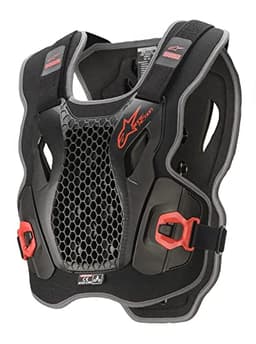
Published EN 1621-3 Level 1 chest rating
Alpinestars Bionic Action Chest Protector
CE EN 1621-3 Level 1 (chest) + EN 1621-2 Level 1 (back)One of the few affordable chest protectors with a real street IMPACT rating — CE EN 1621-3 Level 1 at the chest and EN 1621-2 Level 1 at the back — rather than only roost protection. The difference matters, and most 'chest protectors' don't clear this bar.
See the full chest protector rankingPrice as of October 17, 2026. #ad How we’re funded
CE EN 1621-3 Level 1 at the chest and EN 1621-2 Level 1 at the back, in a harness worn over a base layer under a jacket. Level 1 rather than Level 2 at both ends, and it adds a layer of heat in summer — but a published chest impact rating at this price is rare.
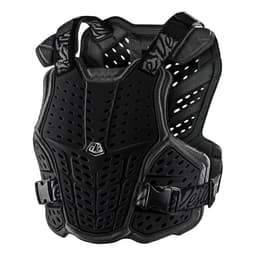
Roost plate plus a rated back insert
Troy Lee Designs Rockfight CE Chest Protector
CE EN 14021 (roost) + D3O back exceeds EN 1621 Level 1A roost-and-impact hybrid: an EN 14021 stone-shield front plate for debris, plus a flexible D3O back insert that exceeds CE EN 1621 Level 1 for impact. Best for adventure and off-road riders who take real hits from roost and terrain.
Compare the hybridsPrice as of October 17, 2026. #ad How we’re funded
An EN 14021 stone-shield front plate for debris plus a flexible D3O back insert that exceeds CE EN 1621 Level 1 for impact. Note precisely what that means: the front plate is roost-rated, not chest-impact-rated. It is the right product for adventure and off-road riders who take real hits from roost and terrain, and the wrong one if your only goal is chest impact protection on the road.
What we would not buy for the street
A vented plastic roost deflector, as chest protection. There is one in our registry and we rank it honestly: it carries EN 14021 for roost and debris and no EN 1621-3 impact rating, which we state on the product itself. It is light, well-vented, cheap and right for dirt. Buying it to protect your sternum on a canyon road is buying the wrong tool.
Anything whose only claim is “CE approved”. Ask which standard and which level. If the listing cannot answer, you are being sold a mark rather than a measurement — and in a category where the difference between two standards is the difference between stones and impact, that matters more than usual.
A hard-shell off-road vest to wear under a road jacket. It will not fit, and forcing it in moves your jacket’s own armor out of position. How gear should fit covers why that undoes protection you have already paid for.
How to read our safety notes. We have not crash-tested any of this gear — nobody honestly can on a review budget. Every helmet and armor pick names the certification the maker publishes (DOT, ECE 22.06, SNELL, or a CE level), which we read from the listing on a dated visit. Certification is the floor, not a guarantee; fit and condition matter as much as the sticker. What the standards actually mean.
Frequently asked questions
Do you need a chest protector for street riding?
It is not the first thing to buy and it is not a gimmick either. The order we would use is helmet, then a certified jacket, then a CE EN 1621-2 back protector, then gloves and boots, then a chest protector. Chest and rib injuries are common in motorcycle crashes and nothing else in a normal kit covers the sternum and ribs — but a back protector covers the spine, costs less and fits in a pocket your jacket already has, so it comes first.
What is the difference between EN 1621-3 and EN 14021?
They test completely different things. EN 1621-3 is the CE chest IMPACT standard: the piece is struck and measured on how much energy it transmits, with Level 1 and Level 2 pass grades. EN 14021 is the stone-shield standard — it tests resistance to flung stones and lofted debris, which is the roost thrown up by the bike in front of you off-road. A roost deflector certified to EN 14021 is doing a real job, and it is not the job of absorbing an impact.
Is a roost deflector the same as a chest protector?
No, and this is the single most common mistake in this category. Many vented plastic shells sold as 'chest protectors' are certified only to EN 14021 for roost and debris and carry no EN 1621-3 impact rating at all. For dirt riding behind other bikes they are exactly the right product. For street riding they give you very little of what you think you are buying — check the product for the string 'EN 1621-3' before you treat it as impact protection.
Does an airbag vest replace a chest protector?
It covers the same area by a different mechanism, and in most cases it covers more. Airbag systems publish performance against EN 1621-4, the airbag test method, and current vests inflate across the chest, back, shoulders and neck area. The trade-offs are cost — many times a passive chest protector — and that it has to be charged, worn correctly and replaced or serviced after a deployment. If you are choosing between them on price, a certified passive protector now beats an airbag you intend to buy next year.
Will a chest protector fit under a normal motorcycle jacket?
The harness style will, if the jacket has room; a full off-road vest with a hard outer shell often will not. Harness-type protectors are designed to be worn over a base layer and under a jacket, which is why both of the impact-rated pieces we rank are that shape. The thing to check is that adding one does not push your jacket's own shoulder and elbow armor out of position — gear is sized for the armor it ships with.
Do any jackets come with chest armor?
A few, usually as empty chest pockets rather than fitted armor, and almost none publish an EN 1621-3 rating for what goes in them. In our registry no jacket publishes a chest impact rating, which is why a chest protector is a separate purchase rather than a box to tick on a jacket. Check your jacket's inner front panels: if there are pockets there, an insert is cheaper and less bulky than a harness.
Is a chest protector worth it for commuting?
Lower priority than for fast roads, because the mechanism is different: a city crash is usually lower-speed with more chance of hitting something, while a fast-road crash is higher-energy and more likely to involve sliding and tumbling. If your commute includes highway miles, treat it like fast-road riding. If it is all 30 mph streets, spend the money on a certified back protector and good gloves first.
Sources
- NHTSA — Traffic Safety Facts 2023: Motorcycles (DOT HS 813 732) — 2023 motorcyclist fatality, injury and helmet-use statistics (accessed July 21, 2026)
- MotoCAP — Independent Motorcycle Clothing & Helmet Assessment — Independent Australian lab rating protective clothing and helmets for protection and comfort (accessed July 21, 2026)
- NHTSA — Motorcycle Helmet Effectiveness Revisited (DOT HS 809 715) — Helmets ~37% effective at preventing rider fatalities (accessed July 21, 2026)
Keep reading
Best chest protectors
The full ranking, with the EN 1621-3 and EN 14021 distinction stated on every entry.
See the rankingCE armor ratings explained
EN 1621-1, -2, -3 and -4, which body part each covers, and what Level 1 and Level 2 mean.
Read the ratings guideBest motorcycle armor
The hub ranking across back, chest, limbs and airbags, in the order we would buy them.
See the armor picksBest airbag vests
The other way to cover the chest, compared on what each maker publishes against EN 1621-4.
See the airbag picks