How to Choose Motorcycle Boots
Ankle protection, sole stiffness, height and closure — what actually decides whether a boot does its job, and why 'sturdy work boots' aren't the shortcut people think.
How this is funded: we earn a commission if you buy through our links, at no extra cost to you. It never changes which gear we recommend, and we’ll tell you plainly when to skip a pick. Full disclosure.
Boots are the piece of gear riders postpone longest. A helmet is obviously necessary, a jacket is obviously necessary, and boots feel like the thing you can put off because you already own shoes. The problem is that feet and ankles are involved in a large share of motorcycle injuries, they are what the bike lands on, and an ankle is a joint that does not tolerate being pushed past its range.
This guide is what to look for, in the order that actually decides whether a boot works. None of it requires a certification to be published, which is fortunate, because for most boots sold in the US none is.
1. Ankle protection
The ankle bones — the malleoli, the knobs on each side of the joint — sit right at the surface with almost nothing over them. A proper motorcycle boot has a shaped cup, plate or dense padded panel over each one. Run your thumb over the inside and outside of the ankle area: if there is nothing there but soft leather, the boot is a leather boot, not a motorcycle boot.
The other half of ankle protection is stopping the joint rotating past its limit, which is a job for the sole and the shaft rather than for padding.
2. Torsional stiffness — the test you can do in the shop
Hold the boot with one hand at the heel and one at the toe and try to twist it, like wringing out a cloth. A sneaker twists easily. A hiking boot twists a fair amount, because walking requires it. A motorcycle boot should strongly resist that motion, because that motion is what happens to your foot when it is trapped between a peg and the road.
Then try to bend the sole side to side and fold it in half lengthwise. A motorcycle boot should feel stiff in both. Some flex at the ball of the foot is necessary — you have to be able to walk and to feel the shifter — but a boot you can roll into a tube is a boot with no structure.
3. Heel and toe box
Both should be reinforced. The toe box because the front of the foot is what a bike lands on and what catches on things, and the heel because a collapsed heel counter lets the boot deform and come off. Squeeze the toe area between finger and thumb: it should not collapse. Push into the back of the heel: it should feel like there is a cup in there.
Look also for a shift pad on the left toe. It is a small piece of reinforcement that stops the shifter wearing a hole in the boot, and its absence is a reliable sign a boot was not designed for riding.
4. Height, and being honest about walking
More height means more coverage and less walkability, and the right answer depends entirely on the ride, not on the theory:
- Riding shoes / low boots. Ankle coverage only just above the joint, ordinary-looking, walkable all day. The right choice for short commutes and for anyone whose realistic alternative is sneakers.
- Mid-height sport and touring boots. The default. Well above the ankle, with a shin section, and still fine to walk around a fuel stop in. Most riders should start here.
- Tall adventure and off-road boots. Full shin coverage, serious crush protection, buckle closures. Genuinely uncomfortable to spend a day on foot in, though ADV boots are far more walkable than motocross ones.
5. Closure
A boot has to stay on. Laces alone are a poor motorcycle closure — they can come undone and they can catch on the bike — which is why laced motorcycle boots almost always have a covering flap or an additional strap. Zips are quick and are the norm on sport and touring boots, but a zip on its own is a single point of failure, so look for a velcro storm flap over it. Buckles and ratchets on ADV boots are the most secure of the lot and the slowest to use.
Whatever the system, check it does up firmly around the ankle rather than just around the calf. That is what stops the boot being dragged off.
6. Waterproofing — and its cost
A waterproof-breathable membrane will keep your feet dry in sustained rain in a way that treated leather will not, and cold wet feet are the most reliable way to cut a ride short. The trade is warmth: a membrane is a layer, so a waterproof boot runs hotter and breathes less than an unlined or vented one. If you ride year-round in a mixed climate, buy waterproof and accept the summer penalty. If you ride hot and dry, buy vented. Our waterproof boots page goes through the constructions and the failure modes.
7. Sizing and break-in
Try boots on late in the day, with the socks you will ride in, and stand up in them. You want no heel lift, toes not touching the end, and no pressure point across the top of the foot. Leather boots soften and mold with wear; they do not get longer. Synthetic and ADV boots barely break in at all, so what you feel in the shop is close to what you get.
Sizing is inconsistent across brands, and some of the boots we cover run large or run stiff when new. We carry each maker’s own fit note on the product rather than a generic sizing rule, because a rule that works for one Italian brand will not work for an American one.
Three boots, three answers
These are the three shapes this decision usually takes. Each links to the full ranking it comes from.
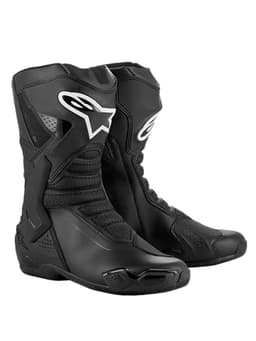
The do-everything boot
Alpinestars SMX-6 V3
The do-everything sport-touring boot: ankle and shin protection, a locking heel/toe structure and enough comfort to walk in. The default upgrade from sneakers for street riders.
Compare all the boot picks →Price as of October 18, 2026. #ad How we’re funded
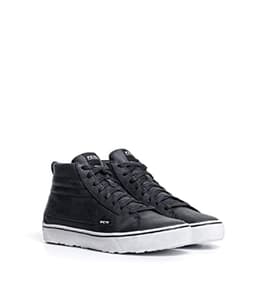
The commuter boot
TCX Street 3 Waterproof
A waterproof riding shoe that looks like a sneaker — ankle armor and a reinforced structure hidden under casual styling. The commuter pick for riders who walk into an office at the other end.
Compare the waterproof picks →Price as of October 18, 2026. #ad How we’re funded
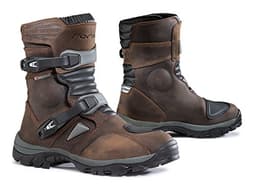
The adventure boot
Forma Adventure Boots
The value adventure-touring boot a lot of ADV riders settle on: tall protection, a walkable sole and a waterproof membrane, without the four-figure price of a hardcore off-road boot.
Compare the ADV picks →Price as of October 18, 2026. #ad How we’re funded
What to buy if the budget is tight
A cheap boot that covers the ankle, resists twisting and does up firmly beats an expensive one you have not bought yet. There is a real floor below which boots stop being boots — unbranded footwear with soft soles and no ankle structure — but above it, the difference between a budget riding boot and a premium one is mostly comfort, waterproofing and lifespan rather than a cliff in protection. Our budget boots page is where that floor sits.
And if boots are competing with other gear for the money, our beginner gear guide sets out the buying order we would actually recommend: helmet, gloves, jacket, boots, back protector. If you have not yet decided that boots belong on that list at all, are motorcycle boots necessary? makes the case honestly, including the parts of it that argue for a riding shoe instead.
How to read our safety notes. We have not crash-tested any of this gear — nobody honestly can on a review budget. Every helmet and armor pick names the certification the maker publishes (DOT, ECE 22.06, SNELL, or a CE level), which we read from the listing on a dated visit. Certification is the floor, not a guarantee; fit and condition matter as much as the sticker. What the standards actually mean.
Frequently asked questions
Why can't I just wear work boots or hiking boots?
Because they are built to flex. A work boot or hiking boot is designed so your foot can roll through a stride, which is exactly the movement a motorcycle boot is designed to resist. A motorcycle boot adds a torsionally stiff sole so the foot cannot twist past its range, a reinforced heel and toe box against crushing, and ankle protection at the malleolus. A tall leather work boot does give you more coverage than a sneaker, so it is not nothing — but the specific injuries motorcycle boots exist to prevent are ones work boots do not address.
Are motorcycle boots CE certified?
The European standard is EN 13634, and it is not required for sale in the US, so most boots sold into this market publish no certification at all. Where a maker states CE certification for a specific model we quote it; where they do not, we report 'Check current listing' rather than assuming a level. In the absence of a rating, judge a boot on structure: reinforced heel and toe, ankle protection, sole rigidity and a closure that will not come undone in a slide.
How tall should motorcycle boots be?
Above the ankle, at minimum — a boot that stops below the ankle bone leaves the joint it is supposed to be protecting exposed. Mid-height touring boots are the sensible default for most road riding: they cover the ankle, tuck under a trouser cuff and remain walkable. Tall adventure and off-road boots add shin coverage and far more crush protection, at a real cost in comfort off the bike. Low riding shoes are a genuine compromise, and worth it only if the alternative is that you would wear sneakers instead.
Should motorcycle boots be tight?
Snug, with room for your toes and no heel lift. A boot that slips at the heel will rub, and a boot that is loose enough to move can be pulled off in a slide. Try them on late in the day with the socks you will actually ride in, and remember that most leather boots break in and soften slightly while very few of them stretch in length. If you are between sizes, most makers' fit notes tell you which way to go — we quote each maker's own note rather than a generic rule.
Do I need waterproof motorcycle boots?
If you commute or tour, they are one of the highest-value comforts in motorcycle gear — cold water in a boot at speed ends rides. If you ride in the dry by choice, a vented boot is cooler and breathes better. The distinction to watch is between a membrane-lined boot, which stays waterproof in sustained rain, and treated leather, which is water-resistant and eventually wets through. Both get advertised as waterproof.
How long do motorcycle boots last?
Longer than most riding gear, and they usually fail at the parts rather than the boot: soles wear through, zips give up, and gear-shift pads abrade away on the left toe. Many good boots can be resoled, and a shift pad is a cheap replacement. Replace a boot outright when the structure is compromised — a cracked ankle cup, a heel counter that has collapsed, or an upper that has torn away from the sole.
Sources
- NHTSA — Traffic Safety Facts 2023: Motorcycles (DOT HS 813 732) — 2023 motorcyclist fatality, injury and helmet-use statistics (accessed July 21, 2026)
- MotoCAP — Independent Motorcycle Clothing & Helmet Assessment — Independent Australian lab rating protective clothing and helmets for protection and comfort (accessed July 21, 2026)
- NHTSA — How to Choose the Right Motorcycle Helmet — NHTSA consumer guidance on DOT certification and spotting novelty helmets (accessed July 21, 2026)
Keep reading
Best motorcycle boots for beginners
This guide applied to a first purchase — six boots ranked on published certification, not styling.
See the beginner picksBest motorcycle boots
Our top all-round picks, from sport-touring boots to waterproof commuter shoes.
See the boot picksBest waterproof motorcycle boots
Membrane and treated-leather boots compared — and what actually keeps water out on a four-hour ride.
See the waterproof picksBest adventure & touring boots
Tall, waterproof, walkable boots for riders who ride and hike in the same day.
See the ADV picksBeginner motorcycle gear: head-to-toe
What to buy first as a new rider, by budget, with one certified pick per category.
Read the beginner guide