How Motorcycle Airbag Vests Work
Tethered against electronic, what EN 1621-4 actually covers, what happens after it fires, and the honest answer to whether one is worth the money.
How this is funded: we earn a commission if you buy through our links, at no extra cost to you. It never changes which gear we recommend, and we’ll tell you plainly when to skip a pick. Full disclosure.
Airbag vests are the most significant thing to happen to motorcycle protective gear in decades, and they are also the piece of gear people understand least — partly because the marketing is loud, partly because two completely different technologies are sold under the same name, and partly because the certification picture is genuinely complicated.
This guide explains the mechanism, the two triggering systems, what the European standard does and does not cover, what happens after one fires, and the honest answer to whether one belongs in your gear before other things do.
The mechanism
An impact injures you because energy is transferred into your body over a very short distance and a very small area. Every piece of protective equipment ever made attacks one of those two variables: spread the load over more area, or stretch the event over more distance and therefore more time.
A helmet does it with a crushable EPS liner. A back protector does it with a viscoelastic pad. An airbag does it by inflating a cushion around your torso in the fraction of a second before you land, which does three things at once:
- Adds distance. There is now several centimeters of gas between you and whatever you hit, so the deceleration happens over a longer stroke.
- Spreads load. A pressurized bladder distributes force across the whole covered area rather than concentrating it where you landed.
- Adds rigidity where you want it.An inflated collar and torso structure resists the neck and spine being forced past their range — and that is arguably the biggest benefit, because it addresses an injury mechanism padding cannot.
None of that is speculative. It is the same principle as a car airbag, applied to a body that is not held in a seat.
Tethered: mechanical, cheap, no batteries
A tethered vest clips to the bike with a coiled lanyard. When you and the bike separate far enough, the lanyard pulls a ball-and-socket pin, which punctures a small CO2 cartridge, which inflates the vest. That is the whole system. No electronics, no firmware, nothing to charge, and nothing that can decide incorrectly.
Strengths: simple, comparatively inexpensive, reliable in the specific scenario it is designed for, and reset with a cheap cartridge you can usually fit yourself. Tethered vests are also the ones most likely to carry outright CE EN 1621-4 certification, because that standard was written around mechanical triggering.
Weaknesses:you have to clip in every ride and unclip every time you get off, which is a habit that takes a while and which produces the classic accidental deployment when you forget. It also cannot help before separation — if you are still on the bike when you hit something, the tether has not pulled.
Electronic: sensors, algorithms and a battery
An electronic vest carries accelerometers, gyroscopes and a processor running a crash-detection algorithm. It watches the motion signature of the ride continuously and fires when the pattern matches a crash rather than a pothole, a hard stop or a bumpy road. No cable, nothing to clip, and it can inflate while you are still on the bike.
Strengths: nothing to remember, covers scenarios a tether does not, and it can begin inflating earlier in the event. Wearable under or over a jacket depending on the model.
Weaknesses: it needs charging, so a flat vest is an expensive gilet. It must make a decision from motion data, which is a harder problem than pulling a pin. And it typically states that it meets the impact-performance thresholds of EN 1621-4 rather than being certified to the standard, for the reason in the next section.
The certification picture, stated plainly
CE EN 1621-4:2013 is the European standard for inflatable motorcycle protectors. It defines how an inflatable protector is tested and what impact performance it must deliver, and it was written around mechanically-triggered systems. It has not been revised to cover electronic triggering.
The practical consequence is the sentence you will see on product pages and may not have understood: tethered vests are commonly certified to EN 1621-4 outright, while electronic vests generally state that they meet its impact-performance levels. Both statements can be entirely true. They are not the same statement, and a page that treats them as interchangeable is not telling you something you should know.
This is the same principle as the rest of our armor coverage: we report the certification the maker publishes for that exact product, on a dated visit, and where they publish nothing we say so. Our CE armor ratings guide covers how EN 1621 works across the rest of the armor categories.
What happens after it fires
The vest deflates itself within seconds — it is protecting you during the impact and the tumble, not holding you inflated afterwards, and staying inflated would make it harder to get you out of.
Then it needs resetting. On a tethered vest that means a new CO2 cartridge and re-packing the bladder, which is a user job on most models and inexpensive. On an electronic vest it means a new gas generator, which depending on the maker is either a cartridge you can swap or a return-to-service. Some brands include a number of free deployments; some sell the vest on a subscription that covers it. This is a real ownership cost and it should be part of the buying decision, not a surprise afterwards.
Where an airbag belongs in your gear priorities
Honestly: not first. The order we recommend elsewhere on the site holds here — a certified helmet that fits, then gloves, then a jacket with real CE armor, then boots, then a rated back protector. An airbag vest is a genuine step beyond all of that, and it costs more than most of it combined.
Where it makes the most sense: riders doing high mileage, riders doing track days, riders on fast roads, and riders who have already sorted every cheaper layer of protection. Where it makes least sense: as a substitute for gear you have not bought yet. An airbag over a jacket with empty armor pockets is a strange allocation of money, and a CE Level 2 insert in that empty pocket is a fraction of the cost.
The two systems, in products
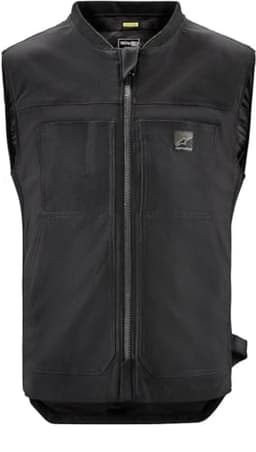
The electronic route
Alpinestars Tech-Air 3 V2 Canvas
Airbag Level 2 impact performance (EN 1621-4 test method)An electronically-triggered airbag vest you wear over or under a jacket, with no subscription and no tether to the bike. Alpinestars states it meets the EN 1621-4 airbag Level 2 impact requirement across both full chest and full back.
Compare all the airbag picks →Price as of October 18, 2026. #ad How we’re funded
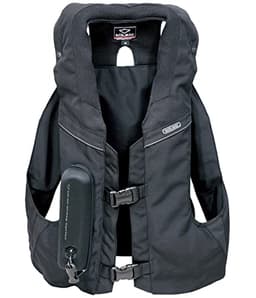
The tethered route
Hit-Air MLV2
CE EN 1621-4:2013 (Level 1, back)A mechanically-triggered airbag vest: a coiled tether clips to the bike, and separating from the bike pulls the CO2 cartridge. No electronics, no charging, and certified to EN 1621-4:2013 — Level 1 at the back.
See where it ranks →Price as of October 18, 2026. #ad How we’re funded
Three things to check before you buy one
- What it covers. Chest and back? Neck and collarbones? Does it include a rated back protector or does it expect you to keep wearing one? Coverage varies more between models than the category name suggests.
- How it is worn.Over a jacket, under a jacket, or either. A vest designed to be worn under a fitted jacket needs room in that jacket to inflate into — buying one for a snug leather jacket is a mistake people make.
- What resetting costs. Cartridge price, whether you can fit it, and whether deployments are included. Ask before, not after.
How to read our safety notes. We have not crash-tested any of this gear — nobody honestly can on a review budget. Every helmet and armor pick names the certification the maker publishes (DOT, ECE 22.06, SNELL, or a CE level), which we read from the listing on a dated visit. Certification is the floor, not a guarantee; fit and condition matter as much as the sticker. What the standards actually mean.
Frequently asked questions
Do motorcycle airbag vests actually work?
The mechanism is sound and it is the same one used in car airbags: inflate a cushion before the impact so the deceleration happens over a longer distance and a larger area, and add rigidity around the neck, collarbones, ribs and spine. What we will not do is hand you an effectiveness percentage — unlike helmets, where NHTSA has published fleet-wide figures from crash data, there is no comparable independent US dataset for motorcycle airbag vests. What can be verified is what a specific vest is certified to and what impact-performance level the maker publishes for it, and that is what we report on each product.
What is the difference between a tethered and an electronic airbag vest?
A tethered vest connects to the bike by a lanyard. When you and the bike separate far enough, the lanyard pulls a pin, a CO2 cartridge fires, and the vest inflates. It is purely mechanical: no battery, no software, nothing to charge or update. An electronic vest uses sensors and an algorithm to detect a crash and fires itself. It has no cable to forget, works when you are thrown clear in ways a tether might not catch, and can trigger before you have separated from the bike — but it needs charging, and it has to decide, from motion data alone, that what just happened was a crash.
What is EN 1621-4 and are electronic vests certified to it?
CE EN 1621-4:2013 is the European standard for inflatable motorcycle protectors. It was written around mechanically-triggered systems and has not been revised to cover electronic triggering. That is why you will typically see tethered vests certified to it outright, while electronic vests state that they meet its impact-performance thresholds rather than claiming full certification to the standard. We report that distinction on every airbag product rather than smoothing it over, because it is a real difference in what has been independently assessed.
What happens after an airbag vest goes off?
It deflates on its own within a few seconds — it is not designed to keep you inflated. After that, a tethered vest needs a new CO2 cartridge, which you can usually fit yourself and which is inexpensive. An electronic vest needs the gas generator replaced, and depending on the maker that is either a user-replaceable cartridge or a return-to-service job. Budget for it: an airbag you cannot afford to reset is an airbag you will be tempted to keep riding without.
Can an airbag vest go off accidentally?
A tethered one can, and it is the classic user error: getting off the bike with the lanyard still clipped on. Most have a quick-release specifically to stop this, and it takes a couple of rides to build the habit. Electronic systems are designed to distinguish a crash from ordinary riding — hard braking, potholes, wheelies and dropping the bike at a standstill should not fire them — and false positives are rare rather than impossible.
Do I still need a back protector if I have an airbag vest?
Check what the vest covers. Some airbag vests include a rated back protector as part of the garment, in which case that is your back protection. Others inflate around the torso without an EN 1621-2 back insert, and pair with one rather than replacing it. The two are complementary anyway: a back protector is a passive impact absorber that works every time, and an airbag has to detect and inflate first. If you can only have one, a CE Level 2 back protector is cheaper, simpler and always deployed.
Sources
- NHTSA — Traffic Safety Facts 2023: Motorcycles (DOT HS 813 732) — 2023 motorcyclist fatality, injury and helmet-use statistics (accessed July 21, 2026)
- MotoCAP — Independent Motorcycle Clothing & Helmet Assessment — Independent Australian lab rating protective clothing and helmets for protection and comfort (accessed July 21, 2026)
- NHTSA — Motorcycle Helmet Effectiveness Revisited (DOT HS 809 715) — Helmets ~37% effective at preventing rider fatalities (accessed July 21, 2026)
Keep reading
Best motorcycle airbag vests
Electronic and tethered airbags compared on what each one is actually certified to.
See the airbag picksBest motorcycle back protectors
CE EN 1621-2 Level 2 inserts and vests — the upgrade nearly every jacket needs, airbag or not.
See the back protector picksCE armor ratings explained
What EN 1621 actually measures, and why Level 2 isn't automatically the right answer.
Read the guideBest motorcycle chest protectors
The honest difference between roost deflectors and real impact protectors — and which is which.
See the chest picks