Motorcycle Gear for Hot Weather
How to stay covered when it's 100 degrees — what mesh actually does, why airflow stops helping above a certain temperature, and the head-to-toe kit that keeps ATGATT survivable.
How this is funded: we earn a commission if you buy through our links, at no extra cost to you. It never changes which gear we recommend, and we’ll tell you plainly when to skip a pick. Full disclosure.
Hot-weather gear is not really a comfort problem. It is a compliance problem. Every rider who quietly stops wearing a jacket does it in summer, and the reason is always the same: the gear they own is unbearable at 95 degrees in stop-start traffic. Solve that and ATGATT holds all year. Fail to solve it and the best jacket you own protects a wardrobe.
This is the head-to-toe version: what actually works, what the physics will and will not do for you, and the kit that makes riding covered in real heat a normal thing rather than an act of willpower.
The physics, briefly, because it changes what you buy
Air moving over you removes heat in two ways. Convection carries heat away when the air is cooler than your skin. Evaporation removes heat when sweat turns to vapor, and it does so regardless of air temperature as long as the air can absorb the moisture.
At 80 degrees, both are working and maximum airflow is straightforwardly the answer. Once the air is hotter than your skin — roughly the high 90s and above — convection reverses. The wind is now a fan heater. All you have left is evaporation, and blasting hot dry air across your skin dries the sweat off faster than it can cool you, which is why experienced riders in desert heat cover up rather than open up.
The practical consequences: below skin temperature, buy maximum airflow. Above it, buy airflow plus something wet, and drink constantly. Humidity wrecks the second strategy, because saturated air cannot take more moisture — which is why 90 degrees and humid feels far worse than 105 and dry.
Jacket: mesh, and where the mesh is
A mesh jacket has open panels the air goes straight through, and it is not close to any other construction for cooling. Perforated leather moves some air; a vented textile jacket with zip openings moves more; mesh moves the most by a wide margin.
What separates a good mesh jacket from a bad one is panel placement. The best ones keep solid, abrasion-resistant material at the shoulders, elbows and forearms — the parts that hit the road — and open up the chest, back and underarms where nothing is likely to make contact. A jacket that is mesh everywhere, including the impact zones, has traded away the thing you were buying.
Check for CE armor at shoulders and elbows in the box, and what is in the back pocket — foam or a rated protector. Our mesh jacket picks cover the category in full.
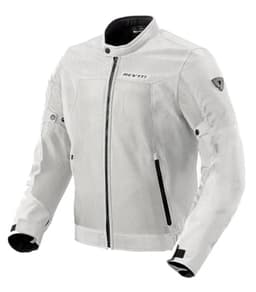
Hot-weather jacket
REV'IT! Eclipse 2 Mesh
The mesh jacket to beat for hot-weather value: huge airflow from a premium brand, CE armor at the shoulders and elbows included, and a back-protector pocket ready to upgrade. Genuinely breezy without feeling flimsy.
Compare all the mesh picks →Price as of October 18, 2026. #ad How we’re funded
Base layer: the counterintuitive one
Adding a layer under a mesh jacket makes you cooler, not hotter, for two reasons. A wicking synthetic or merino layer pulls sweat off your skin and spreads it across a larger surface where airflow can evaporate it, rather than letting it pool in the small of your back. And it stops you sunburning through an open-weave jacket, which happens more often than riders expect.
Cotton does the opposite of all this — it holds water against your skin, stays wet, and stops wicking entirely. The one summer garment worth never wearing under a riding jacket is a cotton t-shirt.
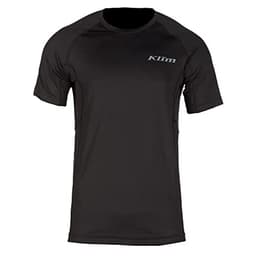
Cooling layer
KLIM Aggressor -1.0 Short Sleeve
A cooling base layer, not an armored one: KLIM's hot-weather fabric moves sweat off the skin so a mesh jacket can actually evaporate it. The unglamorous piece that makes summer riding bearable.
Compare the base-layer picks →Price as of October 18, 2026. #ad How we’re funded
Gloves: still gloves
Hands hit the ground first in the great majority of falls, and summer is exactly when riders talk themselves out of gloves. Vented and mesh short-cuff gloves with a hard knuckle are the standard hot-weather answer: they move real air across the back of the hand while keeping a doubled leather palm where the abrasion happens.
A short cuff is genuinely more comfortable in heat than a gauntlet — the wrist is open and there is no sleeve trapping air — and it goes on and off in seconds at every stop, which on a hot day is the difference between wearing gloves and carrying them. We have covered that trade on gauntlet vs short-cuff.
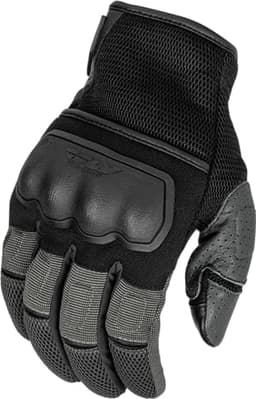
Hot-weather gloves
Fly Racing CoolPro Mesh
A mesh summer glove built for airflow first, with knuckle armor and touchscreen fingers, at a value price. The one to reach for when it's too hot for leather.
Compare the summer picks →Price as of October 18, 2026. #ad How we’re funded
Helmet: vents you can actually operate
The temptation in summer is to go open-face, and it is worth being honest about what that trades: the chin bar covers the part of your face most likely to hit first. A well-vented full-face with intake vents at the brow and chin and exhaust vents at the back moves a surprising amount of air, and the ones that work best are the ones whose vent sliders you can find and move with gloves on at speed.
Two summer-specific things: a Pinlock or anti-fog insert matters even in heat, because a humid day plus a stop at a light fogs a shield instantly; and a helmet liner you can remove and wash is worth more in July than any other month. Our ranking of the best helmets for hot weather works through all of that model by model — and starts by admitting that no maker publishes an airflow figure, so there is no number to sort them by. If you do want the open-face route, our open-face picks rank them honestly, including exactly what you give up.
Legs and feet, which everyone skips
Riding jeans with CE armor at the knees and hips are the realistic summer answer for legs — they breathe far better than textile overtrousers and they are wearable at the other end. They are hotter than ordinary jeans, and they are the difference between a graze and a skin graft. Our armored jeans page covers what is actually rated and what is merely reinforced.
For feet, a vented or perforated boot rather than a membrane-lined one. A waterproof boot is a warm boot by construction — the membrane is an extra layer that limits breathability — so if you own one pair of boots for the year, expect summer to be the season it is worst at.
An armored shirt: the hot-climate alternative
In genuinely extreme heat some riders switch to an armored base layer — a mesh shirt with CE-rated inserts at the shoulders, elbows, chest and back, worn under a light overshirt or on its own. It is not equivalent to a jacket: the shell fabric offers far less abrasion resistance. It is, though, a serious step up from a t-shirt, and it is the honest compromise for someone who would otherwise ride uncovered.
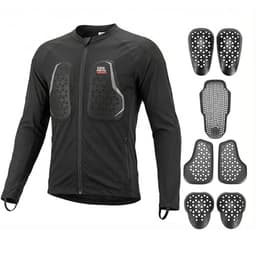
Extreme-heat option
KEMIMOTO Mesh Armored Shirt
CE Level 1 (listing)An armored mesh shirt you wear under a normal jacket — or on its own on the hottest days. The listing states CE Level 1 protectors at shoulders, elbows and back for under $80.
Compare the armored shirts →The non-gear half of the problem
- Drink before you are thirsty. Thirst lags dehydration, and dehydration degrades concentration and reaction time long before it feels serious. A hydration bladder in a small pack is the single most effective piece of hot-weather equipment there is, gear included.
- Ride the cool hours. Early morning and evening are dramatically better than the middle of the afternoon, and the traffic is usually better too.
- Stop more often, in shade. Heat load accumulates. A ten-minute stop out of the sun resets more than it costs.
- Watch for the warning signs. Stopping sweating, confusion, chills in heat, or a headache that appears mid-ride are reasons to get off the bike now, not at the next town.
How to read our safety notes. We have not crash-tested any of this gear — nobody honestly can on a review budget. Every helmet and armor pick names the certification the maker publishes (DOT, ECE 22.06, SNELL, or a CE level), which we read from the listing on a dated visit. Certification is the floor, not a guarantee; fit and condition matter as much as the sticker. What the standards actually mean.
Frequently asked questions
Are mesh motorcycle jackets safe?
A good one is a real riding jacket that happens to breathe. The protection in any textile jacket comes from the CE armor at shoulders and elbows plus the abrasion resistance of the shell, and mesh jackets carry the same armor as their solid equivalents — the panels between the reinforced areas are what has been opened up. What separates a good mesh jacket from a bad one is where the mesh is: the best ones keep solid, abrasion-resistant material at the shoulders, elbows and forearms and use mesh across the chest, back and underarms. A jacket that is mesh everywhere including the impact zones is a different and weaker product.
Does airflow still cool you when it's really hot?
Only up to a point, and it is worth understanding why. Moving air cools you two ways: by carrying heat away when the air is cooler than your skin, and by evaporating sweat. Once the air temperature climbs past skin temperature the first mechanism reverses — the airflow is now heating you — and you are relying entirely on evaporation. That is why riders in genuinely extreme heat sometimes do better in a lightly-vented jacket over a damp cooling layer than in maximum-airflow mesh, and why hydration matters more than gear once it gets that hot.
Can I ride in just a t-shirt when it's hot?
You can, and it is the trade most likely to be regretted. A t-shirt provides essentially no abrasion resistance and no impact protection, and the road surface on a hot day is hotter than the air. The point of hot-weather gear is that it makes the honest choice survivable: a mesh jacket with CE armor is dramatically cooler than a three-season jacket and dramatically more protective than a shirt. The failure mode we are designing around is not discomfort, it is a rider giving up on gear entirely in July.
Do cooling vests work?
Evaporative cooling vests do work, on the same principle as sweating: you soak them, wear them under a vented jacket, and airflow through the mesh evaporates the water and pulls heat with it. They work best in dry heat and hardly at all in high humidity, where the air cannot take more moisture. They need re-wetting at stops. A plain wicking base layer is the cheaper, always-useful version of the same idea — it moves sweat off your skin to where it can evaporate rather than pooling.
What about sunburn through a mesh jacket?
It is a real thing on light-colored, open-weave jackets over bare skin, and it surprises riders every summer. The simple fix is a thin long-sleeve base layer under the jacket, which also handles the sweat problem. It is one of the few cases in motorcycle gear where adding a layer makes you cooler rather than hotter.
Should I get a lighter-colored helmet in summer?
It helps a little with radiant heat while you are stopped — a black shell in direct sun gets noticeably hot to touch — and makes very little difference while you are moving. Ventilation matters far more: intake vents at the brow and chin, exhaust vents at the back, and the ability to actually open and close them with gloves on. Visibility is a stronger argument for a light or high-contrast helmet than temperature is.
Sources
- MotoCAP — Independent Motorcycle Clothing & Helmet Assessment — Independent Australian lab rating protective clothing and helmets for protection and comfort (accessed July 21, 2026)
- NHTSA — Traffic Safety Facts 2023: Motorcycles (DOT HS 813 732) — 2023 motorcyclist fatality, injury and helmet-use statistics (accessed July 21, 2026)
- NHTSA — How to Choose the Right Motorcycle Helmet — NHTSA consumer guidance on DOT certification and spotting novelty helmets (accessed July 21, 2026)
Keep reading
Best mesh motorcycle jackets
Maximum-airflow summer jackets, from premium sport shells to value picks with rain liners.
See the mesh picksBest summer motorcycle gloves
Vented and mesh gloves that keep their protection when it's genuinely hot.
See the summer picksBest motorcycle base layers
Armored shirts, cooling layers and thermals — the layer that decides whether you keep the jacket on.
See the base-layer picksMotorcycle gear for cold weather
The other end of the year — layering, wind chill and the kit that keeps you riding into winter.
Read the cold-weather guide