Apex & Armor

Best Motorcycle Knee Guards

EN 1621-1 is the limb standard, not the back one — and the difference between Level 1 and Level 2 at the knee is not the difference most riders assume. The guards worth wearing, and the ones you will actually keep on.

By Stephen V.Last updated How we research

Knees are the part of a rider that most reliably reaches the road. A low-side puts the outside of the knee down before almost anything else; a bike falling on you at a standstill puts the whole machine on one. And unlike the torso, there is nothing between the skin and the joint — no muscle mass, no fat, just skin over the patella and the ligament structure underneath.

Despite that, knee protection is the piece most riders in ordinary trousers skip entirely. Part of the reason is a genuine confusion about standards. EN 1621-1 is the limb-protector standard — shoulders, elbows, hips and knees. EN 1621-2 is the back protector standard, EN 1621-3 is chest, and EN 1621-4 is airbags. They are different tests with different thresholds, which means “CE Level 2” on a knee guard and “CE Level 2” on a back protector are not the same claim. Our CE armor guide covers the family properly, and our elbow guard roundup applies the same standard to the other end of the limb — where, unusually, every guard worth buying publishes a level.

Four guards below, ranked with a deliberate bias: the best knee guard is the one you will still be wearing in August. Every certification here was read from the maker’s own published specification, and where a maker states the standard but not the level — as Leatt does — the spec table says exactly that rather than assuming the higher one.

How this is funded: we earn a commission if you buy through our links, at no extra cost to you. It never changes which gear we recommend, and we’ll tell you plainly when to skip a pick. Full disclosure.

Quick picks

Ranked on certification, spec and buyer fit. Select a row to jump to the full write-up. We haven’t crash-tested this gear — here is exactly what we do instead.

#GearBest forPrice
1
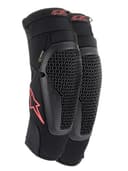
Alpinestars Bionic Flex Knee Protector

Alpinestars Bionic Flex Knee Protector

CE EN 1621-1:2012 Level 1

Perforated Nucleon Flex armor on a breathable stretch-mesh sleeve, certified to EN 1621-1:2012 Level 1. The version you will actually wear under textile pants in July, which is worth more than a Level 2 guard left in the garage.

Best overall
$107.00 · View on Amazon

Price as of September 4, 2026. #ad How we’re funded

2
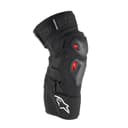
Alpinestars Bionic Pro Plasma Knee Protector

Alpinestars Bionic Pro Plasma Knee Protector

CE EN 1621-1:2012 Level 2

The Level 2 answer: dual thermoplastic patella shells over a removable Nucleon Plasma insert, certified to EN 1621-1:2012 Level 2. Hard shells also do the job soft armor cannot — they slide instead of gripping the tarmac.

Best Level 2
$149.95 · View on Amazon

Price as of September 4, 2026. #ad How we’re funded

3
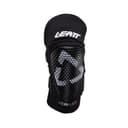
Leatt AirFlex Pro Knee Guard

Leatt AirFlex Pro Knee Guard

CE EN 1621-1 (Leatt does not publish the level)

The slimmest certified guard here — 3D-molded AirFlex gel in a wicking sleeve, from 300 g a pair, with side as well as front knee coverage. Leatt publishes the standard it passes but not the level, which is worth knowing before you compare it to a Level 2 guard.

Slimmest under jeans
4
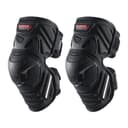
Scoyco CE Level 1 Knee and Shin Guards

Scoyco CE Level 1 Knee and Shin Guards

CE Level 1 (listing; standard not named)

Strap-on knee and shin guards with a TPU shell, listed as CE Level 1, for the price of a tank of fuel. The compromise is the format: strap-on guards move around more than a sleeve, and Scoyco does not name the EN standard on the listing.

Best budget
$29.99 · View on Amazon

Price as of September 4, 2026. #ad How we’re funded

The picks in full

#1Best overallCE EN 1621-1:2012 Level 1

Alpinestars Bionic Flex Knee Protector

Perforated Nucleon Flex armor on a breathable stretch-mesh sleeve, certified to EN 1621-1:2012 Level 1. The version you will actually wear under textile pants in July, which is worth more than a Level 2 guard left in the garage.

Strengths

  • CE EN 1621-1:2012 Level 1 in a soft, low-bulk format
  • Highly perforated protector on breathable stretch mesh — it vents
  • Silicone hems and an elasticated top strap keep it from migrating down the shin

Trade-offs

  • Level 1, not Level 2 — it transmits more force than a hard-shell guard
  • Soft armor grips tarmac rather than sliding on it
Safety standardCE EN 1621-1:2012 Level 1
ConstructionBreathable stretch-mesh sleeve with perforated Nucleon Flex protectors
Claimed weightCheck current listing
Key featureEN 1621-1 Level 1 in a vented soft sleeve
Fit / sizingSlip-on sleeve, S/M and L/XL; silicone hems to stop migration
Best forEveryday street riders who want certified knee armor they forget they are wearing

Specs and certification read from the manufacturer and retailer listing, on August 19, 2026. “Check current listing” means the maker doesn’t publish that figure — we won’t guess it.

#2Best Level 2CE EN 1621-1:2012 Level 2

Alpinestars Bionic Pro Plasma Knee Protector

The Level 2 answer: dual thermoplastic patella shells over a removable Nucleon Plasma insert, certified to EN 1621-1:2012 Level 2. Hard shells also do the job soft armor cannot — they slide instead of gripping the tarmac.

Strengths

  • CE EN 1621-1:2012 Level 2 — the higher of the two limb ratings
  • Thermoplastic shells for abrasion and sliding performance, not just impact absorption
  • Removable insert, so the sleeve washes without the armor in it

Trade-offs

  • The most expensive knee protector here by a distance
  • Hard-shell guards are more noticeable under close-fitting jeans than a soft insert
Safety standardCE EN 1621-1:2012 Level 2
ConstructionDual thermoplastic patella shells over a Nucleon Plasma insert
Claimed weightCheck current listing
Key featureEN 1621-1 Level 2 with a hard sliding shell
Fit / sizingSlip-on with silicone calf strips; insert removable for washing
Best forRiders who want the highest published limb rating and a hard outer shell

Specs and certification read from the manufacturer and retailer listing, on August 19, 2026. “Check current listing” means the maker doesn’t publish that figure — we won’t guess it.

#3Slimmest under jeansCE EN 1621-1 (Leatt does not publish the level)

Leatt AirFlex Pro Knee Guard

The slimmest certified guard here — 3D-molded AirFlex gel in a wicking sleeve, from 300 g a pair, with side as well as front knee coverage. Leatt publishes the standard it passes but not the level, which is worth knowing before you compare it to a Level 2 guard.

Strengths

  • CE tested and certified as impact protection to knee EN 1621-1
  • From 300 g a pair — light enough to forget about on a long day
  • Side and upper-knee coverage, not only the patella

Trade-offs

  • Leatt states EN 1621-1 but does not publish the level, so it cannot be ranked against a Level 2 guard
  • Gel guards are pliable rather than hard-shelled, so they do not slide
Safety standardCE EN 1621-1 (Leatt does not publish the level)
Construction3D-molded AirFlex gel in MoistureCool and AirMesh wicking fabric
Claimed weightCheck current listing
Key featureSlim AirFlex gel, from 300 g per pair
Fit / sizingSleeve with silicone-printed grip cuffs; slim enough for under jeans
Best forRiders who want certified knee armor that disappears under jeans

Specs and certification read from the manufacturer and retailer listing, on August 19, 2026. “Check current listing” means the maker doesn’t publish that figure — we won’t guess it.

#4Best budgetCE Level 1 (listing; standard not named)

Scoyco CE Level 1 Knee and Shin Guards

Strap-on knee and shin guards with a TPU shell, listed as CE Level 1, for the price of a tank of fuel. The compromise is the format: strap-on guards move around more than a sleeve, and Scoyco does not name the EN standard on the listing.

Strengths

  • Listed as CE Level 1 with a TPU protective shell and a dynamic flex hinge
  • Adjustable straps, so it fits over or under most trousers
  • Cheap enough to buy alongside the jacket rather than instead of it

Trade-offs

  • The listing says CE Level 1 but does not name the EN standard behind it
  • Strap-on guards rotate on the leg more than a compression sleeve does
Safety standardCE Level 1 (listing; standard not named)
ConstructionTPU shell over padded backing with adjustable straps
Claimed weightCheck current listing
Key featureStrap-on knee and shin coverage, CE Level 1 (listing)
Fit / sizingAdjustable straps; one size across most adult legs
Best forAdding knee protection to jeans on the smallest possible budget

Specs and certification read from the manufacturer and retailer listing, on August 19, 2026. “Check current listing” means the maker doesn’t publish that figure — we won’t guess it.

What EN 1621-1 actually measures

The test drops a defined impactor onto the protector and measures the force transmitted through to a sensor underneath. Less force through means a better result. For limb protectors the standard sets two levels, with Level 2 permitting substantially less transmitted force than Level 1.

Two things follow from that which are worth internalizing:

  • The test is about impact, not abrasion. A soft certified guard can pass EN 1621-1 comfortably and still grip the tarmac and get dragged off your leg. A hard outer shell does not improve the impact number, but it does let the guard slide, which is a different and real benefit.
  • Level 2 is not automatically the right answer. A Level 2 guard is usually thicker, stiffer, hotter and more noticeable — and a rider who takes it off in summer is running at zero. On the road, where an insert only has to work occasionally, Level 1 worn every ride beats Level 2 in a drawer. On a dirt bike, where you hit things regularly and predictably, take the Level 2.

Sleeve or strap-on?

Compression sleeve

A stretch sleeve you pull on before your trousers, with the protector held in a pocket or molded to the outside. The Alpinestars and Leatt picks above all work this way.

Why it wins: it does not move. Silicone hems and an elasticated top strap keep the guard over the patella through a whole ride, which is the single most important thing a knee guard has to do — armor that has migrated down your shin protects your shin. Sleeves are also lower-bulk and disappear under textile trousers.

The catch: you have to put them on before your trousers, which means deciding at the start of the day. And a sleeve that has stretched out no longer holds position, so they are a consumable over enough seasons.

Strap-on guard

Two or three adjustable straps around the leg, fitted over or under trousers, like the Scoyco budget pick.

Why it wins: you can fit them without undressing, they adjust across a wide range of leg sizes, and they are cheap.

The catch: they rotate. A strap-on guard on a bare leg or over slick textile will work its way round and down over a long ride, and you will spend the day pulling it back. Tighten the top strap more than the bottom one, which helps.

Knee guards versus armored jeans

If you are riding in denim, you have two routes to knee protection and they are not equivalent.

Armored riding jeans hold a CE insert in a pocket at the knee and give you abrasion-resistant fabric as well — usually an aramid liner. That is the more complete answer, because a knee guard under ordinary denim protects the joint from impact while the denim itself abrades through in about half a second.

Standalone knee guards win on three counts: they work with trousers you already own, they can be moved between garments, and a good sleeve holds position better than a jeans pocket sized for a range of leg lengths. The best answer is armored jeans with the insert correctly positioned; the practical answer for a lot of riders is a sleeve under whatever they are wearing.

Fitting: the part that decides whether it works

  1. Position it seated, not standing. Your knee is bent on the bike, and a guard positioned over the patella while standing rides high when you sit down. Fit it, then get on the bike and check.
  2. Cover the outside of the joint, not just the front. Low-sides load the lateral side of the knee. Guards with side coverage — the Leatt above states side and upper-knee protection — are covering the area that actually gets hit.
  3. Check it does not foul the tank or the pegs. A bulky hard-shell guard can catch on a sportbike tank cutout, which is exactly the wrong moment to discover it.
  4. Wash the sleeve, not the armor. Guards with removable inserts wash properly. Ones without get funky.

What about elbows?

Same standard, same logic, and if your jacket has armor pockets you probably already have elbow protection — almost every riding jacket ships CE limb armor at the shoulders and elbows even when the back pocket is empty. The gap in most riders’ kit is below the waist, which is why this page is about knees. If your jacket did come with empty pockets, our armor inserts ranking covers the fix.
How to read our safety notes. We have not crash-tested any of this gear — nobody honestly can on a review budget. Every helmet and armor pick names the certification the maker publishes (DOT, ECE 22.06, SNELL, or a CE level), which we read from the listing on a dated visit. Certification is the floor, not a guarantee; fit and condition matter as much as the sticker. What the standards actually mean.

Frequently asked questions

What CE level should motorcycle knee guards be?

Level 1 is genuinely fine for road riding, and often the better choice. EN 1621-1 Level 2 permits less transmitted force than Level 1, but a Level 2 guard is usually thicker, stiffer and hotter, and armor that gets left at home protects nothing. For street riding, a Level 1 sleeve worn on every ride beats a Level 2 guard worn occasionally. For off-road or track, where impacts are frequent and predictable, take the Level 2.

What is the difference between EN 1621-1 and EN 1621-2?

They cover different body parts and set different thresholds. EN 1621-1 is the limb-protector standard — shoulders, elbows, hips and knees. EN 1621-2 is the back protector standard, EN 1621-3 covers chest protectors and EN 1621-4 covers airbags. Because the tests and permitted transmitted forces differ, 'CE Level 2' on a knee guard and 'CE Level 2' on a back protector are not the same claim, and you cannot compare them directly.

Do knee guards stay in place while riding?

A compression sleeve with silicone hems and a top strap does, and that is the main reason to prefer one over a strap-on guard. Strap-on guards rotate around the leg and slide down over a long ride, particularly worn over slick textile. Whichever you choose, fit it while sitting on the bike rather than standing — your knee is bent when riding, and a guard positioned over the patella while standing will sit too high the moment you get on.

Are knee guards better than armored jeans?

They solve different halves of the problem. A knee guard handles impact; armored jeans handle impact plus abrasion, because they add an abrasion-resistant liner that ordinary denim does not have. Plain denim abrades through in about half a second on tarmac, so a knee guard under jeans protects the joint while the fabric around it disappears. The complete answer is armored jeans with the insert positioned correctly. The practical answer for riders in ordinary trousers is a sleeve underneath.

Do hard-shell knee guards protect better than soft ones?

Not on the impact test — a soft certified guard can meet the same EN 1621-1 level as a hard-shelled one, because the level measures transmitted force rather than construction. What a hard outer shell adds is sliding performance: it lets the guard skate along the tarmac instead of gripping it, which reduces the chance of the guard being dragged out of position or your leg tumbling. That is a real benefit the certification does not capture.

Can you wear knee guards under regular jeans?

A slim sleeve-type guard, yes — the Leatt AirFlex Pro is specifically designed to be low-profile enough for that, and Alpinestars' Bionic Flex is a soft perforated sleeve. Hard-shell guards under close-fitting denim are noticeable and can be uncomfortable. Bear in mind that the jeans themselves offer very little abrasion protection, so this is an impact solution rather than a complete one.

Sources

Keep reading

More in Armor