How a $500 ceiling gets ranked when certification stops separating the field
A price-band roundup has to admit something a category roundup does not: the helmets on it are not substitutes for each other. A retro full-face with a 3/4-sized eyeport and a race-shaped sport lid are different pieces of equipment, not trim levels of one. So the criteria below are applied in order, and that order produced the ranking — not a score, not a star rating, and not a test we did not run.
1. What the maker publishes above the DOT floor
DOT FMVSS 218 is a self-certification: the maker declares conformance and NHTSA buys random samples off shelves to re-test. Everything beyond it is a test somebody chose to pay for. In this band, that choice is inconsistent in a way the band below is not.
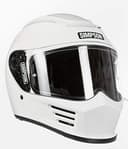
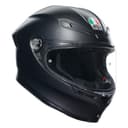
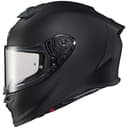
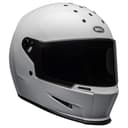
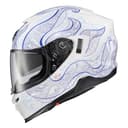
The Speed Bandit publishes DOT plus ECE 22.05, and we say 22.05 rather than letting the page imply the current revision, because that is what Simpson publishes. The AGV K6 S publishes DOT plus ECE 22.06, the current revision with its oblique rotational-impact criteria — the strongest certification pair on this page, and one of only a handful in the registry at any price. The ScorpionEXO R1 Air and T520 both publish DOT and ECE without naming a revision, which is honest but less useful than a number. The Bell Eliminator and the Sena Outrush R publish DOT only, and both cards say so.
Read that list again and notice the absence: no helmet under $500 in our registry publishes a SNELL rating. Six helmets do, and every one of them is priced above this page’s line or had no live offer on the day we built it. Our SNELL-certified helmet list is cross-checked against Snell’s own published certification lists rather than retailer copy, and it is the page to read if a SNELL sticker is what you are shopping for. Treat it as a decision above this band, not inside it.
2. Shell material and shell count, which is what the money really buys
This is where the band earns its keep. Below $300 the shell is polycarbonate with one composite exception; here, three of six are composite or fiberglass. The K6 S is a carbon-aramid shell at a published 1,255 g — the lightest certified full-face we track. The Eliminator is a fiberglass composite at a published 1,402 g, which is remarkable for a helmet with the widest eyeport of any full-face on this site. The R1 Air uses Scorpion’s TCT composite, though Scorpion publishes no weight for the non-carbon shell, so it cannot be ranked on weight and we have not guessed one.
Shell count matters more than most buyers realize and is almost never on the spec sheet. A maker that tools three shells does not stretch one shell across six head sizes, so a size S rider is not wearing a helmet sized for a size L head. The Speed Bandit publishes three shell sizes and the Eliminator publishes three as well — at this money that is the quiet differentiator, and our shell-sizes explainer counts how few helmets publish the figure at all (nine of thirty-seven). It also refuses the claim that more shells means safer, because certification is tested per size.
3. What comes in the box, and the one helmet that includes an intercom
A Pinlock-ready shield plus the insert, a second dark shield, a drop-down internal sun visor, comms-sized speaker pockets, emergency-release cheek pads — each is money you would otherwise spend separately. The R1 Air ships with a Pinlock-ready shield and emergency-release pads. The T520 carries a drop-down sun visor and Bluetooth-ready pockets at the cheapest price on this page.
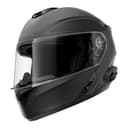
The Outrush R is the outlier and deserves its own sentence: Sena builds the Bluetooth intercom intothe helmet — Bluetooth 5.1, four-rider intercom, 18 hours of published talk time, no bolt-on module to snag. Price that against a helmet plus a separate unit and it is the cheapest route to comms on this page by a wide margin. The cost is real and we state it on the card: the electronics cannot be upgraded independently of the helmet, and Sena publishes no mesh capability for it, so it joins no mesh network. Built-in comms versus a separate intercom frames that decision properly, and our mesh intercom ranking covers what you are giving up.
4. Fit and head shape, which outrank everything above
A helmet that does not fit cannot protect you properly no matter what it is certified to. That is not a slogan; it is why a cheaper helmet that fits beats a dearer one that does not. Five of the six here are cut for an intermediate oval, the most common Western head shape, which is also why riders with long-oval or round-oval heads find mid-priced helmets uncomfortable in a way they often cannot name. Measure first: our sizing guide covers the measurement, head shapes covers why two helmets in the same stated size feel different, and the per-brand size chart shows how far apart two makers’ published charts sit for the same measured head.
The honest version of “spend less”
Two of the six helmets here cost roughly half the band’s ceiling, and both are ranked on what they publish rather than on what they cost. If your riding is touring miles with a sun visor and a comms-ready interior, the T520 at the bottom of this page does that job with DOT and ECE together, and the three hundred dollars you did not spend buys a back protector and a pair of certified gloves — which will do more for your odds than a nicer shell on the same certified helmet.
That is not a throwaway line. Of the gear classes we track, the helmet is the only one with a legally mandated standard in the US. Gloves have none at all, and four of twenty-four gloves in our registry publish a CE rating. Spending the last $200 of a helmet budget on the parts of you that have no legal floor is usually the better trade.
If your ceiling is lower, or higher
If $500 is the stretch rather than the budget, the best helmets under $300 works the band where the second certification arrives, and under $200 works the band below that and is explicit about what disappears down there. Our safest budget helmets goes lower again and names the three rules for buying cheap without buying badly.
If you can go above $500, the next real step is not a nicer polycarbonate helmet — it is a hand-laid composite shell in four shell sizes, a SNELL rating, or both. Our overall best helmets ranking spans every budget, alternatives to Shoei is the page to read if you have been looking at a flagship and want to know what else publishes the same numbers, and the quietest helmets is the one to read if wind noise is what actually bothers you, because noise is a sealing and aerodynamics problem that this band does not solve.
And one thing that costs nothing. A helmet’s EPS liner crushes once and does not recover, so replace any helmet after a significant impact even if the shell looks fine, and roughly every five years otherwise as the liner and comfort foam age. When to replace a motorcycle helmet covers the signs worth acting on.