What to rank on when nobody publishes a rating
A glove has one job the moment a hand leaves a motorcycle: stay between your palm and the road long enough for the slide to finish. Everything else — touchscreen fingertips, visor wipers, reflective piping — is comfort. These are the four things that decide whether a sub-$100 glove does the job, in the order we weighted them.
1. Leather where the hand lands, and which leather
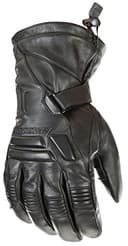
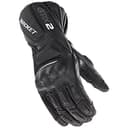
The palm and the heel of the hand take the first and longest contact, and leather is still the material that survives it best. Goatskin is the common choice at this price because it is thin, supple and unusually abrasion-resistant for its weight — the Joe Rocket GPX 2.0 is goatskin front and back, the Tourmaster Super-Tour uses genuine goat leather on the backhand, palm and overlays, and the KLIM Baja S4 uses perforated goat leather at the palm and fingers.
Full textile gloves are not automatically out. A good textile glove with a reinforced leather palm and real overlays beats a cheap leather glove with a thin unreinforced palm. What you should treat with suspicion is a glove whose listing will not say what the palm is made of at all. In our registry that silence is the single most reliable marker of a glove not worth buying.
2. Knuckle hardware, and what “hard knuckle” actually covers
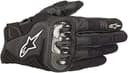
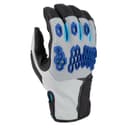
Almost every glove here has something over the knuckles, and they are not the same thing. The KLIM Baja S4 carries a TPU vented knuckle plus perforated 3 mm XRD pads at the thumb and palm base and a 5 mm XRD pad at the wrist — a mapped set of protectors rather than one lump. The Tourmaster uses a 3D molded knuckle protector, which is softer than a rigid TPU shell and says so. The two Joe Rocket gloves carry a hard knuckle protector without publishing its material. The Alpinestars SMX-1 Air V2 carries knuckle protection and a reinforced palm from a maker that builds MotoGP gloves, but Alpinestars does not publish a CE level for this model and we are not going to invent one.
Here is the uncomfortable truth about knuckles: they are the most visible protection on a glove and the least likely to be the thing that saves your hand. The palm and the heel do more work in a real slide. A glove with an impressive carbon-look knuckle and a thin palm is selling you the wrong half.
3. Palm and heel reinforcement
This is where the gloves on this page genuinely separate. The Tourmaster adds SuperFabric overlays on the knuckle, fingers and heel — a guarded abrasion fabric placed exactly where a hand touches down. KLIM places XRD padding at the palm base. The cheaper leather gloves rely on the leather itself and a second layer at the heel. None of these is a certified slider, and none publishes a slide-distance figure, because that figure only exists inside EN 13594 testing — which, as above, none of them has.
4. Cuff coverage, which is the spec people ignore
A short cuff ends at the wrist and leaves a gap between glove and jacket sleeve. A gauntlet goes over the jacket and closes the gap. In a slide, that gap is where a glove gets pulled off — and a glove that comes off protects nothing. Most of the picks here are short-cuff gloves, because short cuffs dominate the sub-$100 market; the Joe Rocket Windchill is the one that publishes a gauntlet cuff, which seals out cold air as well. If you ride in a jacket with a tight sleeve cuff, a short glove is a reasonable compromise. Gauntlet versus short cuff works through the trade properly.
What $100 does not buy, and the glove that sits just over the line
It does not buy a published certification. It also does not buy a named waterproof membrane on a certified glove, a kangaroo or full-grain cowhide palm, a carbon knuckle with a test behind it, or the finger bridge that stops a little finger separating in a tumble — those start one tier up. Our best motorcycle gloves ranking spans every budget and the top of it looks structurally different from this page.
The specific stretch worth knowing about is small. The Alpinestars SMX-Z Drystar is the cheapest glove in our registry that publishes both a CE EN 13594:2015 Level 1 KP rating and a named waterproof membrane, and it lands a little above this page’s line rather than far above it. If you are buying a do-everything glove and you are not in a hurry, that is the one to watch — our adventure and touring glove ranking leads with it and explains why a Level 1 KP road glove is the sane default rather than a track gauntlet.
The KLIM Baja S4 and the word “pending”
One glove on this page comes closer to a certification than the rest, and it is worth being exact about how close. KLIM lists the Baja S4 as carrying a CE Level 1 KP rating to EN 13594 pending — and pending is not granted. We record it as uncertified until that word disappears from KLIM’s own page, and the glove is ranked second on construction alone: perforated goat leather palm, a KARBONITE micromesh backhand, a TPU vented knuckle and mapped XRD padding. It is also the pick that sits closest to the $100 line, so it is the one most likely to cross it on a given day; the note under the picks will say so when it does.
Matching the glove to the weather, not to the price
Hands are the first thing to get cold and the first thing to get soaked, and one pair of gloves cannot cover a year. At this budget you can realistically own two pairs for what one certified glove costs, which is a better outcome than one compromise pair.
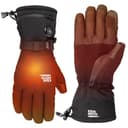
For heat, you want airflow through the backhand and the thinnest acceptable palm — the SMX-1 Air V2 and the Baja S4 are both built that way, and our summer glove ranking covers the category properly. For cold, you have two routes: insulation, which is what the Windchill does while keeping leather and a hard knuckle, or active heat, which is what the Kemimoto does with a rechargeable battery when insulation alone stops working. Winter gloves and how heated gear works cover both, and the heated glove ranking is honest that none of the heated gloves we track publishes a CE rating either — heated gloves trade protection for warmth across the whole category, not just at this price.
For rain, the thing to look for is a named membrane rather than the word “waterproof”. The Tourmaster publishes an Aqua-barrier membrane and a waterproof zippered cuff gusset, which is a real construction claim; many gloves at this price publish nothing and mean “water-resistant for ten minutes”. How waterproof motorcycle gear actually works explains why there is no standard behind the word at all.
Last thing, and it is free: gloves wear out from the inside. A palm that has gone shiny and thin, a seam that has started to open at the little finger, a knuckle protector that has come loose from its pocket — all of those mean the glove will not finish a slide, whatever it cost. How long motorcycle gear lasts covers what to check and when to replace it.