Sorted by the Shoei you were looking at
If you were shopping the Neotec 3 (the modular flagship)
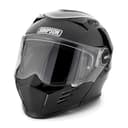
The Neotec 3 is a sealed flip-front with a sun visor and a Cardo system designed into it. The honest alternative is the Simpson Mod Bandit: DOT plus ECE in a flip-front, which not every style brand manages, with a published 3.73 lb (about 1,692 g) weight and — the spec that matters most and gets quoted least — two shell sizes (XS–MD and LG–2XL) rather than one shell stretched across the whole range. It carries a drop-down sun visor, speaker and mic pockets and a removable antibacterial liner. What you give up is the hand-laid shell and the sealing: a hinge and latch cost weight and quiet on every modular ever built, including Shoei’s.
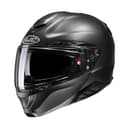
The second option is the HJC RPHA 91, which is the closer match on functionand the weaker match on certification: an advanced composite (PIM) shell, an HJ-37 Pinlock-prepared shield in the box so anti-fog is not a separate purchase, and a drop-down sun visor — but DOT only, with no ECE or SNELL published, and no shell weight published either. Our modular helmet ranking puts both against the Neotec properly, and Neotec 3 vs HJC i90 runs the cheapest version of this same comparison.
If you were shopping the RF-1400 (the sport full-face)
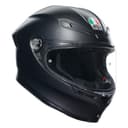
This is the comparison with a clean answer. The AGV K6 S is a carbon-aramid shell at a published 1,255 g — about 385 g lighter than the RF-1400 — and it publishes DOT plus ECE 22.06, the current European revision, which the RF-1400 does not name. So the trade is explicit and it is a genuine fork, not a downgrade: SNELL M2025D and a hand-laid AIM+ shell on one side, the newer ECE protocol and a markedly lighter head on the other. A 385 g difference is felt in the neck on hour four, not in the hand in the shop — how much a motorcycle helmet weighs explains why, and our RF-1400 vs K6 S head-to-head does nothing but this decision.
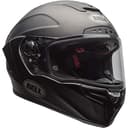
If track days are the point, the Bell Race Star DLX Flex is the alternative that keeps the certification tier rather than trading it: a 3K carbon shell at a published 1,540 g, the three-layer Flex impact liner, and DOT plus SNELL. It is also the loudest helmet in this group at touring speed, because race-tuned airflow and quiet are opposing goals.
If SNELL was the reason you wanted a Shoei
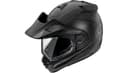
Then there is exactly one non-Bell alternative we track, and it is the Arai XD-5: DOT plus SNELL M2025, a vacuum-formed Super Fiber shell, four shell sizes — more than anything else on this page — and a published 1,683 g. It is an adventure helmet, with a removable peak and shield, so it is not a like-for-like swap for an RF-1400; it is a like-for-like swap for the construction philosophy. It is also a round-oval fit where everything else here is intermediate oval, which is either the best news on this page or the end of the conversation depending on your head. Our head-shapes guide explains why that one line matters more than any spec above it.
If the real answer is “not flagship money”
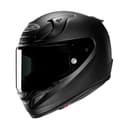
Say it plainly: most riders looking for a Shoei alternative are looking for a cheaper helmet, and the useful version of that answer names what disappears. The HJC RPHA 12 keeps more than you would expect. It is a PIM EVO composite shell of carbon-aramid hybrid, carbon, glass and natural fibers — a construction that normally lives several hundred dollars higher — with DOT on the US listing and ECE 22.06 published for the model, a clear and a dark smoke HJ-42 shield plus the Pinlock insert in the box, and interchangeable cheek pads in every size. What goes: the published weight (HJC publishes none, so it cannot be ranked on weight and we have not estimated one), the hand-laid shell, and the ratchet closure — it is a double D-ring, which is slower in gloves.
Three things that are not reasons to switch
“Shoei is overpriced for the certification.” Half true and half confused. DOT is DOT: a $900 helmet meets the same federal requirement as a $90 one, and that is the single most useful fact on this page. But SNELL M2025D on the RF-1400 is a real, current, independently administered test that almost nothing else in our registry carries, and the two helmets here that match it cost flagship money too.
“Brand X is quieter.” Nobody publishes a decibel figure for a motorcycle helmet, ourselves included. Noise is a function of sealing, shell aerodynamics, the collar, your screen and your riding position, and the same helmet is a different helmet on two different bikes. Our quietest helmets page ranks on the published features that address it — shell shape, neck roll, closed-cell liners — and says outright that no maker publishes a measurement.
“A composite shell is automatically safer.” Composite shells are stiffer and usually lighter for a given strength, and that is worth paying for. It is not a certification. Two helmets on this page are composite and publish nothing above DOT; one polycarbonate helmet in the band below publishes DOT and ECE together. Our safest-helmets ranking sorts the registry purely on what makers publish, which is the only basis we will rank safety on.
What you give up by leaving Shoei, in one list
Hand-laid multi-fiber shells on every model rather than on the flagship only. Shell counts that go to four and five. Published weights across the range, which most makers do not provide at all — our lightest-helmet ranking shows how many publish nothing. A Cardo system engineered into the Neotec 3 and GT-Air 3 shells, which is the one thing on this list nobody else can sell you: the nearest equivalent is the Cardo Packtalk-S built for Shoei Gen 3 helmets, which only fits Shoeis. And a dealer network that stocks replacement cheek pads in multiple thicknesses, which is how a good helmet becomes a fitted one.
If you are cross-shopping on budget rather than on brand, the best helmets under $500 is the page built on exactly that line, and our overall best helmets ranking spans every budget including the Shoeis themselves. Measure your head before you spend anything: the sizing guide and the per-brand size chart will save you more money than any helmet on this page.